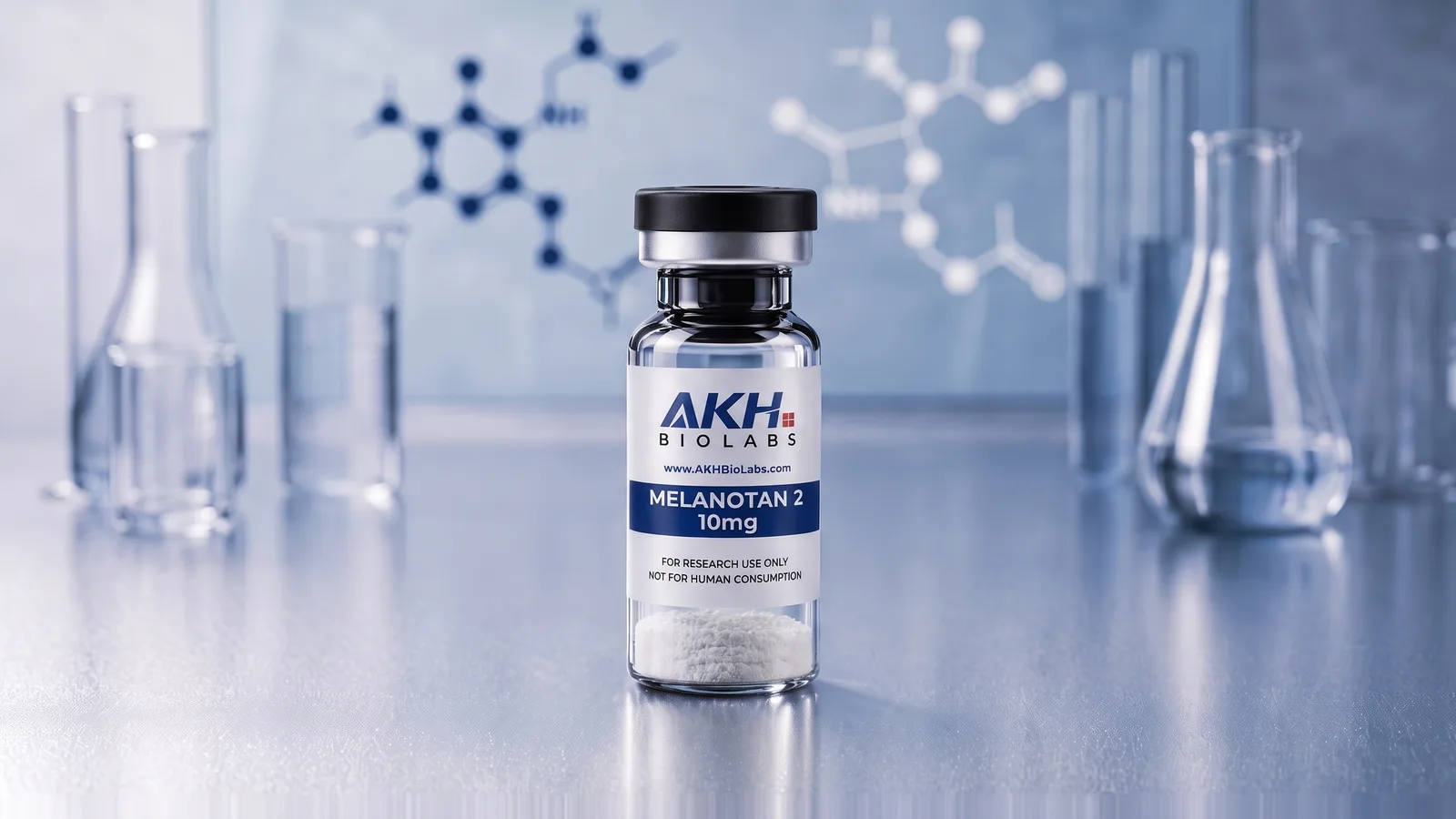
MT1 vs MT2: melanocortin receptors explained
MT1 vs MT2 is a comparison between melanocortin receptor subtypes, not between two peptides. This explainer separates the receptor labels from Melanotan 2, the synthetic analogue studied at those receptors, and points to the published evidence record.
MT1 vs MT2 is a comparison between melanocortin receptor subtypes, not between two peptides, and the shorthand is where most of the confusion starts. The melanocortin receptor family is a group of G-protein-coupled receptors that bind melanocyte-stimulating hormone and related peptides; MT1 and MT2 are labels applied to members of that family, while Melanotan 2 is a synthetic analogue studied at several of those receptors rather than a receptor itself.
The search string mt 2 0 and the phrasings mt1 vs mt2 and mt 1 vs mt 2 all point at the same underlying question: what is being compared, and where does the compound sit. This article is written for researchers and laboratory readers who encounter that phrasing and want the receptor-versus-compound distinction stated plainly. It covers what the melanocortin receptor family is, how the MT1 and MT2 labels are used, where Melanotan 2 sits relative to both, and where the published analogue literature is recorded. It does not restate that literature, and it makes no claims about effects in humans.
Key takeaways
- MT1 and MT2 are shorthand labels for melanocortin receptor subtypes, not names for two peptides.
- Melanotan 2 is a synthetic cyclic analogue of alpha-melanocyte-stimulating hormone, studied as a non-selective agonist at MC1R, MC3R, MC4R and MC5R.
- The numeral in Melanotan 2 distinguishes it from Melanotan 1, a different molecule (afamelanotide), not from a receptor called MT1.
- The published evidence record for the analogue lives on the Melanotan 2 research page, which is where the study list and its limitations are set out.
What MT1 and MT2 actually name
The melanocortin receptor family is conventionally written with an MC prefix and a numeral: MC1R through MC5R. The MT1 and MT2 forms are older or informal shorthand that appears in search queries and in some secondary sources, and the two conventions are not interchangeable with the compound names that share similar letters.
The practical consequence is that a search for MT1 vs MT2 is asking about receptor subtypes, while a search for Melanotan 2 is asking about a peptide. The two questions sit at different levels of the same field: one is about the target, the other about a molecule studied at that target. Treating them as the same question is the source of most of the muddle.
The AKH BioLabs research record for the compound states the receptor profile directly: Melanotan II is a non-selective agonist at the MC1, MC3, MC4 and MC5 receptors. That is a statement about which receptors the analogue engages, not a claim that the analogue is one of them.
How the melanocortin receptor subtypes differ
The receptor subtypes differ in where they are expressed and in what they are studied for. The research record notes that MC1R signalling on melanocytes activates adenylate cyclase, raising cAMP and driving the tyrosinase-dependent eumelanin synthesis pathway, while MC3R and MC4R are expressed centrally and account for the appetite and autonomic effects reported in the clinical literature.
That distribution is why receptor selectivity matters as a research question. A compound that engages one subtype is a different experimental tool from one that engages several, and the downstream observations differ accordingly. The research record makes this point about the analogue directly: its receptor promiscuity is why it became a reference tool compound for dissecting melanocortin biology, and why later clinical candidates pursued receptor-selective analogues instead.
The approved analogue afamelanotide is described in the same record as a selective, largely MC1R-directed analogue. That selectivity is the contrast case: it is the reason afamelanotide trial data cannot be used to infer the safety of the non-selective analogue.
Where Melanotan 2 fits
Melanotan 2, also written MT-II, is a synthetic cyclic seven-amino-acid analogue of alpha-melanocyte-stimulating hormone. The catalogue entry describes it as a synthetic cyclic lactam analogue designed using molecular-dynamics modelling of the native hormone's bioactive conformation, with cyclisation and a D-phenylalanine substitution at position 7 giving the molecule greater potency and metabolic stability than linear alpha-MSH.
The numeral in the name is a compound-series marker, not a receptor index. Melanotan 1 is afamelanotide, a different molecule with a different receptor profile; Melanotan 2 is the non-selective analogue. The two are distinguished by their own names and structures, and neither is a receptor.
The analogue's published human literature is limited. The research record states that there are no completed randomised controlled trials of melanotan II for any indication, no pharmacovigilance system covering it, and no characterisation of the purity, dose or sterility of illicitly supplied product. The full study list, ordered by strength of design, sits on the research page rather than being reproduced here.
Receptor versus compound: a comparison
The table below sets out the distinction in the terms the two search phrasings use. It is a naming and scope comparison, not a pharmacological one.
| Item | What it is | Where it is documented |
|---|---|---|
| MT1 / MT2 | Shorthand labels for melanocortin receptor subtypes | Receptor pharmacology literature |
| MC1R to MC5R | The conventional receptor naming used in the research record | Melanotan 2 research page, receptor profile section |
| Melanotan 2 (MT-II) | A synthetic cyclic analogue of alpha-MSH, non-selective at MC1R, MC3R, MC4R and MC5R | Melanotan 2 research page and product page |
| Melanotan 1 (afamelanotide) | A different analogue, selective and largely MC1R-directed | Melanotan 2 research page, evidence section |
Reading the analogue literature without overreading it
Two recent papers illustrate the kind of work that exists and the limits of what it supports. One describes a stapling method applied to alpha-MSH, producing stapled peptides with nanomolar Ki values, one of them sub-nanomolar, and names Melanotan-II in its title as the application case. That is a chemistry and binding-affinity result from an abstract, not a statement about effects in any organism.
The other examines the stability profile of afamelanotide, described in the abstract as a synthetic 13-amino-acid peptidomimetic of alpha-melanocyte-stimulating hormone and as melanotan-1. It reports degradation under acidic, basic, neutral and oxidative stress, UV exposure and elevated temperature, with fourteen degradation products separated by gradient reversed-phase HPLC and characterised by UHPLC-HRMS/MS. That work concerns the stability of the afamelanotide molecule, not the receptor question, and it does not describe Melanotan 2.
Both papers are cited here for what their abstracts state. Neither supports a claim about receptor selectivity in a living system, and neither should be read as one.
Checking a batch against the label
For laboratory readers, the identity question is separate from the receptor question and is answered by the certificate. One published AKH batch, batch 26087, tested 07 Aug 2026 by the Brown Institute of Biomolecular Research, carries the results string "Melanotan II: 10mg | Purity: 99.64%" at a stated purity of 99.64 percent. The certificate is a report from a named laboratory outside AKH, ordered by the manufacturer and published unaltered.
The certificate documents the batch, not the receptor profile. A purity figure is a chromatographic peak-area ratio and does not by itself confirm which receptors a compound engages, nor does it state the peptide mass in the vial by weight. The distinction between purity and quantity is covered in the linked glossary entries.
Common questions.
- What is the difference between MT1 and MT2?
MT1 and MT2 are shorthand labels for melanocortin receptor subtypes, part of the receptor family conventionally written MC1R to MC5R. They are targets, not compounds. The distinction between them is one of receptor identity and distribution, and it is a different question from the one asked about Melanotan 2, which is a synthetic analogue studied at several of those receptors.
- Is MT2 the same thing as Melanotan 2?
No. MT2 in the receptor-shorthand sense refers to a melanocortin receptor subtype. Melanotan 2, also written MT-II, is a synthetic cyclic analogue of alpha-melanocyte-stimulating hormone and a non-selective agonist at MC1R, MC3R, MC4R and MC5R. The similar lettering is a naming collision, not an identity.
- Is Melanotan 2 a receptor or a peptide?
It is a peptide. The catalogue entry describes Melanotan II as a synthetic cyclic seven-amino-acid analogue of alpha-melanocyte-stimulating hormone, used as a reference tool in melanocortin receptor pharmacology research. Receptors are the targets it binds; the analogue is the molecule doing the binding.
- How does Melanotan 2 differ from afamelanotide?
Afamelanotide, also known as melanotan-1, is described in the research record as a selective, largely MC1R-directed analogue and an approved medicine for erythropoietic protoporphyria. Melanotan II is non-selective across melanocortin receptors and unlicensed. Because the receptor profiles differ, afamelanotide trial data cannot be used to infer Melanotan II safety.
- Where is the published Melanotan 2 research recorded?
On the Melanotan 2 research page, which lists the studies ordered by strength of design and sets out the limitations of the evidence. That record states there are no completed randomised controlled trials of melanotan II for any indication and that the human literature consists largely of case reports, letters and qualitative analyses.
Sources
- 015-Hydroxypyrroloindoline Affords Tryptathionine and 2,2'-bis-Indole Peptide Staples: Application to Melanotan-II.
- 02Investigation of the stability profile of therapeutic α-MSH analogue: Insights from liquid chromatography-high resolution mass spectrometry analysis of afamelanotide.
- 03Buy Melanotan-2 10mg (MT2): Batch COA · AKH BioLabs
- 04Melanotan 2 research — published studies and evidence · AKH BioLabs