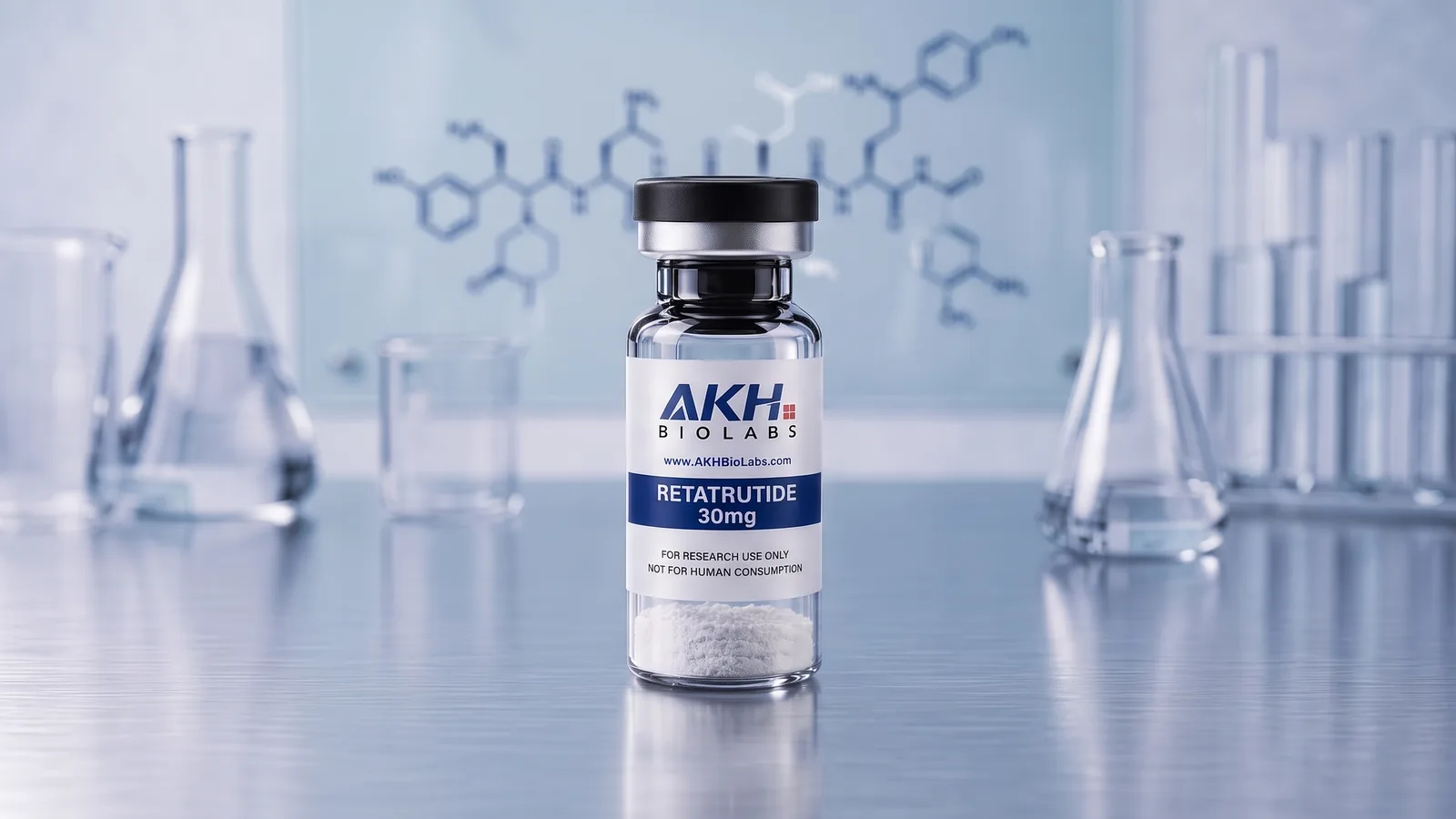
What is GLP-3 R? Is reta a GLP-3?
GLP-3 R is an informal market label for retatrutide, the investigational triple agonist of the GIP, GLP-1 and glucagon receptors. No receptor called GLP-3 appears in the published literature, so the name describes a product alias rather than a pharmacological class.
What is GLP-3 R? It is an informal label used in the research-peptide market for retatrutide, the investigational single-molecule peptide whose published description names three receptor targets: the glucose-dependent insulinotropic polypeptide (GIP) receptor, the glucagon-like peptide-1 (GLP-1) receptor and the glucagon receptor. The label is a naming convention, not a receptor class.
The question behind the search is usually simpler than the label suggests: is reta a GLP-3, and is GLP-3 RT retatrutide? The short answer is that all three strings point at the same molecule, and none of them names a receptor that appears in the peer-reviewed record. This article is written for laboratory researchers and procurement readers who encounter the alias in catalogue copy, certificates or search results and want to know what it does and does not describe. It covers the alias itself, the three targets the literature actually names, and where the trial evidence lives. It does not restate that evidence, which is recorded on the retatrutide research page.
Key takeaways
- GLP-3 R, GLP-3 RT, GLP-3 and reta are market aliases for retatrutide, development code LY3437943.
- The published abstracts name three receptors: GIP, GLP-1 and glucagon. No receptor called GLP-3 appears in either text.
- The numeral in the alias matches the count of receptor targets the papers describe, not a fourth receptor.
- Retatrutide remains investigational and unapproved; the trial literature is recorded on the research page rather than repeated here.
- A certificate of analysis may shorten the compound name further, so the report, the catalogue listing and the literature can each use a different short form.
Where the GLP-3 label comes from
The alias is a market convention rather than a scientific term. The AKH BioLabs catalogue entry for the compound is titled with GLP-3 and Reta and states that retatrutide is often searched as GLP-3 or reta. That sentence is the clearest available statement of what the label is: a search-facing shorthand attached to a product page, not a category drawn from pharmacology.
The published literature does not use it. Both abstracts cited with this article name the compound retatrutide or its development code LY3437943, and neither contains the string GLP-3. A reader who searches the alias and lands on a paper will not find the alias repeated there, which is the first sign that the two vocabularies are separate.
This matters for how the label is read. A receptor class is a defined pharmacological grouping with a shared endogenous ligand and a shared signalling family. An alias is a string that resolves to a product. Treating the second as though it were the first leads to questions about a GLP-3 receptor that the literature does not answer, because the literature does not pose it.
The three receptor targets retatrutide actually engages
The naming question resolves once the actual target list is on the table. One cited abstract opens by describing retatrutide as a novel triple agonist of the glucose-dependent insulinotropic polypeptide, glucagon-like peptide 1 and glucagon receptors. The other describes it as a single peptide with agonist activity at the GIP, GLP-1 and glucagon receptors. Both name the same three targets.
That is where the numeral in the alias most plausibly comes from. Three receptors are named, and the shorthand attaches a 3 to the best-known of them. The count matches; the receptor does not exist. Glucagon is the third target in each abstract, and it is a receptor with its own established literature, not a novel subtype awaiting a GLP-3 designation.
The distinction is not pedantic. GLP-1 receptor agonists, dual GIP/GLP-1 agonists and triple agonists are separate groups in the published record, and the research page sets out how retatrutide differs from semaglutide and tirzepatide on exactly this basis. A label that implies a fourth receptor obscures the comparison the literature actually supports.
| Name form | Where it appears | What it denotes |
|---|---|---|
| Retatrutide | Both cited abstracts | The compound's published name |
| LY3437943 | Both cited abstracts | The development code for the same molecule |
| GLP-3, GLP-3 R, GLP-3 RT | Catalogue copy and search behaviour | Informal aliases resolving to the same product |
| RT | The published certificate results line | A laboratory short form for the same compound |
Reading the alias on a listing or a certificate
Laboratory reports shorten compound names to fit a results line, and catalogue pages shorten them again for search. The result is that one molecule can appear under three or four different strings across the documents a researcher handles, and none of them is wrong. The checkable part is whether the strings resolve to the same product record and the same batch.
One published AKH batch illustrates the point. Batch 26138, tested 10 Aug 2026 by the Brown Institute of Biomolecular Research, carries the results string "RT: 30mg | Purity: 99.86%". The catalogue page for the same product uses GLP-3 as a search alias and Reta in its title. The report and the listing use different forms of the name for the same material.
The practical procedure is to work from the batch rather than the alias. A batch number, a test date, a named laboratory and a results string identify a specific lot of material; an alias identifies a search term. Where a listing and a certificate disagree on spelling, the batch record is the document that ties the two together.
- 01
Confirm the alias resolves to one product record
Check that the alias, the catalogue name and the certificate short form all point at the same product page and the same compound identity.
- 02
Read the results line verbatim
The certificate states the batch, the mass and the purity figure in its own short form. That line is the record, not a paraphrase of it.
- 03
Match the batch, not the name
A batch number plus a test date plus a named laboratory identifies a specific lot. An alias does not.
- 04
Check the regulatory status separately
Naming has no bearing on approval status. The research record states that retatrutide was not an approved medicine in any jurisdiction as of August 2026.
What the published literature covers, and where it is recorded
The two abstracts cited here are a phase 2a trial in metabolic dysfunction-associated steatotic liver disease and a phase 2 trial in type 2 diabetes. Both are randomised, double-blind and placebo-controlled, and both describe the same triple-agonist mechanism. They are the source for the receptor description used throughout this article.
They are not the whole evidence base. The retatrutide research page lists fifteen published studies ordered by strength of study design, covering phase 1, phase 2 and phase 3 work, body-composition substudies, kidney and cardiovascular biomarker analyses, appetite endpoints and preclinical models. It also sets out what the evidence does not establish, including the absence of long-term safety and durability data in peer-reviewed reports.
That division of labour is deliberate. This article answers a naming question; the research page carries the trial record. A reader who wants the reported figures, the study designs or the limitations should read the evidence record directly rather than infer them from an alias.
Why the alias persists
Informal names spread faster than published ones. A compound in active development accumulates shorthand in catalogue copy, forum discussion and search queries long before any of it reaches a journal, and the shorthand is often built from the most familiar part of the mechanism rather than from the target list.
The alias also does useful work. It groups searches that would otherwise scatter across spellings, and it lets a reader who has only seen the market label find the underlying compound. The problem is not the alias itself but the inference it invites: that a numbered GLP label names a receptor.
The correction is small and worth stating plainly. Retatrutide is a triple agonist of the GIP, GLP-1 and glucagon receptors. GLP-3 is a market nickname for that molecule. The two statements are compatible, and only the first is a pharmacological claim.
Common questions.
- What is GLP-3 R?
GLP-3 R is an informal market label for retatrutide, the investigational single-molecule peptide described in the published literature as a triple agonist of the GIP, GLP-1 and glucagon receptors. The AKH BioLabs catalogue entry states the compound is often searched as GLP-3 or reta. No receptor called GLP-3 appears in the cited abstracts.
- Is reta a GLP-3?
Reta and GLP-3 are two names for the same compound. Reta is shorthand for retatrutide, development code LY3437943, and GLP-3 is a search alias attached to the same product record. Neither string names a receptor class, and the published papers use only the compound name and the development code.
- Is GLP-3 RT retatrutide?
Yes. GLP-3 RT is another form of the same alias, and it resolves to retatrutide. The published certificate for batch 26138, tested 10 Aug 2026 by the Brown Institute of Biomolecular Research, shortens the name further to RT in its results line, which reads "RT: 30mg | Purity: 99.86%".
- Does a GLP-3 receptor exist in the published literature?
No receptor called GLP-3 appears in either abstract cited with this article. Both name three targets: the glucose-dependent insulinotropic polypeptide receptor, the GLP-1 receptor and the glucagon receptor. The numeral in the alias matches the count of those targets rather than designating a fourth receptor.
- Why does the certificate use a different name from the catalogue listing?
Laboratory reports shorten compound names to fit a results line, and catalogue pages shorten them again for search. One published AKH batch carries the results string "RT: 30mg | Purity: 99.86%" while the product page uses GLP-3 as an alias. The batch number and test date, not the spelling, identify the material.
Sources
- 01Triple hormone receptor agonist retatrutide for metabolic dysfunction-associated steatotic liver disease: a randomized phase 2a trial.
- 02Retatrutide, a GIP, GLP-1 and glucagon receptor agonist, for people with type 2 diabetes: a randomised, double-blind, placebo and active-controlled, parallel-group, phase 2 trial conducted in the USA.
- 03Buy Retatrutide 30mg (GLP-3, Reta): Price & COA · AKH BioLabs
- 04Retatrutide research — published studies and evidence · AKH BioLabs