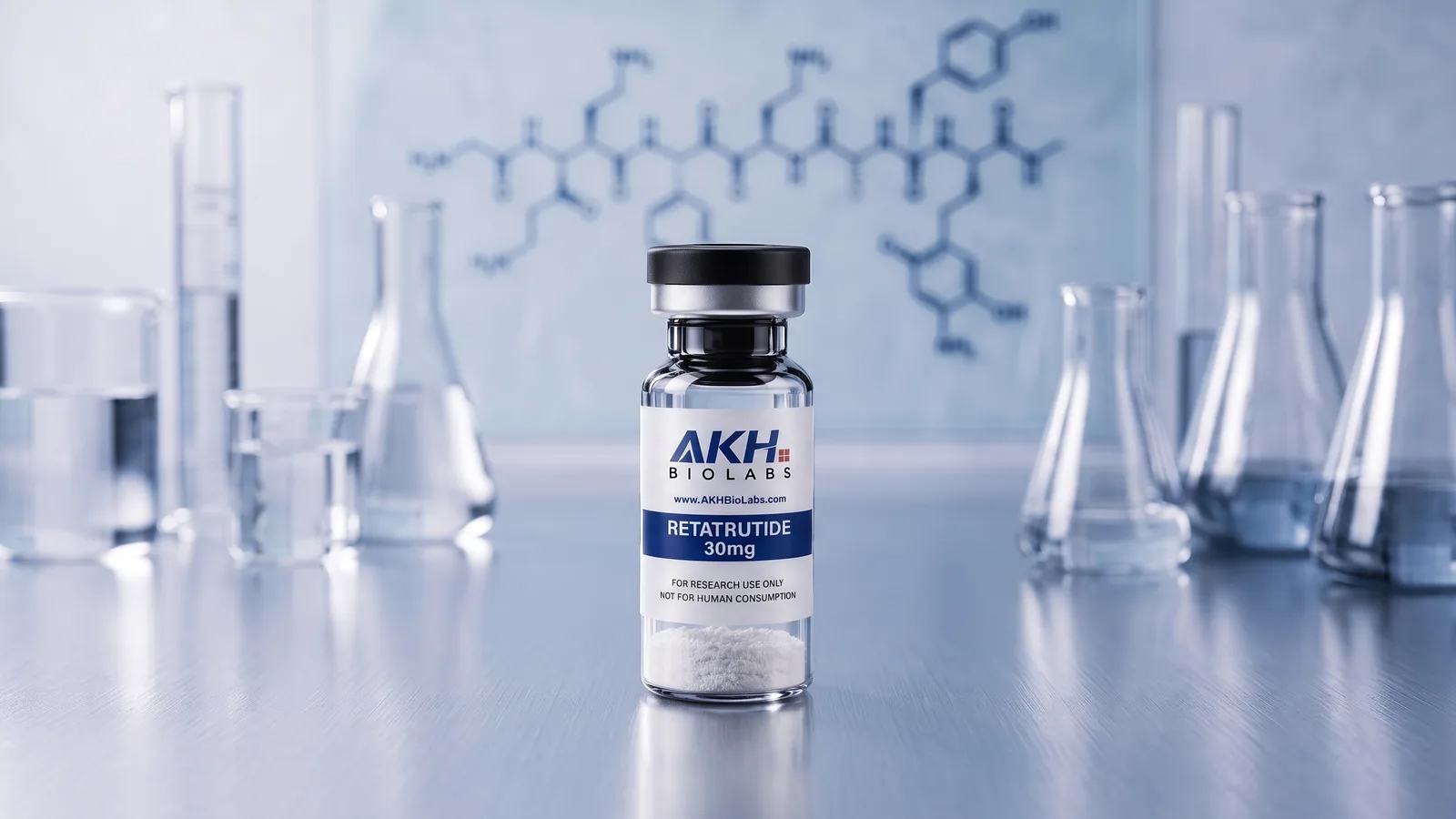
What is GLP-3 RT?
GLP-3 RT is a search alias used for retatrutide, the investigational single-peptide triple agonist of the GIP, GLP-1 and glucagon receptors; the catalogue entry carries GLP-3 as a search name, while the cited papers name the compound retatrutide or LY3437943.
GLP-3 RT is a search alias used for retatrutide, the investigational single-peptide triple agonist of the glucose-dependent insulinotropic polypeptide (GIP) receptor, the glucagon-like peptide-1 (GLP-1) receptor and the glucagon receptor. The shorter glp 3 string sits beside it in the AKH BioLabs catalogue entry for the compound, a page titled 'Buy Retatrutide 30mg (GLP-3, Reta): Price & COA · AKH BioLabs' whose copy states that retatrutide is 'often searched as GLP-3'.
The alias, the compound and the published record each use a different form of the name, and sorting out which surface says what is the job of this explainer. It is written for researchers and buyers who have met the shorthand in a listing or a search field and want to know which form a claim should be checked against. The mapping draws on four documents supplied with the post: the catalogue entry, the published laboratory certificate for one batch, and the two peer-reviewed abstracts listed at the end.
Key takeaways
- GLP-3 RT is a search alias used for retatrutide; the AKH BioLabs catalogue entry for the compound is titled with GLP-3 and Reta.
- Both cited abstracts name the compound retatrutide, with LY3437943 given as the development code.
- Both abstracts describe agonist activity at three receptors: GIP, GLP-1 and glucagon.
- The published certificate for batch 26138 carries the results string 'RT: 30mg | Purity: 99.86%' and names the Brown Institute of Biomolecular Research.
- The AKH BioLabs research record states that, as of August 2026, retatrutide was not an approved medicine in any jurisdiction.
Where the alias appears in the catalogue entry
The AKH BioLabs product page lists the material as 30mg lyophilised powder for in-vitro and laboratory research and states that retatrutide is 'often searched as GLP-3'. It adds that the compound is 'supplied strictly for laboratory research use only' and carries the line 'Not for human or veterinary use.' The same listing gives the formula as C112H164N26O31 and the purity as 99.86 percent.
Lyophilised describes material dried from the frozen state under vacuum; the glossary entry on lyophilisation sets out the process. The page frames GLP-3 as a phrase the compound is searched under, and the dated search data supplied with this brief (OpenSEO, pulled 2 October 2026) lists 'glp 3' and 'glp-3 rt' among its measured queries. The catalogue entry is the surface where the alias appears; the papers are where the compound's receptor activity is described.
What the cited abstracts call the compound
The phase 2 paper opens with the naming: 'Retatrutide (LY3437943) is an agonist of the glucose-dependent insulinotropic polypeptide, glucagon-like peptide 1, and glucagon receptors.' That sentence supplies the compound name, the development code and the receptor set the alias points at.
The design paper for the TRIUMPH programme describes retatrutide as 'a novel synthetic molecule' and as 'a triple agonist activating the glucose-dependent insulinotropic polypeptide, glucagon-like peptide-1 and glucagon receptors'. It sets out four phase 3, multicentre, randomised, double-blind studies with more than 5,800 participants, covering weight management alongside obstructive sleep apnoea and knee osteoarthritis protocols, and reports rationale and design.
In the two abstracts supplied for this post, the compound is named retatrutide, with LY3437943 given once as the development code. The shorthand does not appear in either abstract's text.
Matching the numeral in GLP-3 to the receptor count
Read side by side, the catalogue alias and the two abstracts line up on one number. The alias carries a 3, and both papers describe a single molecule acting at three receptors: GIP, GLP-1 and glucagon, with glucagon named third in each.
The certificate uses a shorter form again, abbreviating the compound to RT in its results line. The table below sets out which surface uses which form of the name.
| Naming surface | Form of the name it uses |
|---|---|
| Catalogue page title | Retatrutide 30mg (GLP-3, Reta) |
| Catalogue copy | 'often searched as GLP-3' |
| Published certificate, batch 26138 | 'RT: 30mg | Purity: 99.86%' |
| Phase 2 paper, PMID 37366315 | 'Retatrutide (LY3437943)' |
| TRIUMPH design paper, PMID 41090431 | Retatrutide; 'a novel synthetic molecule'; 'a triple agonist' |
The certificate published with the listing
The product page publishes one laboratory report for the compound: batch 26138, test date 10 Aug 2026, task ID #1812434, laboratory the Brown Institute of Biomolecular Research, purity 99.86 percent, and the results string 'RT: 30mg | Purity: 99.86%'. The page's certificate panel repeats those fields, and the page states that a printed copy ships in every parcel.
It also states the document's provenance: 'The Certificate is a test report from a named laboratory outside AKH, ordered by our manufacturer and shown here exactly as the laboratory issued it.'
The report names one batch; the abstracts describe the molecule.
What the alias does not settle
Naming does not carry study status. The AKH BioLabs research record states that retatrutide is investigational and that, as of August 2026, it was not an approved medicine in any jurisdiction. The same record notes that the TRIUMPH-1 to TRIUMPH-4 phase 3 trials had published rationale and design papers only, with efficacy results disclosed by the sponsor as topline announcements rather than peer-reviewed publications.
That record also sets out the limits of the published evidence: long-term safety, cardiovascular outcome data and durability of effect after discontinuation are not established in published peer-reviewed reports. Study designs, reported findings and those stated limits sit on the retatrutide research page; this post covers the naming.
Common questions.
- What is GLP-3 RT?
GLP-3 RT is a search alias used for retatrutide, the investigational single-peptide triple agonist of the GIP, GLP-1 and glucagon receptors. The AKH BioLabs catalogue entry for the compound is titled with GLP-3 and Reta and states that retatrutide is 'often searched as GLP-3'. The two abstracts cited in this post name the compound retatrutide or LY3437943.
- Is GLP-3 RT the same as retatrutide?
Yes. The alias points to the compound the cited papers name retatrutide, development code LY3437943. Both abstracts describe one molecule acting at three receptors, GIP, GLP-1 and glucagon. The catalogue entry attaches the GLP-3 string to the same product page, and the published certificate shortens the name to RT in its results line.
- Does the '3' in GLP-3 refer to a receptor called GLP-3?
The two abstracts cited here name three receptors, GIP, GLP-1 and glucagon, and no receptor called GLP-3 appears in either text. Glucagon is the third target listed in each. The numeral in the alias matches the count of receptor targets the papers describe.
- Does a certificate of analysis name GLP-3 RT?
Not in the case of the batch published with this product. The certificate for batch 26138, tested 10 Aug 2026 by the Brown Institute of Biomolecular Research, carries the results string 'RT: 30mg | Purity: 99.86%', while the catalogue page uses GLP-3 as a search alias. The report and the listing use different forms of the name.
- What is the regulatory status of retatrutide?
The AKH BioLabs research record states that, as of August 2026, retatrutide was not an approved medicine in any jurisdiction and remains investigational. The TRIUMPH phase 3 programme had published rationale and design papers only, and long-term safety, cardiovascular outcome data and durability of effect after discontinuation are not established in published peer-reviewed reports.
Sources
- 01Triple-Hormone-Receptor Agonist Retatrutide for Obesity - A Phase 2 Trial.
- 02Retatrutide for the treatment of obesity, obstructive sleep apnea and knee osteoarthritis: Rationale and design of the TRIUMPH registrational clinical trials.
- 03Buy Retatrutide 30mg (GLP-3, Reta): Price & COA · AKH BioLabs
- 04Retatrutide research — published studies and evidence · AKH BioLabs