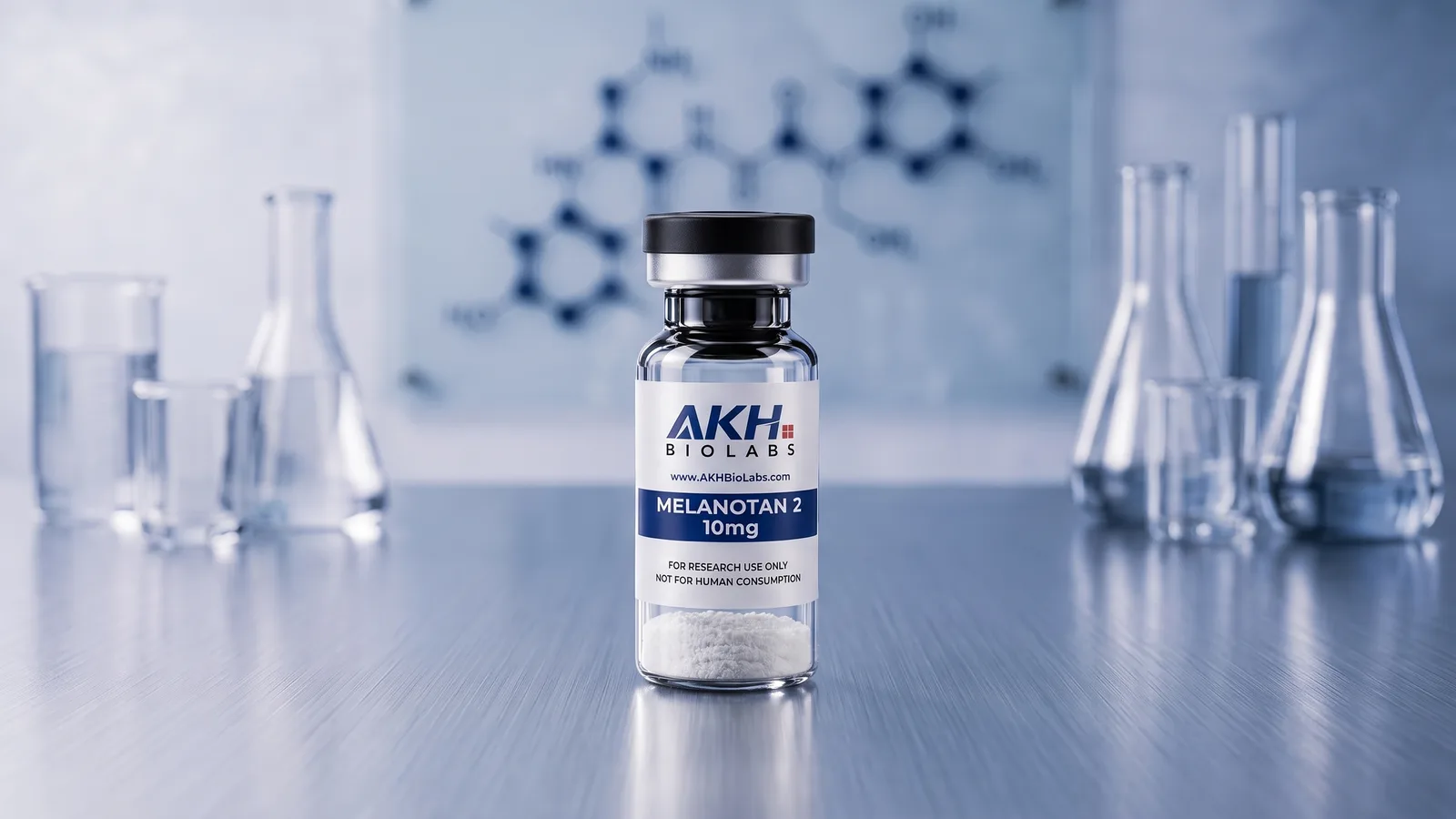
What is MT2 (Melanotan 2)?
MT2 is the shorthand for Melanotan II, a synthetic cyclic analogue of alpha-melanocyte-stimulating hormone and a non-selective melanocortin-receptor agonist. A definition-first explainer of the abbreviation, the receptor activity, and the safety signals the published literature documents.
MT2 is the shorthand for Melanotan II, a synthetic cyclic analogue of alpha-melanocyte-stimulating hormone (alpha-MSH), the hormone that drives melanin production in skin. The abbreviation resolves to one specific molecule with a documented receptor profile and a documented set of safety signals, and the spaced variant mt 2 is the same string with a space inserted.
This article is written for readers who have encountered the string MT2 and want to know what compound sits behind it, without wading through a comparison page that assumes the answer already. It covers the chemical identity, the melanocortin receptor activity, the difference between Melanotan II and the approved analogue afamelanotide, and what the published literature does and does not establish. It is a research-use explainer, not guidance of any kind, and the full evidence record with citations lives at the Melanotan 2 research page.
Key takeaways
- MT2 is an abbreviation for Melanotan II, also written MT-II, a synthetic cyclic analogue of alpha-melanocyte-stimulating hormone.
- It is a non-selective agonist at the melanocortin receptors MC1R, MC3R, MC4R and MC5R, which is why it behaves differently from receptor-selective successors such as bremelanotide (PT-141).
- Melanotan II is not the same compound as afamelanotide, the MC1R-directed analogue that is an approved medicine for erythropoietic protoporphyria.
- The published human literature on Melanotan II consists almost entirely of adverse-event case reports and qualitative forum analyses, with no completed randomised controlled trials for any indication.
- Whether melanotan exposure causes melanoma is unresolved: reported cases are consistently confounded by concurrent ultraviolet and sunbed exposure.
What the abbreviation MT2 stands for
MT2 is a shortened form of Melanotan II, which is also written MT-II. The numeral is part of the compound name, not a version number: Melanotan I and Melanotan II are two different molecules, and the second is the cyclic analogue that became a reference tool in melanocortin pharmacology.
The catalogue entry for the compound states the identity plainly: Melanotan II is a synthetic cyclic seven-amino-acid analogue of alpha-melanocyte-stimulating hormone, acting as a non-selective agonist at MC1R, MC3R, MC4R and MC5R. The research record gives the same definition and adds the chemical identifiers: molecular formula C50H69N15O9, molecular weight 1024.2 g/mol, CAS number 121062-08-6 and PubChem CID 92432.
Those identifiers describe the free base. Lyophilised peptide is normally supplied as an acetate or trifluoroacetate salt and carries residual water, so the mass of powder in a vial is not the same quantity as the molecular weight would suggest. That distinction matters when reading a certificate of analysis, and it is covered in the glossary entry on free base versus salt mass.
Melanocortin receptor activity: what the literature describes
The defining pharmacological feature of Melanotan II is that it is non-selective across the melanocortin receptor family. The research record describes activity at MC1R, MC3R, MC4R and MC5R, and the catalogue entry explains the downstream consequence: MC1R signalling on melanocytes activates adenylate cyclase, raising cAMP and driving the tyrosinase-dependent eumelanin synthesis pathway, while MC3R and MC4R are expressed centrally and account for the appetite and autonomic effects reported in the clinical literature.
That receptor promiscuity is the reason the compound became a reference tool for dissecting melanocortin biology, and also the reason later clinical candidates pursued receptor-selective analogues instead. The clearest example is bremelanotide, marketed as PT-141, which the research record describes as a metabolite-derived analogue of Melanotan II developed for MC4R selectivity. The PT-141 versus Melanotan 2 comparison page covers that divergence in detail.
The first published description of the compound's design is cited in the product page reference list as a 1989 paper in the Journal of Medicinal Chemistry on potent and prolonged-acting cyclic lactam analogues of alpha-melanotropin, designed using molecular dynamics. The catalogue entry attributes the design to the University of Arizona and notes that cyclisation and a D-phenylalanine substitution at position 7 give the molecule greater potency and metabolic stability than linear alpha-MSH, which is degraded within minutes in circulation.
Melanotan II is not afamelanotide
The two names are frequently conflated because both are alpha-MSH analogues that act at melanocortin receptors to increase eumelanin synthesis. They are not interchangeable. The research record states that afamelanotide is a selective, largely MC1R-directed analogue that is an approved medicine for erythropoietic protoporphyria, supported by randomised placebo-controlled trials and post-authorisation safety cohorts, and has been trialled with narrowband UV-B in vitiligo.
Melanotan II, by contrast, is described in the same record as a non-selective, unlicensed peptide sold illegally for tanning that has never been through a completed efficacy or safety programme. The record is explicit that because Melanotan II is non-selective across melanocortin receptors, its systemic effects differ from those of the MC1R-selective approved analogues, so afamelanotide trial data cannot be used to infer Melanotan II safety.
The table below sets out the contrast as the research record presents it.
| Attribute | Melanotan II (MT2) | Afamelanotide |
|---|---|---|
| Receptor profile | Non-selective agonist at MC1R, MC3R, MC4R and MC5R | Selective, largely MC1R-directed |
| Regulatory status | Unlicensed; sold illegally for tanning | Approved medicine for erythropoietic protoporphyria |
| Evidence base | Case reports, letters and qualitative forum analyses | Randomised placebo-controlled trials and post-authorisation safety cohorts |
| Pharmacovigilance | None covering the compound | Structured, including a regulator-mandated observational study |
What the published literature documents about safety
The research record summarises the human literature on Melanotan II as consisting almost entirely of adverse-event case reports, including eruptive and dysplastic naevi, melanoma and mucosal melanoma, priapism, renal infarction and systemic reactions. It also states that there are no completed randomised controlled trials of Melanotan II for any indication, no pharmacovigilance system covering it, and no characterisation of the purity, dose or sterility of illicitly supplied product.
Two of those reports are cited directly in this article. A 2021 qualitative study of online discussion forums, published in Dermatology, analysed 623 discussion entries from 205 contributors across UK and Ireland chatrooms and forums between January 2016 and October 2017. Its authors reported that the covert nature of supply makes population-level prevalence and adverse-event rates difficult to establish, and advised clinicians to be aware not only of potential risks in relation to pigmented skin lesions but also of other medical hazards associated with use of the substance, namely transmission of infectious diseases, use of potentially contaminated products, polypharmacy, and sunbed exposure.
A 2014 case report in Dermatology described a 20-year-old woman with Fitzpatrick skin type II who was referred to a dermatology clinic with a suspicious black melanocytic lesion in her left gluteal region and universally intensely pigmented skin. The lesion was excised and histology confirmed cutaneous melanoma. The authors noted that concurrent sunbed use is an acknowledged confounder, and that because the drug is unlicensed and incompletely tested, the extent and types of adverse effects are unknown.
The research record is careful about what this adds up to. Whether melanotan exposure causes melanoma is unresolved: reported cases are consistently confounded by concurrent ultraviolet and sunbed exposure, and no controlled epidemiological study exists. The case-report literature documents temporal associations, not causation.
Reading the MT2 evidence without overreading it
The research record counts 20 published studies on Melanotan 2, of which 12 were published since 2023, and characterises the direct MT2 literature as consisting of the original design papers and a handful of small early-phase trials, with clinical development having shifted to receptor-selective successors once the receptor pharmacology was mapped.
That means a reader looking for a clean answer to what MT2 does in humans will not find one in the peer-reviewed record. What exists is a receptor-pharmacology picture that is well characterised, a set of small early-phase observations, and a growing case-report literature documenting harms in the context of unregulated use. The research record states plainly that no study summarised there should be read as a recommendation.
The practical implication is that claims about MT2 should be checked against the study design behind them. A receptor-binding result, a case report and a randomised trial carry very different weight, and the glossary entry on evidence tiers explains how that hierarchy is applied across the site.
Identity and verification of a Melanotan II sample
For laboratory work, the identity question is separate from the pharmacology question. A certificate of analysis for a Melanotan II sample reports what the laboratory measured for that batch, and the published certificate for the AKH BioLabs Melanotan 2 product is a report from a named laboratory outside AKH, ordered by the manufacturer and shown unaltered. For batch 26087, tested 07 Aug 2026 by the Brown Institute of Biomolecular Research under task ID #1812383, the results string reads "Melanotan II: 10mg | Purity: 99.64%".
That figure is a chromatographic purity measurement, which is a peak-area ratio from the chromatogram rather than a statement of how much peptide is present by weight. The glossary entry on HPLC purity explains what the number measures, and the entry on purity versus quantity explains why the two are separate claims. The full report for the batch is available through the certificate archive.
Common questions.
- What is MT2?
MT2 is the shorthand for Melanotan II, also written MT-II, a synthetic cyclic analogue of alpha-melanocyte-stimulating hormone. It is a non-selective agonist at the melanocortin receptors MC1R, MC3R, MC4R and MC5R, and it is used as a reference tool in melanocortin receptor pharmacology research.
- Is MT2 the same as Melanotan 2?
Yes. MT2, mt 2 and Melanotan II all refer to the same compound. The numeral distinguishes it from Melanotan I, which is a different molecule. The catalogue entry for the product lists Melanotan II Acetate as the full name and notes that the compound is often searched as MT2.
- How does MT2 differ from PT-141?
PT-141, or bremelanotide, is a metabolite-derived analogue of Melanotan II developed for MC4R selectivity. Melanotan II activates the wider melanocortin receptor family, whereas the PT-141 programme deliberately narrowed the receptor profile after the erectile-response findings in the Melanotan II crossover study.
- Is MT2 the same compound as afamelanotide?
No. Afamelanotide is a selective, largely MC1R-directed analogue that is an approved medicine for erythropoietic protoporphyria. Melanotan II is non-selective across melanocortin receptors and unlicensed. Because the receptor profiles differ, afamelanotide trial data cannot be used to infer Melanotan II safety.
- Does the published research establish that MT2 causes melanoma?
No. Reported melanoma cases in the literature are consistently confounded by concurrent ultraviolet and sunbed exposure, and no controlled epidemiological study exists. The case reports document temporal associations rather than causation, and the research record states that whether melanotan exposure causes melanoma is unresolved.