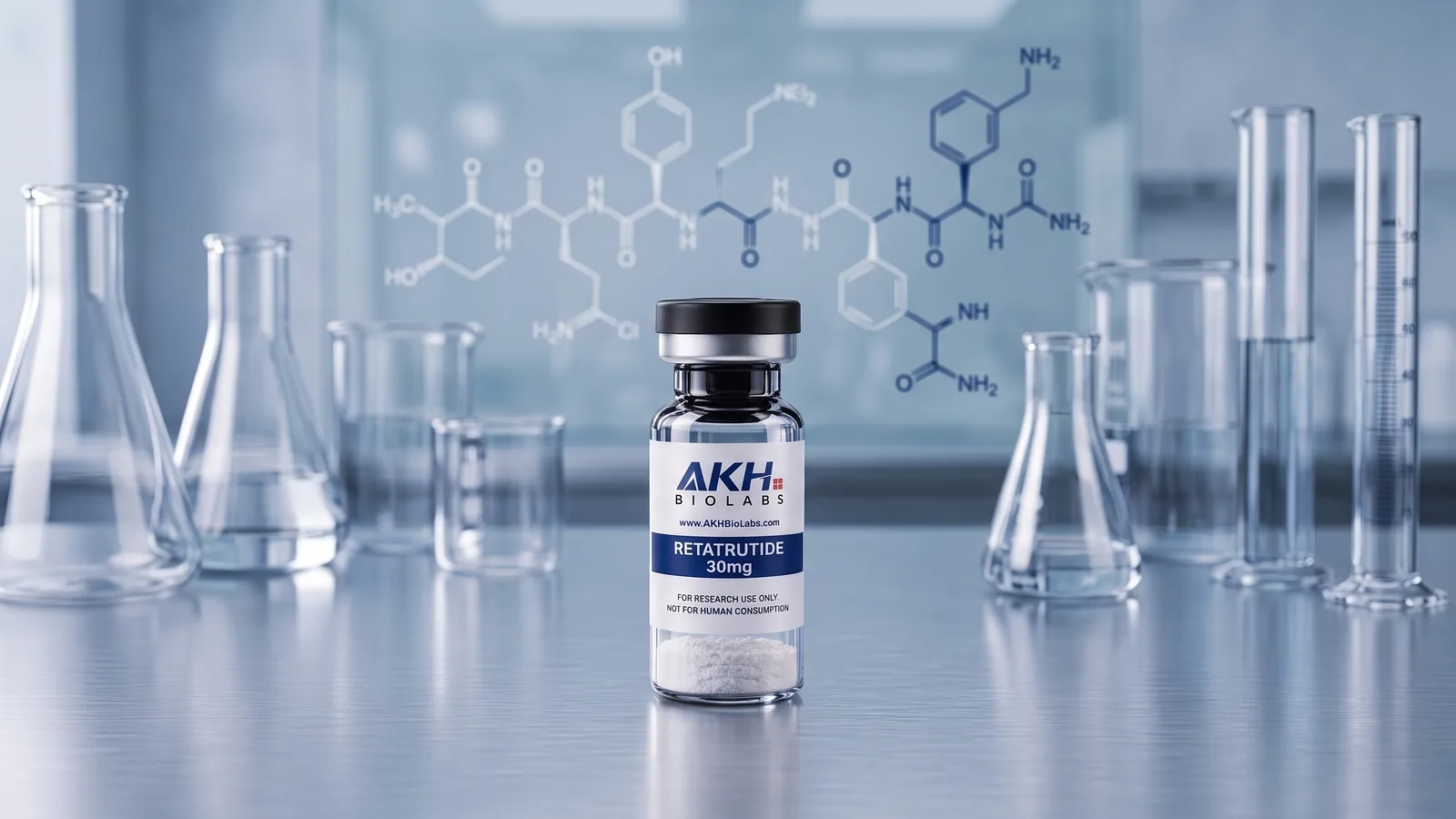
What is reta (GLP-3)?
Reta is shorthand for retatrutide, an investigational triple agonist of the GIP, GLP-1 and glucagon receptors. GLP-3 is an informal search alias, not a receptor class, and no GLP-3 receptor appears in the published literature.
What is reta? Reta is shorthand for retatrutide, an investigational single-molecule peptide that activates three metabolic receptors at once: GIP, GLP-1 and glucagon. The same compound is also searched as reta glp3, and the question behind that phrase is whether GLP-3 names a fourth receptor or a separate drug.
It does not. GLP-3 is an informal label attached to retatrutide in search and in some catalogue listings, not a pharmacological class name. The published literature names three receptors, and the numeral in the alias matches the count of targets rather than any receptor called GLP-3.
This article is written for researchers and laboratory buyers who encounter the compound under several names and need to know which ones point to the same molecule. It covers where the reta shorthand comes from, why the GLP-3 label is informal, how the name appears on a certificate of analysis, and where the published pharmacology lives. Compound evidence is not restated here; the evidence record sits at /research/retatrutide.
Key takeaways
- Reta is shorthand for retatrutide, development code LY3437943, an investigational triple agonist of the GIP, GLP-1 and glucagon receptors.
- GLP-3 is an informal search alias, not a recognised receptor class; the published literature names GIP, GLP-1 and glucagon, and no GLP-3 receptor.
- The numeral in the alias matches the count of receptor targets the papers describe, which is why the label persists despite having no pharmacological definition.
- A certificate of analysis may use a different short form again: one published AKH batch carries the results string "RT: 30mg | Purity: 99.86%".
- As of August 2026 retatrutide was not an approved medicine in any jurisdiction, and long-term safety and durability data are not established in peer-reviewed reports.
Where the reta shorthand comes from
Reta is a clipped form of retatrutide, the name used in the peer-reviewed literature for the compound with development code LY3437943. The AKH BioLabs catalogue entry for the product states that retatrutide is "often searched as GLP-3 or 'reta'", which is a description of how buyers look for it rather than a second chemical identity.
The research record describes the molecule as an investigational single-peptide triple agonist of the GIP, GLP-1 and glucagon receptors, first described in preclinical rodent pharmacology and phase 1 studies in 2022 and subsequently in phase 2 randomised trials in obesity, type 2 diabetes and metabolic dysfunction-associated steatotic liver disease. That is one molecule with one development code, whatever short form a search box accepts.
Shorthand is normal in this market. Compound synonyms accumulate because search behaviour, catalogue copy and certificate results lines each shorten names differently, and the glossary entry on compound synonyms and aliases covers the general pattern. The practical point is that a nickname does not create a new compound, and a figure measured for retatrutide describes retatrutide regardless of which alias was typed.
Is GLP-3 reta? What the label does and does not mean
Is glp-3 reta? In search and in catalogue copy, yes: the two strings point to the same product page and the same molecule. GLP-3 is not, however, a receptor name or a drug class. The published literature describes retatrutide as an agonist at the glucose-dependent insulinotropic polypeptide (GIP) receptor, the glucagon-like peptide-1 (GLP-1) receptor and the glucagon receptor. No receptor called GLP-3 appears in that description.
The naming convention in this field counts receptors. Semaglutide is described as a single GLP-1 receptor agonist, tirzepatide as a dual GIP/GLP-1 agonist, and retatrutide as a triple agonist that adds glucagon-receptor activity on top of GIP and GLP-1. The research record sets out that comparison directly. A label that reads GLP-3 is therefore best understood as a compressed way of saying three receptor targets, not as a claim about a third incretin receptor.
That distinction matters when reading supplier copy. A page that presents GLP-3 as a pharmacological class is using a marketing alias as if it were a mechanism. The checkable version of the claim is the receptor list, and the receptor list is what the cited literature actually reports.
Reta
Shorthand for retatrutide, development code LY3437943. Used in catalogue copy and in search.
GLP-3
An informal alias attached to the same compound. Not a receptor, not a class, and not defined in the cited literature.
Triple agonist
The mechanism the papers describe: agonist activity at the GIP, GLP-1 and glucagon receptors in one peptide.
What the published papers actually name
The two abstracts cited with this article are reviews of peptide therapy in sports and orthopaedic medicine, and they illustrate how the wider literature handles naming. Neither names a GLP-3 receptor. Both describe peptides as short chains of amino acids with a pharmacological niche between small-molecule drugs and large proteins, and both frame the field around named compounds rather than receptor-class nicknames.
One review notes that many unapproved peptides show favourable tissue-repair and metabolic outcomes in animal models while rigorous human safety data remain scarce, and that a parallel gray market of unapproved compounds operates largely outside regulatory oversight. The other reports that information on indications, frequency and duration of treatment for the peptides it reviews remains unknown, and that significant further research is required before definitive recommendations can be made.
Those statements are about peptide therapy as a category, not about retatrutide specifically, and they are cited here for the naming and evidence-framing point only. The compound-specific pharmacology, trial results and limitations belong to the evidence record at /research/retatrutide, which summarises 15 peer-reviewed studies and states plainly what the evidence does not establish.
How the name appears on a certificate of analysis
A certificate of analysis is a test report from a named laboratory outside the vendor, and its results line often shortens the compound name further. One published AKH batch, batch 26138, tested 10 Aug 2026 by the Brown Institute of Biomolecular Research, carries the results string "RT: 30mg | Purity: 99.86%". The report uses RT, the catalogue page uses GLP-3 as a search alias, and the literature uses retatrutide.
Three surfaces, three short forms, one compound. That is the reason a name-matching exercise is a weak way to verify a product and a batch-level document is a stronger one. The certificate states the batch, the test date, the laboratory and the measured result; the alias on a listing page states none of those things.
The glossary entry on compound synonyms and aliases explains why this happens across the catalogue, and the guide on reading a certificate of analysis sets out which fields make a report checkable. For this compound, the product page carries the published certificate and the archive at /lab/coa holds the wider set.
Regulatory status and what the alias does not change
The research record states that, as of August 2026, retatrutide was not an approved medicine in any jurisdiction. A registrational phase 3 programme (TRIUMPH-1 to TRIUMPH-4) and a separate TRANSCEND programme have been described in published design papers, and the first phase 3 readout, a 40-week trial in 537 adults with type 2 diabetes, was published in 2026. Long-term safety, cardiovascular outcome data and durability of effect after discontinuation have not been established in peer-reviewed reports.
None of that changes because a listing calls the compound GLP-3. An alias does not alter regulatory status, does not create a receptor, and does not convert an investigational molecule into an approved one. The AKH BioLabs catalogue entry for the product carries the same framing: retatrutide is described as an investigational single-molecule peptide in active clinical development, supplied strictly for laboratory research use only.
For a laboratory buyer, the useful reading is that the alias is a discovery problem rather than a scientific one. The compound is identified by its receptor profile, its development code and its batch documentation, and those three things are checkable in a way that a nickname is not.
Common questions.
- What is reta?
Reta is shorthand for retatrutide, development code LY3437943, an investigational single-molecule peptide with agonist activity at the GIP, GLP-1 and glucagon receptors. The AKH BioLabs catalogue entry states the compound is often searched as GLP-3 or reta. It remains unapproved in every jurisdiction as of August 2026.
- Is GLP-3 reta, or are they different compounds?
They are the same compound under two names. GLP-3 is an informal search alias attached to retatrutide in catalogue copy and search behaviour, not a separate molecule and not a pharmacological class. The published literature names retatrutide or LY3437943 and describes three receptor targets: GIP, GLP-1 and glucagon.
- Does a GLP-3 receptor exist?
No receptor called GLP-3 appears in the literature cited with this article. The papers describe GIP, GLP-1 and glucagon as the three targets of retatrutide. The numeral in the alias matches the count of receptor targets rather than naming a fourth receptor, which is why the label is best treated as informal shorthand.
- Why does a certificate of analysis use a different name for the same compound?
Laboratory reports shorten compound names to fit a results line. One published AKH batch, batch 26138, tested 10 Aug 2026 by the Brown Institute of Biomolecular Research, carries the results string "RT: 30mg | Purity: 99.86%". The report, the catalogue listing and the literature each use a different short form for the same molecule.
- Is retatrutide an approved medicine?
No. The AKH BioLabs research record states that as of August 2026 retatrutide was not an approved medicine in any jurisdiction. Phase 3 design papers have been published and the first phase 3 readout appeared in 2026, but long-term safety, cardiovascular outcome data and durability of effect after discontinuation are not established in peer-reviewed reports.
Sources
- 01Safety and Efficacy of Approved and Unapproved Peptide Therapies for Musculoskeletal Injuries and Athletic Performance.
- 02Injectable Peptide Therapy: A Primer for Orthopaedic and Sports Medicine Physicians.
- 03Buy Retatrutide 30mg (GLP-3, Reta): Price & COA · AKH BioLabs
- 04Retatrutide research — published studies and evidence · AKH BioLabs