Should bacteriostatic water be refrigerated?
The published bacteriostatic water label directs storage at 20 to 25°C (68 to 77°F), not refrigeration, and the answer changes once a peptide is dissolved in the vial.
Should bacteriostatic water be refrigerated? No, according to the published labelling: the product is stored at controlled room temperature, and the label gives a specific range rather than a cold-storage instruction. The same labelling states that reconstituted solutions of drugs should not be stored unless the manufacturer of the solute directs otherwise, which is where the answer stops being about the water alone.
This article is written for laboratory and procurement readers who handle bacteriostatic water as a diluent for lyophilised research peptides and want the storage question answered from the label text rather than from forum habit. It covers what the label states, why the sealed and opened vial are different questions, and why the storage answer changes once a peptide is in the vial. It does not cover handling technique, volumes or any use of the material in humans or animals.
Key takeaways
- The published labelling directs storage at 20 to 25°C (68 to 77°F), under USP Controlled Room Temperature, and does not instruct refrigeration.
- Bacteriostatic water is a multiple-dose container, so the label anticipates repeated withdrawals rather than a single use.
- The label states that reconstituted solutions of drugs should not be stored unless the solute's manufacturer directs otherwise, which moves the storage decision to the peptide supplier.
- One published AKH BioLabs batch, batch JP20251003, tested 04 Nov 2025 by Janoshik Analytical, reports Benzyl Alcohol: 8.72 mg/ml, a measured concentration for that batch.
What the published label says about storage
The DailyMed labelling for bacteriostatic water carries a short storage instruction under the heading HOW SUPPLIED: "Store at 20 to 25°C (68 to 77°F). [See USP Controlled Room Temperature.]" That is the whole of the storage direction in the document. There is no refrigeration instruction, no freezer instruction and no separate cold-storage range for the sealed vial.
The same labelling describes the product as "a sterile, nonpyrogenic preparation of water for injection containing 0.9% (9 mg/mL) or 1.1% (11 mg/mL) benzyl alcohol added as a bacteriostatic preservative," supplied "in a multiple-dose container from which repeated withdrawals may be made to dilute or dissolve drugs for injection." The preservative is the reason the container is described as multiple-dose rather than single-use.
The pH is given as 5.7, with a range of 4.5 to 7.0. The vial itself is described as a semi-rigid container fabricated from a polyolefin copolymer, and the labelling notes that the container requires no vapour barrier to maintain the proper labelled volume. None of those details imply a temperature requirement beyond the stated room-temperature range.
Sealed versus opened: why the question splits
The storage instruction above applies to the product as supplied. The labelling does not add a second, different storage instruction for the container once it has been entered, and it does not state a period of use after first opening. What it does state is a handling requirement: "Use aseptic technique for single or multiple entry and withdrawal from all containers."
That leaves the opened vial governed by the same room-temperature range as the sealed one, on the face of the document, with aseptic technique carrying the burden that a cold-storage instruction would otherwise carry. The preservative is what makes repeated withdrawal from one container possible at all; the labelling describes benzyl alcohol as the bacteriostatic preservative added for that purpose.
The practical consequence is that refrigeration is not a substitute for technique. A vial moved to a refrigerator and entered without aseptic technique has not been protected by the temperature change, and the labelling does not present cold storage as a control measure in the first place.
Why the answer changes once a peptide is in the vial
The labelling addresses the diluent, not the solution that results from using it. Under PRECAUTIONS it states: "Do not store reconstituted solutions of drugs for injection unless otherwise directed by the manufacturer of the solute." That sentence moves the storage decision away from the bacteriostatic water label and onto whoever supplies the material being dissolved.
This is the point at which the refrigeration question stops having a single answer. Bacteriostatic water on its own is stored at controlled room temperature per its label. A peptide dissolved in it is a different preparation, and the label explicitly defers to the solute manufacturer rather than setting a storage condition itself.
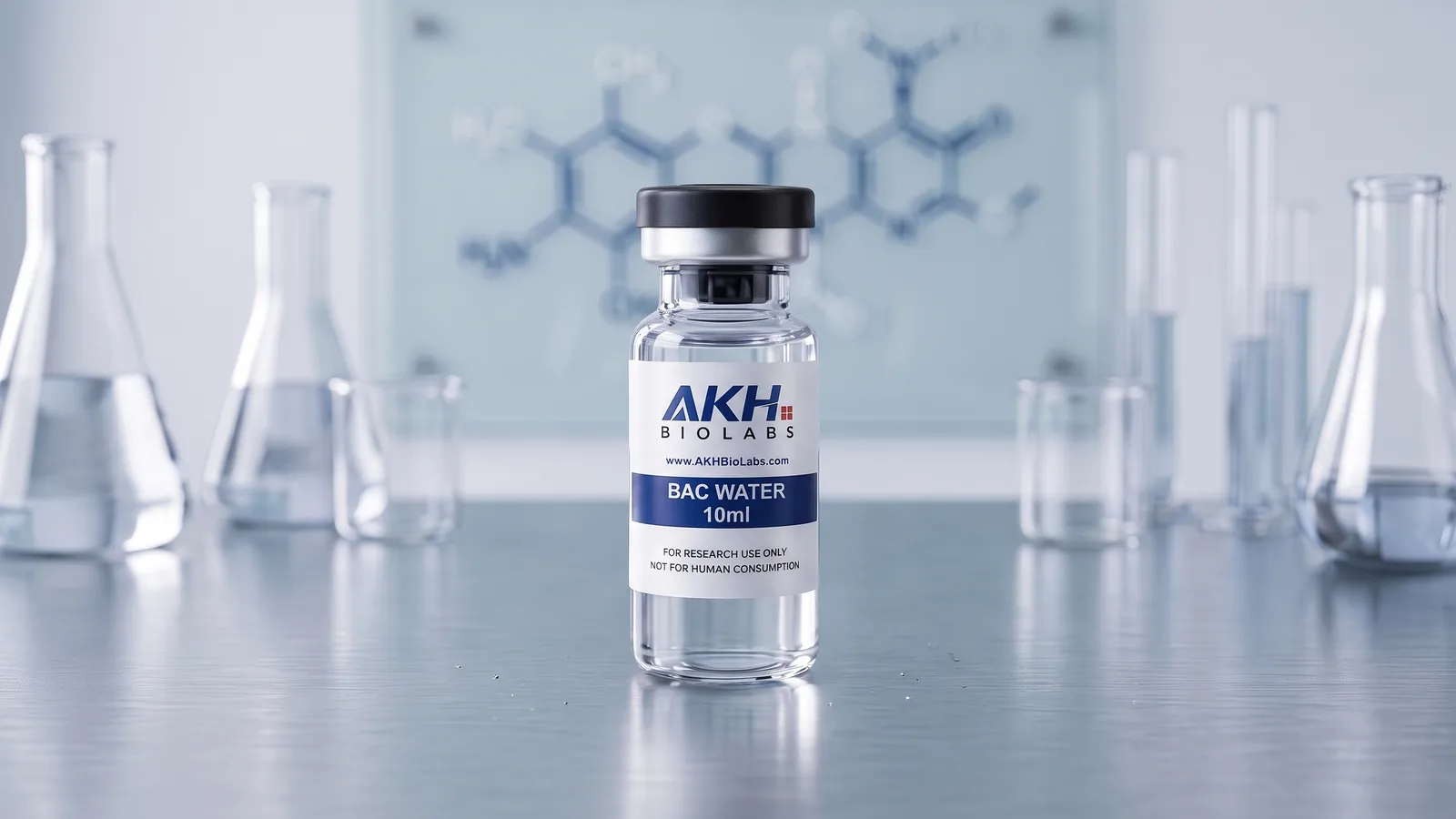
The AKH BioLabs listing for bacteriostatic water describes it as "the standard solvent for reconstituting lyophilised research peptides in the laboratory" and states that it is supplied strictly for laboratory research use only. The listing does not add a storage temperature of its own, so the label text remains the operative instruction for the diluent.
For the peptide side of that equation, the storage and stability material on this site covers what changes when water enters the vial, and the reconstitution glossary entry defines the term. Those records are the place to look for the solute question; this article answers only the diluent question.
What the certificate documents, and what it does not
The certificate published for the AKH BioLabs bacteriostatic water product documents a measurement rather than a storage condition. It names batch JP20251003, tested 04 Nov 2025 by Janoshik Analytical, task ID #86200, and the results line reads "Benzyl Alcohol: 8.72 mg/ml". The certificate is a report from a named laboratory outside AKH, ordered by the manufacturer and published unaltered.
That figure is a concentration for one batch. It is not a specification, not a duration and not a storage instruction, and it should not be read as any of those. The archive row for this product carries no purity percentage, because the published result is a concentration rather than a chromatographic purity figure.
The distinction matters for the refrigeration question because a certificate answers what was measured in a sample, while a storage instruction answers how the product should be kept. The two documents are separate, and only the labelling carries the second.
Reading the storage question in practice
The label text supports a short set of conclusions, and they are worth separating from the surrounding folklore about cold storage. The table below sets the sealed diluent against the reconstituted preparation, using only what the cited documents state.
| Item | What the cited document states |
|---|---|
| Bacteriostatic water, as supplied | Store at 20 to 25°C (68 to 77°F), per USP Controlled Room Temperature |
| Container type | Multiple-dose container from which repeated withdrawals may be made |
| Entry requirement | Use aseptic technique for single or multiple entry and withdrawal from all containers |
| Reconstituted solution of a drug | Do not store unless otherwise directed by the manufacturer of the solute |
| Published AKH batch JP20251003 | Benzyl Alcohol: 8.72 mg/ml, tested 04 Nov 2025 by Janoshik Analytical |
- 01
Confirm the storage instruction from the label, not from habit
The published labelling gives one range, 20 to 25°C (68 to 77°F), and no cold-storage alternative.
- 02
Treat the sealed and opened container as the same storage question
The labelling adds an aseptic-technique requirement for entry but does not add a second storage temperature.
- 03
Move the storage decision to the solute supplier once a peptide is dissolved
The labelling directs that reconstituted solutions of drugs not be stored unless the solute's manufacturer directs otherwise.
- 04
Read the certificate for what it measures, not for how to store
The published result for batch JP20251003 is a benzyl alcohol concentration, not a storage condition.
Common questions.
- Should bacteriostatic water be refrigerated?
The published labelling directs storage at 20 to 25°C (68 to 77°F), under USP Controlled Room Temperature, and gives no refrigeration instruction. That range applies to the product as supplied in its multiple-dose container. Once a peptide is dissolved in the water, the labelling defers the storage decision to the manufacturer of the solute.
- Do you refrigerate bacteriostatic water after opening the vial?
The labelling does not add a second storage temperature for the opened container. It states one range, 20 to 25°C (68 to 77°F), and separately requires aseptic technique for single or multiple entry and withdrawal from all containers. The document does not state a period of use after first opening, so the printed expiry date should not be read as covering the opened vial.
- What is bacteriostatic water use in the laboratory?
It is a diluent. The labelling describes it as supplied in a multiple-dose container from which repeated withdrawals may be made to dilute or dissolve drugs, and the AKH BioLabs listing describes it as the standard solvent for reconstituting lyophilised research peptides in the laboratory. It is supplied strictly for laboratory research use only.
- Does the benzyl alcohol figure on a bacteriostatic water certificate state a storage temperature?
No. The certificate published for batch JP20251003, tested 04 Nov 2025 by Janoshik Analytical, reports Benzyl Alcohol: 8.72 mg/ml. That is a concentration measurement for one batch. Storage conditions come from the labelling, which is a separate document answering a separate question.
- Why does the storage answer change once a peptide is dissolved in bacteriostatic water?
Because the labelling addresses the diluent, not the resulting solution. Under PRECAUTIONS it states that reconstituted solutions of drugs for injection should not be stored unless otherwise directed by the manufacturer of the solute. That sentence transfers the storage decision to the peptide supplier, so the diluent's room-temperature instruction no longer settles the question on its own.