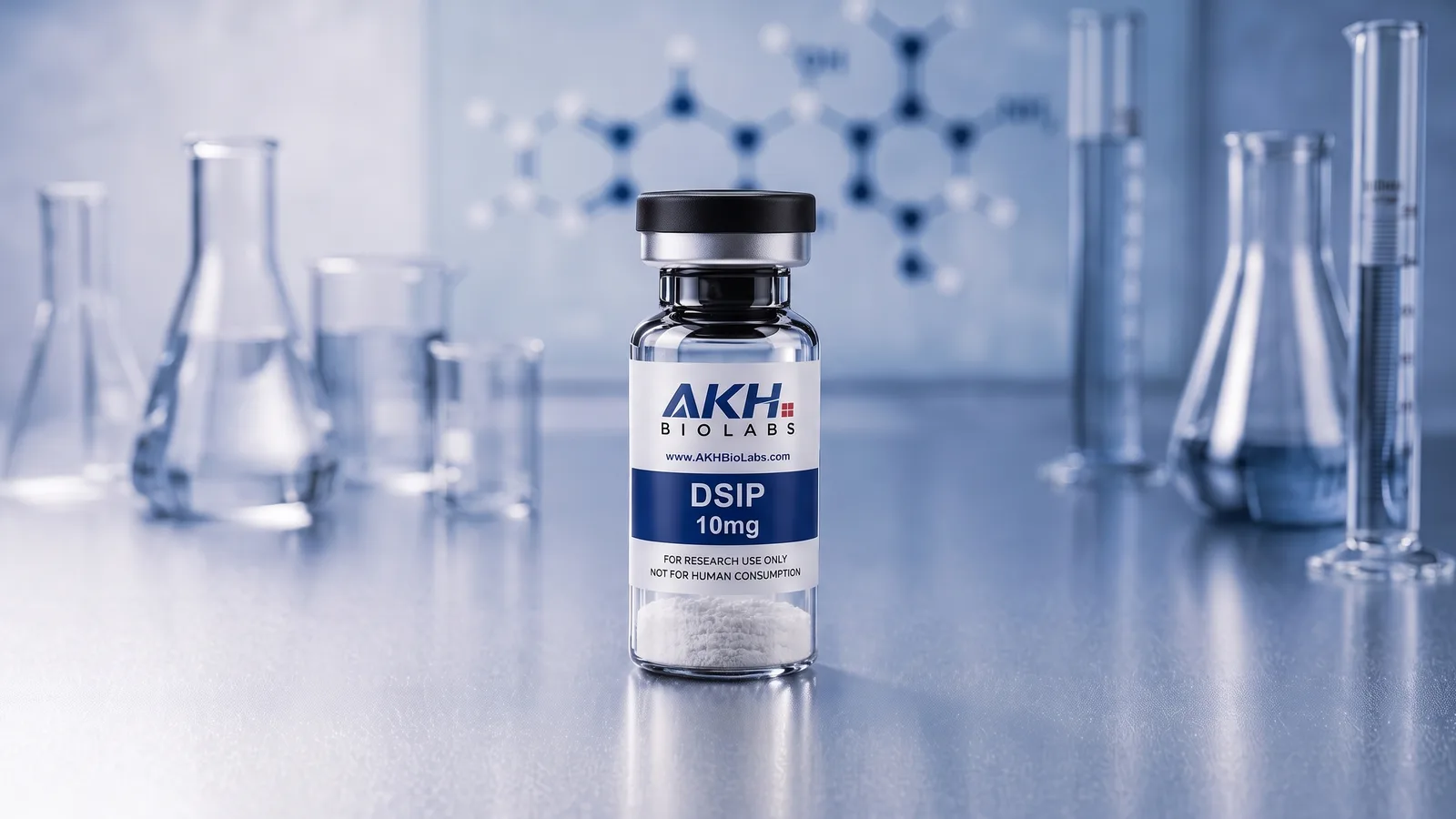
What does DSIP do? What the published research reports
DSIP is a nonapeptide studied since the 1970s in sleep and neuroendocrine research, and no receptor, gene or precursor for it has ever been identified. What the published work reports it does, how the mechanism question is answered in the literature, and where the evidence stops.
What does DSIP do? In the published record, DSIP is a nonapeptide that has been studied since the late 1970s for effects on sleep architecture, the hypothalamic-pituitary-adrenal axis and, more recently, endpoints unrelated to sleep, and the literature does not settle on a single mechanism for it. The name is an abbreviation of delta sleep-inducing peptide, and it records the original observation rather than a confirmed function.
This article is written for researchers and laboratory readers who want a plain answer to the mechanism question before opening the primary papers. It separates what studies report from what the evidence does not establish, and it links to the DSIP research record for the study-by-study detail rather than restating it here. Nothing below is medical advice, and no finding summarised here should be read as a recommendation for human use.
Key takeaways
- DSIP is a nonapeptide first isolated in 1977 from the cerebral venous blood of sleep-induced rabbits, and the name records that observation rather than a settled mechanism.
- No DSIP receptor, gene or precursor protein has been identified, and reviewers describe the peptide as mechanistically unresolved.
- Published work reports interactions with the hypothalamic-pituitary-adrenal axis and the opioid system, plus effects on thermoregulation and gene expression.
- Human studies are small, mostly pre-1995, and produced inconsistent sleep outcomes; recent work is almost entirely rodent.
- Whether DSIP works as a sleep factor is a question the primary literature itself disputes, and the DSIP research record sets out the limitations in full.
What DSIP is, and why the name overstates the evidence
DSIP stands for delta sleep-inducing peptide. It is a nonapeptide, meaning a chain of nine amino acids, with the sequence Trp-Ala-Gly-Gly-Asp-Ala-Ser-Gly-Glu. It was isolated in 1977 from the cerebral venous blood of rabbits during electrically induced slow-wave sleep, which is where the name comes from.
The name has outrun the finding. Reviewers writing three decades later still describe DSIP as an unresolved riddle, and the DSIP research record states that no DSIP gene, precursor protein or receptor has been identified and that the peptide's status as an endogenous sleep factor remains contested. A compound named for an effect is not the same as a compound with a demonstrated mechanism.
The chemical identity is well characterised even though the biology is not. The molecular formula is C35H48N10O15, the molecular weight is 848.8 g/mol, the CAS number is 62568-57-4 and the PubChem CID is 68816. The compound is also written as emideltide. Those figures describe the free base, and lyophilised peptide is normally supplied as an acetate or trifluoroacetate salt carrying residual water, so the mass of powder in a vial is not the same quantity the molecular weight implies.
How does DSIP work? What the literature reports
How does DSIP work is a question the published record answers only in fragments. No receptor has been confirmed and no transduction pathway agreed, so the mechanism account below is a list of reported interactions rather than a pathway.
The most consistently reported interaction is with the hypothalamic-pituitary-adrenal axis. The DSIP research record describes studies reporting reductions in circulating ACTH after parenteral administration in human subjects, alongside reports on opioid-system interaction, thermoregulation and c-Fos expression in rodent brain. Those threads do not converge on one explanation.
A second line of work concerns slow-wave sleep and growth hormone. A 1988 study in the rat, published in the Proceedings of the National Academy of Sciences, reported evidence linking DSIP to slow-wave sleep and sleep-associated growth hormone release, and the research record describes it as the most frequently cited mechanistic basis for the peptide's sleep claims. The same record notes that the 2006 critical review concluded the sleep-factor hypothesis was poorly documented and weak, and that certain synthetic analogues, but not DSIP itself, promoted slow-wave sleep in rabbits and rats.
A third line has moved away from sleep entirely. Work published since 2010 examines motor recovery in a rat focal-stroke model, antioxidant enzyme gene expression in ageing animals, and stress-model physiology. The DSIP research record attributes that shift to the sleep findings proving difficult to replicate, which is where the current literature sits.
Does DSIP work? What that question can and cannot mean here
Does DSIP work is a question with two different readings, and the published record answers them differently. Read as a question about a demonstrated mechanism, the answer is no: there is no confirmed receptor, no agreed pathway and no replicated account of how the peptide produces the effects attributed to it.
Read as a question about whether studies report measurable effects, the answer is that some do and the results disagree. The clearest example is the human anaesthesia work. A 2009 randomised controlled trial in 24 female ASA I-II subjects, published in the European Journal of Anaesthesiology, found that DSIP increased heart rate, decreased heart rate variability and, contrary to the hypothesis, reduced delta rhythm and increased bispectral index at 25 nmol/kg. The authors concluded that DSIP lightened rather than deepened anaesthetic depth, which is the opposite direction to the effect the peptide's name implies.
The sleep trials point the same way. A 1992 double-blind matched-pairs trial in 16 chronic insomnia subjects, published in Neuropsychobiology, found higher sleep efficiency and shorter sleep latency with DSIP, but the effects were weak and partly attributable to change in the placebo group, and the authors concluded that short-term DSIP treatment of chronic insomnia was unlikely to be of major therapeutic benefit. A 1994 diurnal sampling study, published in The Journal of Clinical Endocrinology and Metabolism, found plasma DSIP correlated positively with body temperature and negatively with REM and slow-wave sleep, a pattern opposite to what would be expected of a circulating slow-wave-sleep-promoting factor.
The DSIP research record summarises the position: human trials are small, mostly pre-1995, used parenteral rather than other routes, and produced inconsistent sleep outcomes, with no modern randomised controlled trials, no pharmacokinetic characterisation for non-parenteral routes and no controlled safety data. The record also notes that a 1995 cross-sectional study found morning plasma DSIP-like immunoreactivity did not differ significantly between sleep apnoea subjects, narcolepsy subjects and controls, so single plasma measures did not support use as a disease marker.
What recent DSIP research examines instead
The most recent primary DSIP study indexed in PubMed, according to the DSIP research record, is a 2024 paper in Frontiers in Pharmacology describing a recombinantly produced DSIP fusion peptide expressed in Pichia pastoris that crossed the blood-brain barrier and produced measurable effects in a PCPA-induced insomnia mouse model. That is a delivery-construct study in mice, not a mechanism study in humans.
Other recent work sits in ischaemia and ageing models. A 2021 study in Molecules reported that DSIP administration was associated with recovery of motor function after focal stroke in Sprague-Dawley rats. A companion 2021 paper in Biomedicines reported that a DSIP-like KND peptide reduced infarct size in both brain and myocardial ischaemia-reperfusion models when given during reperfusion. A 2018 study in Life Sciences reported that phosphorylated DSIP improved sleep architecture and was associated with restored spatial memory performance and p-CREB expression under simulated high-altitude conditions in rodents.
A cluster of Russian geroprotection work examines oxidative and antioxidant endpoints. A 2014 study in the Bulletin of Experimental Biology and Medicine reported that DSIP altered expression of antioxidant enzyme genes in brain and blood of ageing rats, and a 2012 paper in the same journal reported that DSIP reduced markers of oxidative protein modification in ageing rats. A 2016 study in the same journal reported that DSIP modified stress-induced changes in hepatocyte functional state, which the research record reads as consistent with a general anti-stress rather than sleep-specific action.
None of this work establishes a mechanism. It establishes that the compound is still being studied, in models that have little to do with the effect its name describes.
Where the DSIP evidence stops
The limitations are stated plainly on the DSIP research record and are worth repeating because they bound every claim above. No DSIP receptor, gene or precursor has ever been identified, and the peptide's classification as an endogenous sleep factor is disputed in the primary literature.
Human trials are small, mostly pre-1995, and produced inconsistent sleep outcomes. There are no modern randomised controlled trials, no pharmacokinetic characterisation for non-parenteral routes, and no controlled safety data. The 1998 open clinical trial in opioid detoxification, published in the Journal of Clinical Psychopharmacology, was a short communication without a control group. The 1984 pilot study in chronic pain, published in European Neurology, was uncontrolled with a sample of seven. The 1983 psychophysiological work by Schneider-Helmert and Schoenenberger reported a sleep-induction latency of about one hour with effects lasting up to 20 hours, but that sits inside a body of work the later reviews describe as unreplicated.
There is also a regulatory fact that is routinely misread. On 23 and 24 July 2026 the FDA's Pharmacy Compounding Advisory Committee considered DSIP, heard under the name emideltide, for the 503A Bulks List and declined to recommend its addition on a reported vote of 6 to 7 with one abstention. The DSIP research record notes it was the only one of the seven peptides the committee declined to recommend. That is not an approval and not a rejection of the research: the committee advises, it does not decide, the recommendation is not binding, and the FDA has not completed the rulemaking that would formally change anything. The list also governs pharmacy compounding, which is a separate activity from research-use-only supply.
The DSIP research record lists 17 published studies ordered by strength of study design and then by recency, with 1 published since 2023 and the newest dated 2024. That record is the place to check any individual finding against the paper rather than against a summary.
Reading a DSIP claim against the record
Most claims about DSIP that circulate outside the literature can be checked against a small number of questions. The checklist below is the one the research record supports.
The pattern to watch for is a study design being described as stronger than it was. An open pilot with seven participants, a short communication without a control group and a double-blind trial with a weak effect are three different things, and the DSIP literature contains all three. The research record labels each entry with its design for that reason.
- 01
Is the claim about DSIP itself or a synthetic analogue?
The 2006 review notes that certain synthetic analogues, but not DSIP itself, promoted slow-wave sleep in rabbits and rats. A finding about an analogue is not a finding about DSIP.
- 02
Is the study in humans or in a rodent model?
Human work is concentrated in the 1980s and early 1990s. Work published since 2010 is almost entirely rodent, covering stroke, stress, ageing and delivery constructs.
- 03
Does the study have a control group?
The 1998 opioid detoxification report was an open trial without a control group, and the 1984 chronic pain study was an uncontrolled pilot with seven participants.
- 04
Does the reported effect point in the expected direction?
The 2009 anaesthesia trial found DSIP lightened rather than deepened anaesthetic depth, and the 1994 diurnal study found a correlation pattern opposite to what a slow-wave-sleep-promoting factor would predict.
- 05
Is the claim about a mechanism?
No receptor, gene or precursor has been identified, so any statement of how DSIP works is a reported interaction rather than an established pathway.
Common questions.
- What does DSIP do in the published research?
The published record reports interactions with the hypothalamic-pituitary-adrenal axis, including reductions in circulating ACTH after parenteral administration in human subjects, alongside reports on opioid-system interaction, thermoregulation and c-Fos expression in rodent brain. Recent work examines motor recovery after focal stroke in rats, antioxidant enzyme gene expression in ageing animals and stress-model physiology. No receptor, gene or precursor has been identified, so these are reported interactions rather than an established mechanism.
- Does DSIP work as a sleep factor?
The primary literature disputes it. The 2006 critical review concluded the sleep-factor hypothesis was poorly documented and weak, and noted that certain synthetic analogues, but not DSIP itself, promoted slow-wave sleep in rabbits and rats. Human sleep trials are small, mostly pre-1995, and produced inconsistent outcomes, with the 1992 insomnia trial reporting weak effects partly attributable to change in the placebo group.
- How does DSIP work if no receptor has been identified?
It does not have a confirmed mechanism. Reviewers describe interactions with the hypothalamic-pituitary-adrenal axis and the opioid system, plus reports on thermoregulation and gene expression, but explicitly characterise the overall picture as unresolved. The DSIP research record states that no DSIP gene, precursor protein or receptor has been identified and that no transduction pathway is agreed.
- Why has DSIP research moved away from sleep?
Because the sleep findings proved difficult to replicate. The DSIP research record states that work published since 2010 has largely moved to other endpoints, including motor recovery after experimental stroke, antioxidant enzyme expression in ageing animals and stress-model physiology. The most recent primary study indexed in PubMed is a 2024 mouse model of PCPA-induced insomnia using a recombinant fusion peptide.
- What did the July 2026 FDA advisory committee vote on DSIP actually do?
The FDA's Pharmacy Compounding Advisory Committee considered DSIP, heard under the name emideltide, for the 503A Bulks List on 23 and 24 July 2026 and declined to recommend its addition on a reported vote of 6 to 7 with one abstention. The committee advises and does not decide, the recommendation is not binding, and the FDA has not completed the rulemaking that would formally change anything. The list governs pharmacy compounding, a separate activity from research-use-only supply.