AKH Signature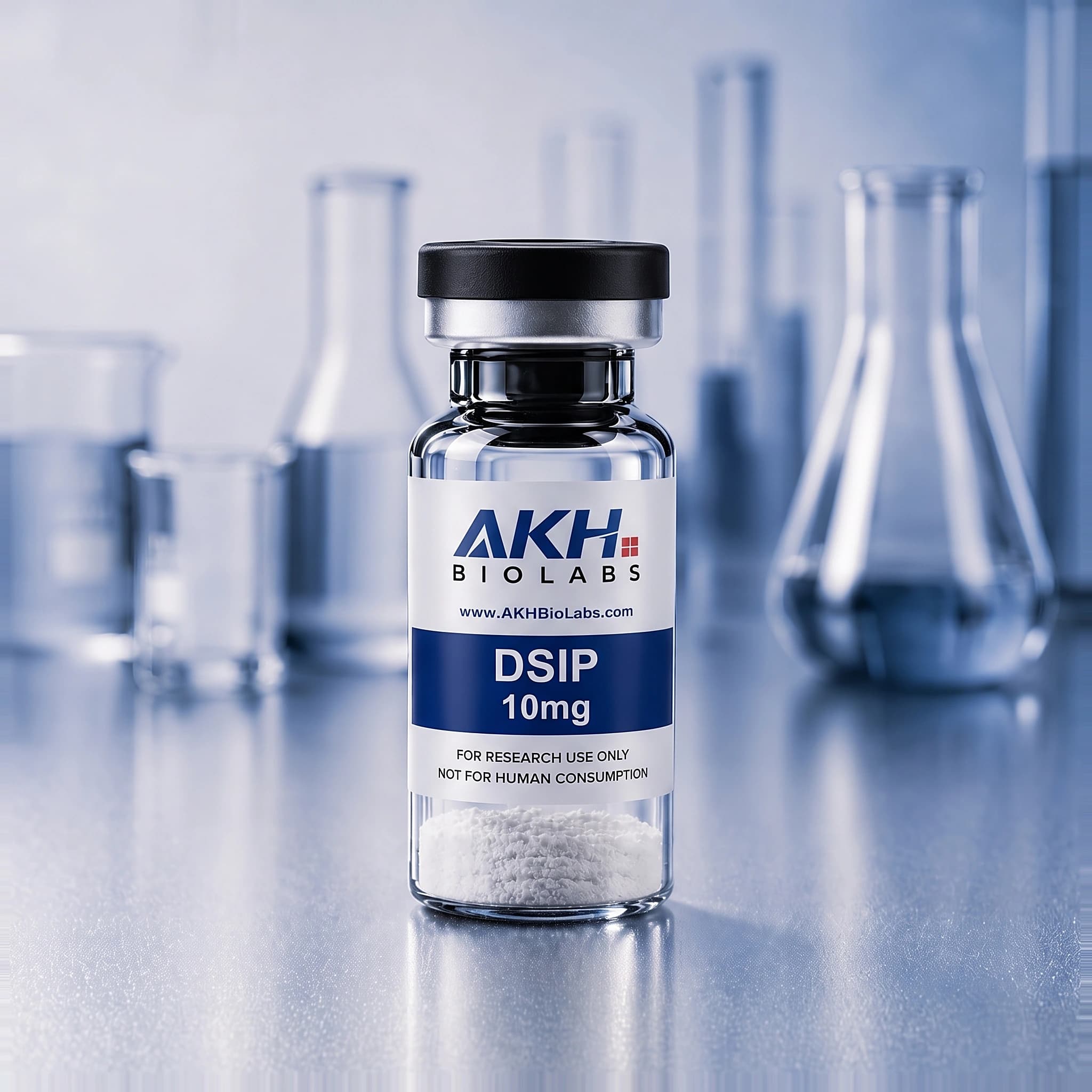
Cognitive· AKH Signature
In stockDSIP
Delta Sleep-Inducing Peptide
Size10mgPurity99.63%FormulaC35H48N10O15
DSIP (Delta Sleep-Inducing Peptide) is a naturally occurring nonapeptide first isolated in 1977 by Schoenenberger and Monnier at the University of Basel from the cerebral venous blood of sleeping rabbits — hence the name. It is researched in preclinical models for its role in sleep-cycle architecture, circadian rhythm modulation, cortisol regulation and stress response.
€70
Quantity
HPLC verified
9–14 day shipping
Full COA
Worldwide delivery
About this compound
The research profile.
Delta sleep-inducing peptide (DSIP) is a nonapeptide first isolated in the 1970s from the cerebral venous blood of rabbits during electrically induced slow-wave sleep. Its name reflects the original observation rather than a settled mechanism: reviewers writing three decades later still describe DSIP as an unresolved riddle, with no confirmed receptor and no agreed transduction pathway.
The published literature reports a scattered set of findings rather than one coherent account. Studies describe interactions with the hypothalamic-pituitary-adrenal axis, including reductions in circulating ACTH after intravenous administration in human subjects, alongside reports on opioid-system interaction, thermoregulation, and c-Fos expression in rodent brain. More recent work has moved away from sleep entirely, examining motor recovery in a rat focal-stroke model and antioxidant enzyme gene expression in ageing animals.
A recurring caveat in the reviews is that endogenous DSIP has been difficult to characterise analytically, and that results across laboratories have not consistently replicated. The compound is best regarded as a historically important research peptide whose pharmacology remains open.
Published research
17 peer-reviewed studies on DSIP are summarised in our research library, including 1 published since 2023 — with study designs, reported findings and what the evidence does not establish.
Read the DSIP evidence baseFor research purposes only. Not for human consumption, diagnosis, treatment, or prevention of any condition.
Categorised as Cognitive — Neuropeptides for neuroscience research.
Dosing at a glance
What the literature reports.
For research and laboratory use only. Not for human consumption.
Route
Subcutaneous
Frequency
Once daily
Reported range
100–250 mcg
Protocol duration
1–3 weeks
100 mcgper administration250 mcg
Intramuscular · Once daily (study protocols) · 20–25 mcg per kg bodyweight (per-kg protocols) · Single administration to 5 days
Parenteral research protocols cluster in the low hundreds of micrograms per administration, generally applied once daily over short courses. Figures describe study designs, not guidance for human use.
Ranges reflect protocols reported in the published literature on DSIP — see research citations.
Calculate a dilutionReconstitution & storage
From powder to solution.
- Step 01
Add 3 ml bacteriostatic water
Aim the stream at the vial wall rather than the powder.
- Step 02
Swirl gently — never shake
Rotate the vial until the solution runs clear. Agitation degrades the peptide.
- Step 03
Refrigerate at 2–8 °C
Reconstituted vials belong in the fridge, protected from direct light.
- Step 04
Use within 28 days
Discard any remainder once the stability window closes.
Lyophilised · −20 °CReconstituted · 2–8 °C, 28 days
A 15 mg vial in 3 ml of bacteriostatic water gives a 5 mg/ml solution, in which 250 mcg measures 0.05 ml — 5 units on a U-100 syringe.
Reconstitution calculator
15 mg vialmg
ml
mcg
250 mcg = 0.25 mg
Draw
5units · U-100 insulin syringe
- Concentration
- 5 mg/ml
- Draws per vial
- 60
- Cost per draw
- €1.17
For research and laboratory use only. Not for human consumption.
Laboratory arithmetic for DSIP — enter the COA-verified vial content for exact figures. Not medical advice.
Effect timeline
Observed across the research window.
Milestones summarise findings reported in the cited studies. Outcomes vary across models and protocols.
Start
Acute administration observations
The historical human work reports endocrine changes — including reduced immunoreactive ACTH in plasma — within hours of a single infusion, alongside the electroencephalographic observations that gave the peptide its name.
Days 1–5
Short repeated courses
Review-level summaries describe short repeated-administration designs across several days, with the caveat that results varied considerably between laboratories.
Week 2
Functional recovery models
In a rat focal-stroke model, motor-function measures were tracked over the weeks following administration and compared against untreated controls.
Week 4
Longer-course end points
Ageing-model work examined antioxidant enzyme gene expression in brain and blood after extended administration schedules, marking the outer end of typical published protocols.
For research and laboratory use only. Not for human consumption.
Scientific research
The published evidence.
The dosing ranges and timeline milestones on this page summarise the peer-reviewed publications below.
References
- 01
Delta-sleep-inducing peptide (DSIP): a review. Neurosci Biobehav Rev (1984). PubMed · 6145137
- 02
Delta-sleep-inducing peptide (DSIP): an update. Peptides (1986). PubMed · 3550726
- 03
Delta sleep-inducing peptide (DSIP): a still unresolved riddle. J Neurochem (2006). PubMed · 16539679
- 04
Effect of delta sleep-inducing peptide on the expression of antioxidant enzyme genes in the brain and blood of rats during physiological aging. Bull Exp Biol Med (2014). PubMed · 25257425
- 05
Delta Sleep-Inducing Peptide Recovers Motor Function in SD Rats after Focal Stroke. Molecules (2021). PubMed · 34500605
Laboratory verification
One Certificate, published unaltered.
The Certificate is a test report from a named laboratory outside AKH, ordered by our manufacturer and shown here exactly as the laboratory issued it. A printed copy ships in every parcel.
- Batch
- 26181
- Test date
- 05 Aug 2026
- Task ID
- #1812477
- Purity
- 99.63%
Results
DSIP: 10mg | Purity: 99.63%
Verified by Brown Institute of Biomolecular Research. Scan the full report for every measurement.
Product FAQ
Questions researchers ask.
Pairs well with
Frequently co-studied.
Compounds that appear alongside DSIP in the research literature.
For research and laboratory use only. Not for human consumption.
Cognitive