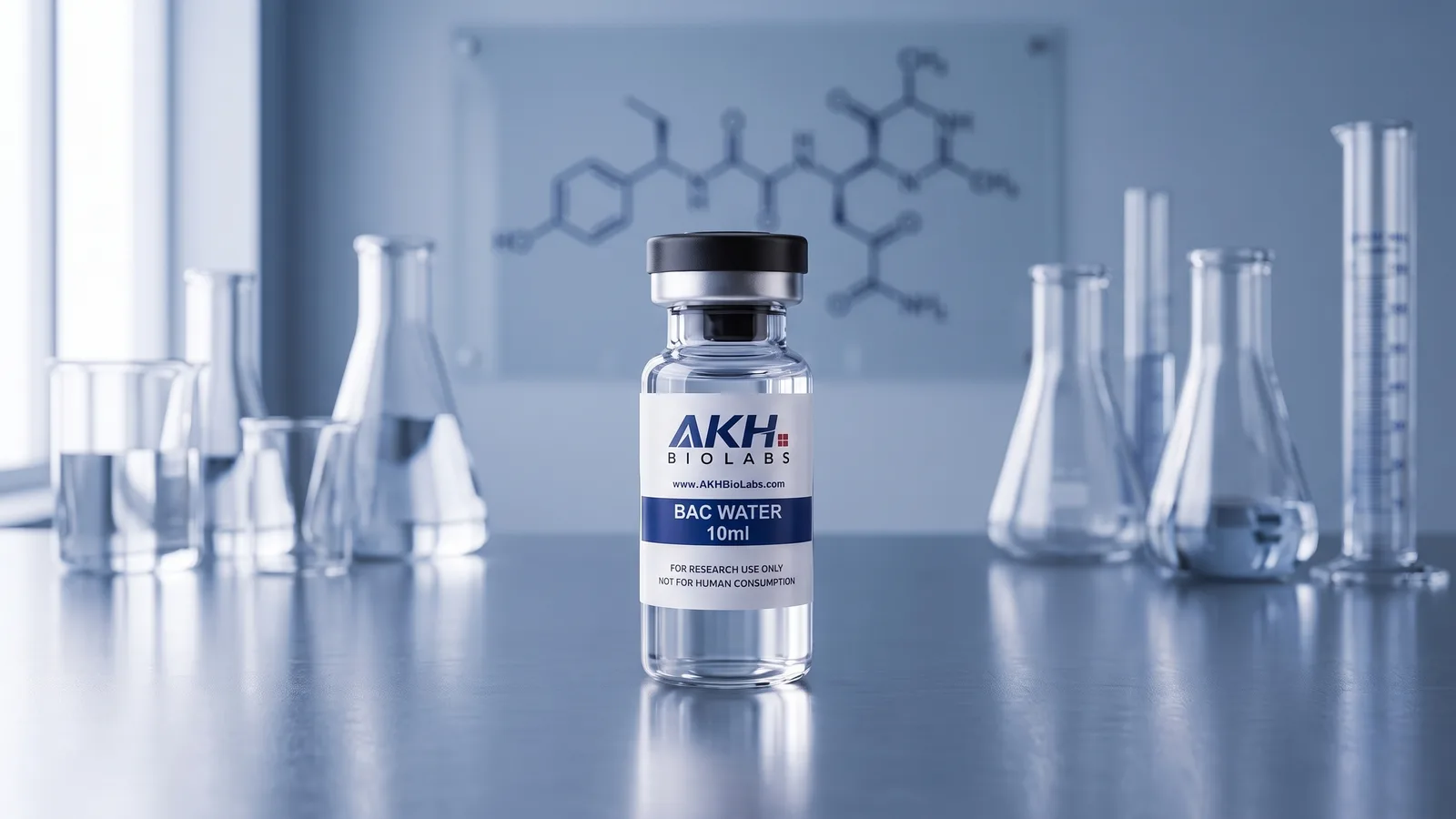
What is bac water? Bacteriostatic water explained
Bacteriostatic water is sterile water for injection with benzyl alcohol added as a bacteriostatic preservative, and the FDA labeling answers the expiry question only for the sealed vial.
Bac water is a short name for bacteriostatic water, which the FDA labeling describes as a sterile, nonpyrogenic preparation of water for injection containing 0.9% (9 mg/mL) or 1.1% (11 mg/mL) benzyl alcohol added as a bacteriostatic preservative, supplied in a multiple-dose container from which repeated withdrawals may be made. The preservative is the point of the product: it suppresses microbial growth after the vial is opened, which is why the same container is built for more than one entry.
This article is written for laboratory researchers and procurement staff who handle lyophilised peptides and need to know what the diluent actually is, what a certificate of analysis can document about it, and whether it expires. It covers the label definition, the benzyl alcohol figure on one published AKH batch, the sealed-vial and opened-vial questions separately, and where the term bac water pharmacy comes from. It does not cover handling procedures or volumes.
Key takeaways
- Bacteriostatic water is water for injection plus benzyl alcohol at 0.9% (9 mg/mL) or 1.1% (11 mg/mL), per the FDA labeling.
- The preservative allows repeated withdrawals from a multiple-dose container, which is the functional difference from sterile water.
- The label gives a storage temperature for the sealed vial, not a use-by window after opening.
- One published AKH batch, batch JP20251003, reports Benzyl Alcohol: 8.72 mg/ml on a report from Janoshik Analytical.
- The term bac water pharmacy describes a supply channel, not a different product.
What the label says bacteriostatic water is
The DailyMed labeling for Bacteriostatic Water for Injection, USP describes it as a sterile, nonpyrogenic preparation of water for injection containing 0.9% (9 mg/mL) or 1.1% (11 mg/mL) benzyl alcohol added as a bacteriostatic preservative. It is supplied in a multiple-dose container from which repeated withdrawals may be made to dilute or dissolve drugs. The stated pH is 5.7, with a range of 4.5 to 7.0.
Two concentrations appear across the marketed presentations. The Hospira labeling lists a 30 mL multiple-dose plastic fliptop vial at 9 mg/mL benzyl alcohol and a 20 mL fill in a 30 mL glass fliptop vial at 11 mg/mL. The vial label carries the concentration directly, so the figure is checkable on the container rather than only in the literature.
Benzyl alcohol is the ingredient that separates this product from plain sterile water. The labeling states that where water is required for preparing or diluting medications for neonates, only preservative-free Sterile Water for Injection should be used, because benzyl alcohol has been associated with toxicity in that group. That is a statement about a specific population and a specific preservative, not a general caution about the product.
Why the preservative changes how the vial is used
A multiple-dose container is entered more than once. The labeling directs aseptic technique for single or multiple entry and withdrawal from all containers, and the bacteriostatic preservative is what makes repeated entry a designed use rather than an off-label one. Sterile water for injection carries no preservative, so the same repeated-entry pattern is not what it is built for.
The distinction matters when reading a certificate of analysis. A certificate for bacteriostatic water reports the preservative content, because that is the measurement that distinguishes the product. The labeling's preservative-free direction for sterile water is a statement about the preparation, not a description of what any particular certificate reports.
The labeling also notes that some drugs may be incompatible in a given vehicle, or when combined in the same vehicle or in a vehicle containing benzyl alcohol, and directs consultation with a pharmacist if available. Compatibility is a property of the specific pair, not of the diluent in isolation.
Reading one published AKH batch
AKH BioLabs publishes the certificate for its bacteriostatic water on the product page. The report is a test report from a named laboratory outside AKH, ordered by the manufacturer and shown as the laboratory issued it.
The published record for batch JP20251003, tested 04 Nov 2025 by Janoshik Analytical under task ID #86200, carries the results string Benzyl Alcohol: 8.72 mg/ml. The product is supplied as a 10ml solution with the formula H2O + 0.9% Benzyl Alcohol.
The 8.72 mg/ml figure sits below the 9 mg/mL nominal concentration for a 0.9% preparation. That is what a measured value looks like next to a label claim: the certificate reports what the laboratory found in that batch, and the label states what the preparation is specified to contain. Neither number is a substitute for the other, and the certificate is the one that is batch-specific.
Batch
JP20251003
Test date
04 Nov 2025
Laboratory
Janoshik Analytical, task ID #86200
Results
Benzyl Alcohol: 8.72 mg/ml
Can bac water expire?
The labeling answers this for the sealed vial and is silent on the opened one. Under How Supplied, the product is to be stored at 20 to 25°C (68 to 77°F), with a reference to USP Controlled Room Temperature. The principal display panel for the 30 mL vial carries a LOT and an EXP field in the format EXP DMMMYYYY, so a printed expiry date is part of the presentation.
That printed date applies to the unopened, properly stored vial. The labeling does not state a period of use after the container is first entered. It directs aseptic technique for entry and withdrawal, and it states that reconstituted solutions of drugs should not be stored unless the manufacturer of the solute directs otherwise, but it does not convert those directions into a number of days for the diluent itself.
The practical consequence is that the expiry question splits in two. For a sealed vial, the answer is the date printed on the label. For an opened vial, the labeling provides handling directions rather than a duration, and any specific window would have to come from the supplier or from the manufacturer of whatever is being dissolved. Treating the printed date as if it also governed the opened vial would read more into the label than it says.
Where the term bac water pharmacy comes from
Bacteriostatic water is a prescription drug product in the United States. The DailyMed record for the Hospira presentation lists the marketing category as New Drug Application under NDA018802, with a marketing start date of 30 April 2005, and the repackaged Henry Schein presentation carries its own NDC and a marketing start date of 17 January 2022. A product with an NDA and an NDC is dispensed through pharmacy channels, which is where the phrase bac water pharmacy originates.
The phrase describes a supply route, not a variant of the product. The same specification, water for injection with benzyl alcohol as a bacteriostatic preservative, is what the labeling describes regardless of which packager's name appears on the carton. What changes between presentations is the packager, the NDC, the fill volume and the benzyl alcohol concentration.
For research use, the relevant question is not which channel the phrase implies but what the accompanying documentation states. A certificate that names the laboratory, the batch, the test date and the measured benzyl alcohol content is checkable against the vial in hand. A listing that carries none of those fields is not.
What to check on a bacteriostatic water certificate
The certificate is the document that ties a specific vial to a specific measurement. The fields below are the ones that make that link checkable, using the AKH record as the worked example.
A certificate that reports a benzyl alcohol figure without naming the laboratory, or that names a laboratory without a batch identifier, cannot be matched to a physical vial. The value of the document is in the linkage, not in the number alone.
- 01
Batch identifier
A code that matches the vial in hand. The AKH record carries JP20251003.
- 02
Test date
The date the laboratory ran the analysis, distinct from the label expiry date. The AKH record carries 04 Nov 2025.
- 03
Laboratory name
The party that issued the report, named in full. The AKH record names Janoshik Analytical.
- 04
Measured result
The reported value with its unit, quoted as issued. The AKH record carries Benzyl Alcohol: 8.72 mg/ml.
- 05
Label claim for comparison
The nominal concentration the product is specified to contain, so the measured figure can be read against it.
Common questions.
- What is bac water?
Bac water is a short name for bacteriostatic water, which the FDA labeling describes as a sterile, nonpyrogenic preparation of water for injection containing 0.9% (9 mg/mL) or 1.1% (11 mg/mL) benzyl alcohol added as a bacteriostatic preservative. It is supplied in a multiple-dose container from which repeated withdrawals may be made.
- Can bac water expire?
The sealed vial carries a printed expiry date: the principal display panel uses the format EXP DMMMYYYY, and the labeling directs storage at 20 to 25°C (68 to 77°F). The labeling does not state a period of use after the container is first opened, so the printed date should not be read as covering the opened vial.
- Is bac water pharmacy the same product as bacteriostatic water?
Yes. Bacteriostatic water is a prescription drug product with a New Drug Application and an NDC, so it is dispensed through pharmacy channels, which is where the phrase comes from. It describes a supply route rather than a different specification; the labeling definition is the same across presentations.
- How much benzyl alcohol does bacteriostatic water contain?
The labeling states 0.9% (9 mg/mL) or 1.1% (11 mg/mL) depending on the presentation. One published AKH batch, batch JP20251003, tested 04 Nov 2025 by Janoshik Analytical, reports Benzyl Alcohol: 8.72 mg/ml, which is a measured value for that batch rather than a restatement of the label claim.
- What is the difference between bacteriostatic water and sterile water?
Bacteriostatic water contains benzyl alcohol as a bacteriostatic preservative and is supplied in a multiple-dose container for repeated withdrawals. Sterile water for injection carries no preservative, and the labeling directs that only preservative-free sterile water be used where water is required for neonates.