What is retatrutide used for, and how does it compare with tirzepatide?
Retatrutide is an investigational triple agonist studied in metabolic research, not an approved medicine. What the published record covers, how it differs from tirzepatide, and why the two are not interchangeable.
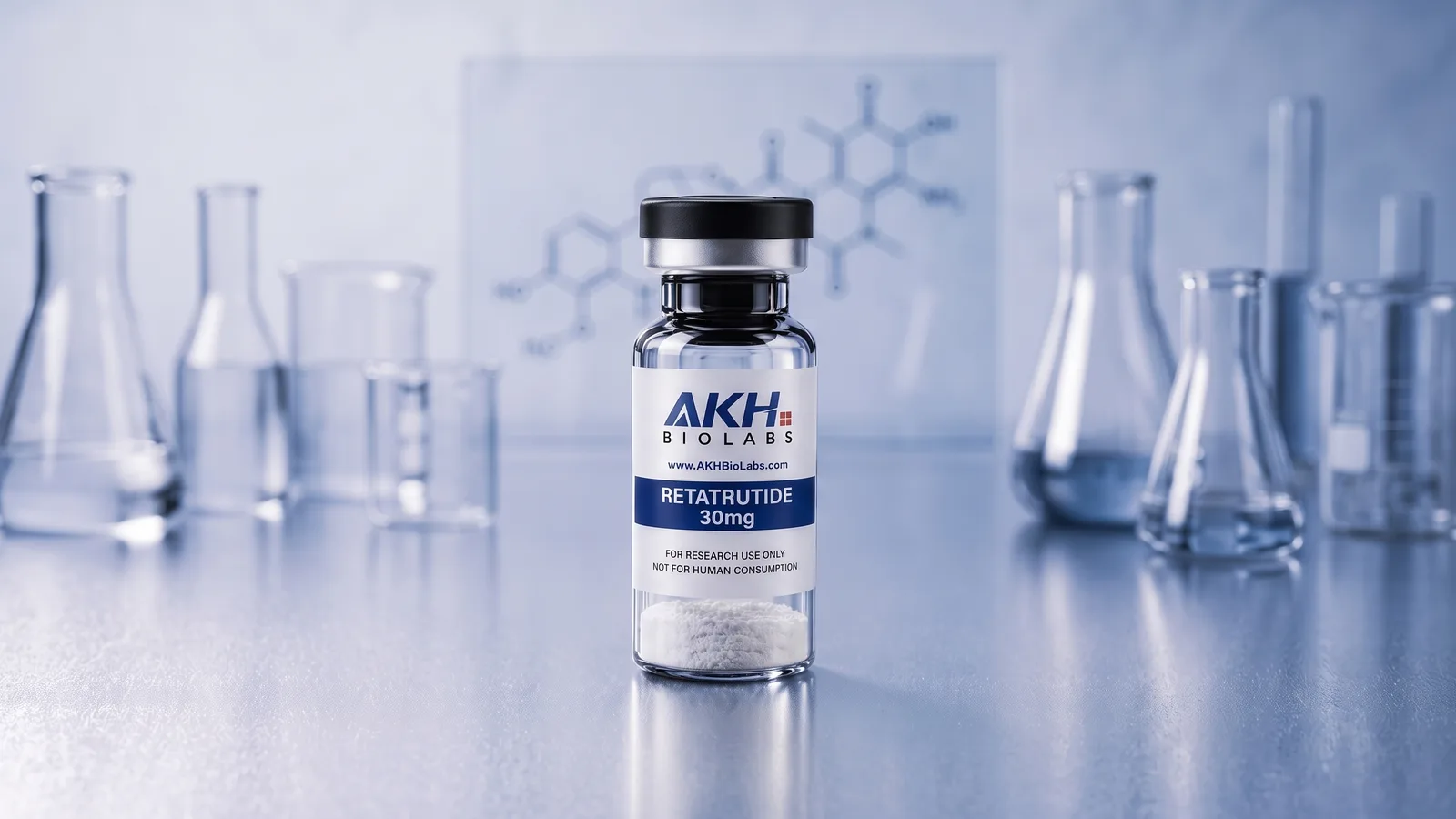
What is retatrutide used for? In the published record, retatrutide is used as an investigational research compound: a single peptide that activates three metabolic receptors, studied in laboratory and clinical research settings for metabolic endpoints rather than as an approved medicine. The AKH BioLabs research record states that as of August 2026 retatrutide was not an approved medicine in any jurisdiction.
That distinction shapes every comparison with tirzepatide, and it also frames the search phrase switching from tirzepatide to retatrutide, which describes a transition the published literature does not document. Tirzepatide is an approved prescription medicine in several jurisdictions with a large clinical literature; retatrutide remains in phase 3 development. This article is written for laboratory researchers and evidence-focused readers who want to know what retatrutide is studied for and how the published literature positions it against tirzepatide, without preparation or handling guidance. The full citation list lives on the retatrutide research record, and this post links there rather than restating it.
Key takeaways
- Retatrutide is an investigational single-peptide triple agonist of the GIP, GLP-1 and glucagon receptors, and is not an approved medicine in any jurisdiction as of August 2026.
- Tirzepatide is a dual GIP/GLP-1 agonist and an approved prescription medicine in several jurisdictions, with a much larger clinical literature.
- The two molecules target different receptor sets, so a finding reported for one does not describe the other.
- The published retatrutide record covers phase 1, phase 2 and one phase 3 readout, plus design papers for the ongoing TRIUMPH and TRANSCEND programmes.
- Switching from tirzepatide to retatrutide is not a documented research procedure; the two sit in different regulatory and evidence positions.
What retatrutide is studied for
Retatrutide, development code LY3437943, is described in the AKH BioLabs research record as an investigational single-peptide triple agonist of the GIP, GLP-1 and glucagon receptors. It was first described in preclinical rodent pharmacology and phase 1 studies in 2022, then in phase 2 randomised trials in obesity, type 2 diabetes and metabolic dysfunction-associated steatotic liver disease (MASLD, the current name for fatty liver disease not caused by alcohol).
The recurring themes in the literature are receptor pharmacology, dose-dependent body-weight change in phase 2 obesity trials, glycaemic control in type 2 diabetes, hepatic steatosis and liver fat content, body composition, cardiometabolic biomarkers, renal endpoints, appetite and eating-behaviour endpoints, gastrointestinal tolerability, and the design of the phase 3 registrational programme. Those themes describe what the compound is studied for, not what it is approved to treat.
The research record lists 15 published studies, 13 of them published since 2023, with the newest paper dated 2026. The record was last reviewed in August 2026.
Phase 2 obesity
A 48-week phase 2 randomised, double-blind, placebo-controlled trial in 338 adults with obesity reported a least-squares mean change in body weight of -24.2 percent in the 12 mg group compared with -2.1 percent with placebo.
Phase 2 type 2 diabetes
A 36-week phase 2 trial in 281 adults with type 2 diabetes reported an HbA1c change of -2.02 percent at 24 weeks with 12 mg versus -0.01 percent with placebo, and a 16.94 percent fall in body weight at 36 weeks against 3.00 percent with placebo.
MASLD liver fat
A phase 2a randomised, double-blind, placebo-controlled sub-study in 98 adults with MASLD reported relative liver fat content declines of -42.9 percent (1 mg), -57.0 percent (4 mg), -81.4 percent (8 mg) and -82.4 percent (12 mg) at 24 weeks, against +0.3 percent with placebo.
First phase 3 readout
A 40-week phase 3 double-blind randomised trial in 537 adults with type 2 diabetes reported a mean HbA1c change of -1.69 percent with retatrutide 4 mg versus -0.81 percent with placebo, with treatment differences across doses from -0.88 percent to -1.12 percent.
Is retatrutide better than tirzepatide? What the receptor difference means
Is retatrutide better than tirzepatide? The published record does not answer that question directly, because the two molecules have not been compared head to head in a randomised trial. What the record does establish is that they target different receptor sets, which is the reason a finding reported for one cannot be read across to the other.
Tirzepatide, development code LY3298176, is described in the AKH BioLabs research record as a synthetic 39-amino-acid peptide built on a glucose-dependent insulinotropic polypeptide (GIP) backbone, engineered to act as an agonist at both the GIP receptor and the glucagon-like peptide-1 (GLP-1) receptor. Retatrutide adds glucagon-receptor activity on top of GIP and GLP-1, a triple-agonist profile described in the cited literature.
The two compounds also sit in different regulatory positions. Tirzepatide is an approved prescription medicine for type 2 diabetes and for weight management in several jurisdictions, with a clinical literature spanning the SURPASS glycaemic-control programme, the SURMOUNT body-weight programme, and dedicated outcome trials. Retatrutide remains investigational, and the research record states that long-term safety, cardiovascular outcome data and durability of effect after discontinuation have not been established in published peer-reviewed reports.
| Feature | Retatrutide | Tirzepatide |
|---|---|---|
| Receptor targets | GIP, GLP-1 and glucagon (triple agonist) | GIP and GLP-1 (dual agonist) |
| Development code | LY3437943 | LY3298176 |
| Regulatory status | Investigational; not approved in any jurisdiction as of August 2026 | Approved prescription medicine for type 2 diabetes and weight management in several jurisdictions |
| Published studies cited in the AKH research record | 15 studies, 13 published since 2023, newest 2026 | 17 studies, 9 published since 2023, newest 2025 |
| Phase 3 programme | TRIUMPH-1 to TRIUMPH-4 and TRANSCEND; first readout published 2026 | SURPASS, SURMOUNT and dedicated outcome trials; SURPASS-CVOT reported 2025 |
| Head-to-head trial against the other | None published | None published |
Switching from tirzepatide to retatrutide: what the record shows
Switching from tirzepatide to retatrutide is a search phrase with no matching procedure in the published record. No study cited in either the retatrutide or the tirzepatide research record randomises participants from one compound to the other, and no switching protocol appears in the abstracts or design papers summarised there.
The closest published evidence on treatment change comes from within a single compound. The SURMOUNT-4 randomised-withdrawal trial in the tirzepatide record switched participants to placebo after a 36-week open-label lead-in: mean weight change from week 36 to week 88 was -5.5 percent with continued treatment versus +14.0 percent after the switch to placebo. That finding describes withdrawal from tirzepatide, not a transition to retatrutide, and the two are different questions.
The practical point for a research reader is that switching is not a documented research procedure. The evidence base for each compound is separate, the receptor profiles differ, and the regulatory positions differ. Any comparison drawn between them rests on the two separate literatures rather than on a study of the transition itself.
What the retatrutide evidence does not establish
The AKH BioLabs research record sets out the limits of the retatrutide evidence explicitly. Retatrutide remains investigational and unapproved; long-term safety, cardiovascular outcome data and durability of effect after discontinuation have not been established in published peer-reviewed reports.
As of August 2026 the TRIUMPH-1 to TRIUMPH-4 phase 3 obesity, sleep apnoea and osteoarthritis trials had published only rationale and design papers, with efficacy results disclosed by the sponsor as topline announcements rather than peer-reviewed publications. The first phase 3 readout, a 40-week trial in 537 adults with type 2 diabetes, was published in 2026.
The tirzepatide record carries its own limitations, which matter for any comparison. Almost all of the pivotal literature was funded and conducted by the manufacturer, and independent replication outside that programme remains limited. SURPASS-CVOT established non-inferiority to dulaglutide for major adverse cardiovascular events but did not demonstrate superiority, and no placebo-controlled cardiovascular outcome trial has been published. Comparative evidence between dual and triple incretin receptor agonists is sparse.
Reading the two evidence records side by side
Both compounds have a dedicated evidence record on this site, and each lists its studies ordered by strength of study design, then by recency. The retatrutide record covers 15 studies; the tirzepatide record covers 17. Each entry links to its source record so a finding can be checked against the paper rather than taken on trust.
The records are the right place to check a specific figure, because they carry the study design, the population, the duration and the reported result for each entry. This post answers the what-is-it-used-for question and the tirzepatide comparison; it does not restate the citation lists, and it does not re-argue the evidence.
One further distinction is worth holding onto. The material supplied by AKH BioLabs for both compounds is a lyophilised research compound for laboratory use, not a medicine. The certificates published for each batch are test reports from a named laboratory outside AKH, ordered by the manufacturer and shown as issued. A certificate documents a batch; it does not change a compound's regulatory status.
- 01
Check the regulatory position first
Retatrutide is investigational and unapproved as of August 2026; tirzepatide is an approved medicine in several jurisdictions. That difference frames every other comparison.
- 02
Check the receptor profile
Retatrutide is a triple agonist at GIP, GLP-1 and glucagon; tirzepatide is a dual agonist at GIP and GLP-1. A finding for one does not describe the other.
- 03
Check whether a head-to-head trial exists
No randomised trial has compared the two compounds directly, so any ranking between them rests on separate literatures rather than a controlled comparison.
- 04
Check the study design and population
Figures differ between trials because the populations, comparators and durations differ. The research records carry those details for each entry.
- 05
Check the batch documentation separately
A certificate of analysis reports measurements for one batch. It answers a different question from the one about what a compound is studied for.
Common questions.
- What is retatrutide used for in published research?
It is studied as an investigational triple agonist of the GIP, GLP-1 and glucagon receptors. The published record covers phase 1 and phase 2 trials in obesity, type 2 diabetes and MASLD, plus design papers for the phase 3 TRIUMPH and TRANSCEND programmes. The AKH BioLabs research record states that as of August 2026 retatrutide was not an approved medicine in any jurisdiction.
- Is retatrutide better than tirzepatide?
The published record does not answer that directly, because no randomised trial has compared the two head to head. They target different receptor sets: tirzepatide is a dual GIP/GLP-1 agonist and an approved medicine, while retatrutide adds glucagon-receptor activity and remains investigational. Any ranking between them rests on separate literatures rather than a controlled comparison.
- Is switching from tirzepatide to retatrutide a documented research procedure?
No. No study cited in either the retatrutide or the tirzepatide research record randomises participants from one compound to the other, and no switching protocol appears in the summarised abstracts or design papers. The closest published evidence on treatment change comes from within a single compound, such as the SURMOUNT-4 randomised-withdrawal trial of tirzepatide.
- How many published studies does retatrutide have compared with tirzepatide?
The AKH BioLabs research record cites 15 published studies for retatrutide, 13 of them published since 2023, with the newest dated 2026. The tirzepatide record cites 17 studies, 9 published since 2023, with the newest dated 2025. Each record orders its entries by strength of study design, then by recency.
- Does a certificate of analysis change a compound's regulatory status?
No. A certificate is a test report from a named laboratory outside AKH, ordered by the manufacturer, and it documents measurements for one batch. Regulatory status is a separate matter: the research record states that retatrutide was not an approved medicine in any jurisdiction as of August 2026, and a batch certificate does not alter that.
Sources
- 01Safety and Efficacy of Approved and Unapproved Peptide Therapies for Musculoskeletal Injuries and Athletic Performance.
- 02Injectable Peptide Therapy: A Primer for Orthopaedic and Sports Medicine Physicians.
- 03Buy Retatrutide 30mg (GLP-3, Reta): Price & COA · AKH BioLabs
- 04Retatrutide research — published studies and evidence · AKH BioLabs
- 05Buy Tirzepatide 30mg (GLP-2T): Batch COA · AKH BioLabs
- 06Tirzepatide research — published studies and evidence · AKH BioLabs