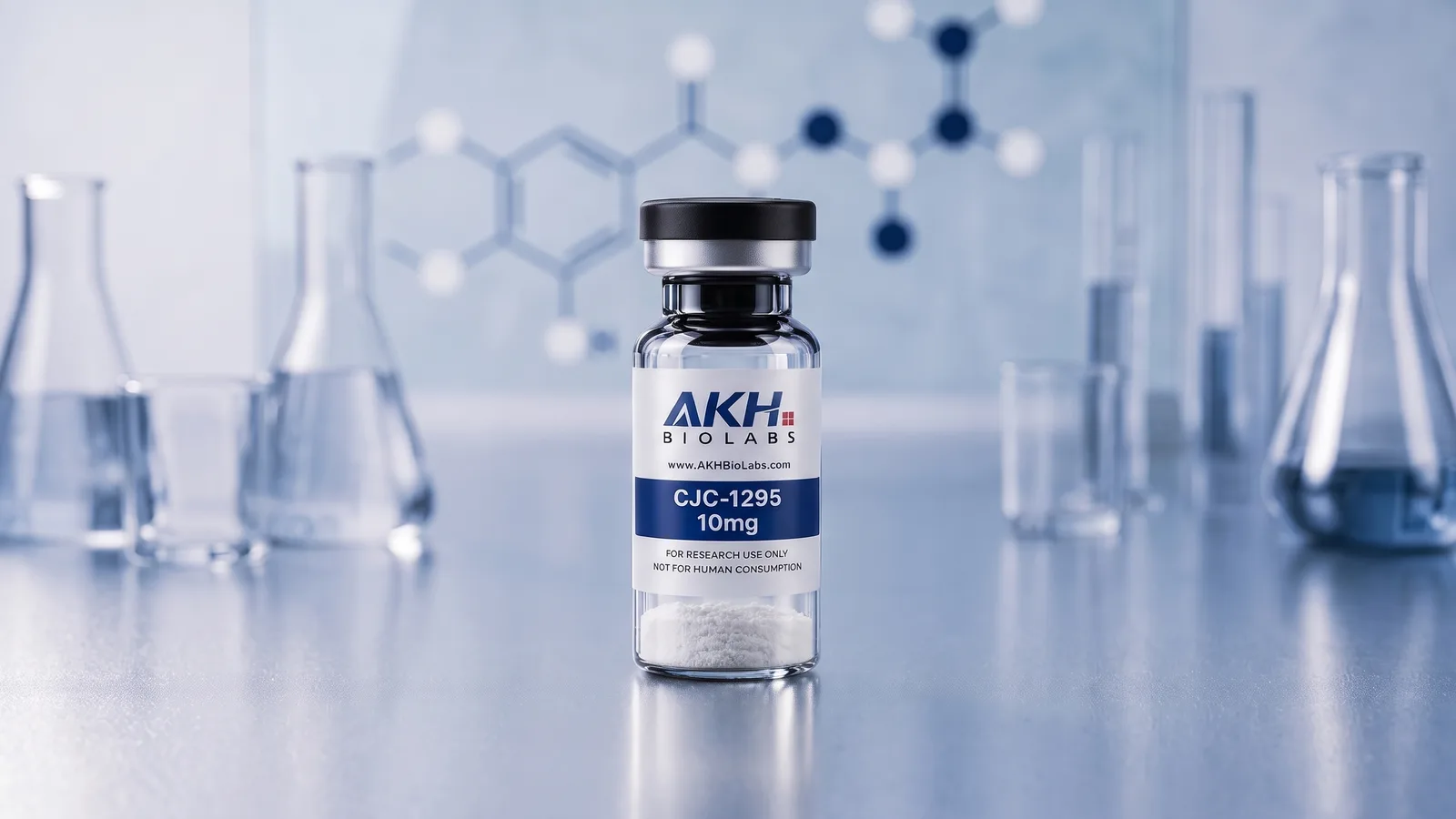
Best cjc 1295: how to choose for research
A buyer's guide to choosing CJC-1295 for laboratory research: confirm the form, the 10mg fill, the certificate fields and the delivery terms before ordering, and see where the AKH BioLabs page publishes each one.
For laboratory research, the checks that can be made before an order is placed are the form, the fill and the certificate. This guide sets out those checks for the no-DAC presentation and shows where the CJC-1295 product page publishes the form, fill and certificate.
It is written for laboratory buyers comparing research-use-only listings, not for anyone seeking a medicine. CJC-1295 is an unapproved research material, and the checks below concern documentation rather than a medical claim.
Key takeaways
- The name CJC-1295 covers two constructs: the DAC form, which carries a drug affinity complex, and the no-DAC form, also written Modified GRF 1-29.
- The AKH BioLabs page describes a 10mg lyophilised powder with a stated purity of 99.94% marked HPLC verified and formula C152H252N44O42.
- A certificate of analysis (COA) is one report for one batch, issued by a named laboratory outside AKH on a report ordered by the manufacturer.
- A chromatographic purity figure does not resolve the difference between powder mass and peptide mass.
- The retrieved page text states worldwide delivery in 9 to 14 days and does not print a storage temperature, so that field is read on the page before ordering.
What the name CJC-1295 covers
CJC-1295 is a synthetic analogue of growth hormone-releasing hormone (GHRH), built on the first 29 amino acids of the native hormone. The product page describes the supplied vial as the no-DAC form, also written Modified GRF 1-29, and states that it is supplied as 10mg lyophilised powder for laboratory research.
The DAC form is a different construct. It carries a drug affinity complex, a maleimide group that binds covalently to circulating albumin, and the research record describes that linker as extending the plasma half-life to roughly one to two weeks. The no-DAC form lacks the linker and clears far faster.
The 2006 paper cited below describes CJC-1295 as a long-acting GHRH analog and reports an estimated half-life of 5.8 to 8.1 days for the construct it studied. The product page cautions that those published DAC pharmacokinetics should not be read onto the no-DAC form.
The four checks on a CJC-1295 listing
A checkable listing answers four questions in public: which form is supplied, what the stated fill and purity are, which certificate covers the product, and what delivery and storage terms apply.
The form is the first check because the two constructs are not interchangeable. The AKH BioLabs page names the no-DAC form and gives the formula C152H252N44O42, so the identity line can be compared with the certificate before an order.
The fill is the second check. The page states 10mg, and the purity figure beside it is 99.94% marked HPLC verified. Those are separate fields: the 10mg describes the presentation, and the percentage records a chromatographic measurement for a batch.
The certificate is the third check. The page states that a Certificate (COA) from a named outside laboratory is on the page, and the archive describes each row as one Certificate for one batch, tested once, by a named laboratory outside AKH, on a report ordered by the manufacturer.
Delivery and storage are the fourth check. The page states worldwide delivery in 9 to 14 days. The retrieved text does not print a storage temperature, so that term is read on the page rather than inferred from the powder form.
Reading the certificate and the purity figure
A certificate of analysis (COA) is a report from a named laboratory outside AKH, ordered by the manufacturer, and published for one batch. It is not a regulatory approval and it does not describe a product line as a whole.
The fields that make the report checkable are the product name, the batch number, the test date, the issuing laboratory and the reported measurement. A document that gives a percentage without a batch number cannot be tied to a container.
The purity figure needs its scope stated. The research record notes that lyophilised peptide is normally supplied as an acetate or trifluoroacetate salt and carries residual water, so the mass of powder in a vial is not the same quantity as the molecular weight would suggest. Chromatographic purity does not resolve that difference.
That is why the 99.94% figure on the listing is read as a chromatographic measurement for a batch, not as a statement that 99.94% of the vial mass is CJC-1295. The listing gives size, purity and formula; the mass of peptide in the vial is a separate measurement.
Storage, delivery and the limits of a listing
Storage is a field the retrieved product page leaves implicit. The AKH BioLabs page states worldwide delivery in 9 to 14 days, which is a shipping term, and the retrieved text does not print a holding temperature. Until the page states a holding temperature, the storage question remains open for anyone comparing listings.
Delivery is a commercial term rather than a quality claim. It states reach and timing, not identity or purity, and it belongs beside the certificate fields rather than in place of them.
The listing also states that the material is for laboratory research and not for human or veterinary use. That intended-use statement is separate from the certificate: one describes the category of supply, the other records measurements for a batch.
What the listing and certificate do not establish is a clinical claim, an approval, or the mass of peptide in the vial. Those questions are outside the document set, and the research record sets out the published evidence and its limits.
Where the AKH BioLabs page shows each check
The CJC-1295 product page is the place where the listing facts sit together: the no-DAC form, the 10mg fill, the 99.94% purity figure marked HPLC verified, the formula C152H252N44O42, the certificate statement and the worldwide delivery window.
The COA archive at /lab/coa is the second place to look. It presents every published Certificate as one row, so the batch number, test date, laboratory and purity figure can be compared with the product page.
The research record at /research/cjc-1295 is the third. It separates the two constructs, describes the published evidence and states what the literature does not establish, which is the context a buyer needs before treating a certificate as more than a batch measurement.
For a laboratory order, the sequence is: confirm the form, read the fill and purity as separate fields, match the certificate to the product, then confirm delivery terms on the page. The product link above is the starting point for those checks.
Common questions.
- How can a buyer tell whether a CJC-1295 listing is the DAC or no-DAC form?
Read the identity line and the certificate, not the family name. The AKH page names the no-DAC form and gives Modified GRF 1-29 as the alternative writing. The DAC form carries a drug affinity complex that binds albumin, and the research record keeps the two as separate constructs.
- What does the CJC-1295 certificate from a named outside laboratory actually cover?
One batch. The archive describes each row as one Certificate, one batch, tested once, by a named laboratory outside AKH, on a report ordered by the manufacturer. It does not cover the product line as a whole, and it is not an approval.
- Does the AKH BioLabs CJC-1295 page state a storage temperature?
The retrieved page text states worldwide delivery in 9 to 14 days and does not print a storage temperature. The powder form alone does not settle the holding condition, so that field is read on the page before an order.
- Why does the CJC-1295 research record separate the DAC and no-DAC forms?
Because the published human data concern the DAC form. The research record states that human data are confined to a small number of phase I and phase II studies of the DAC form conducted in 2005 to 2009, and that no peer-reviewed randomised controlled trial of the non-DAC form was located. The product page adds that DAC pharmacokinetics should not be read onto the no-DAC form.
Sources
- 01CJC 1295 Buy 10mg: COA · AKH BioLabs
- 02CJC-1295 research: published studies · AKH BioLabs
- 03COA archive — every published Certificate · AKH BioLabs
- 04Prolonged stimulation of growth hormone (GH) and insulin-like growth factor I secretion by CJC-1295, a long-acting analog of GH-releasing hormone, in healthy adults.