Best cjc 1295 plus ipamorelin: a buyer's checks for research
A buying guide to CJC-1295 + Ipamorelin for laboratory research: which form and fill to confirm, which certificate fields to read, what storage and delivery terms the listing states, and where AKH BioLabs publishes each one.
The best cjc 1295 plus ipamorelin for laboratory research is the listing whose form, blend mass, batch certificate and storage terms can all be checked against a public document before payment. The compound name alone does not settle any of those four points: it does not say which CJC-1295 construct is in the vial, what the 10mg figure covers, or which batch the published report describes.
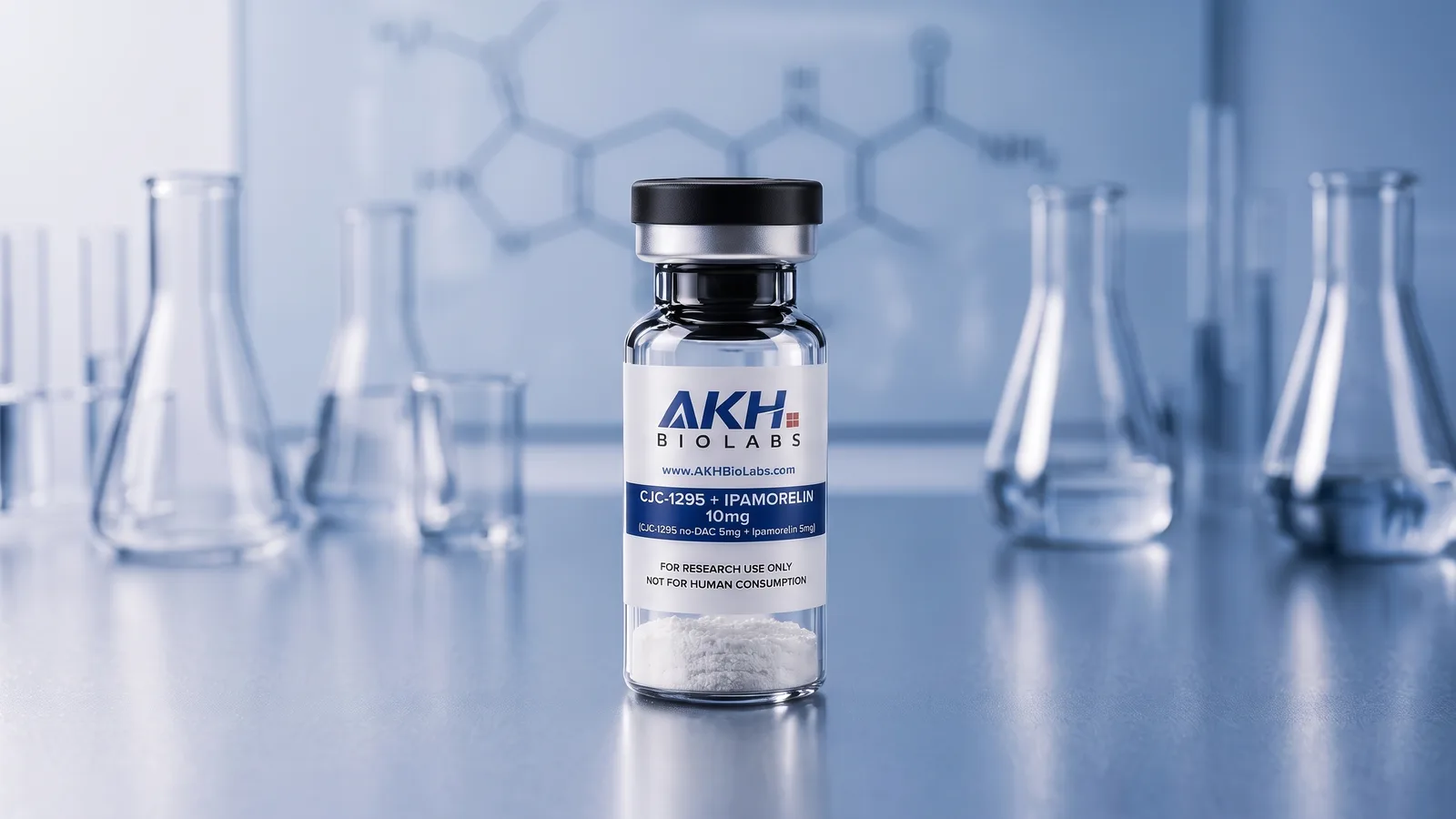
AKH BioLabs lists the pairing as CJC-1295 + Ipamorelin, a 5mg + 5mg lyophilised blend with a certificate published for batch 26085. This guide is written for laboratory buyers comparing research-use-only listings: the material discussed is supplied for research purposes only, and nothing below concerns human use.
Key takeaways
- The name covers two molecules: CJC-1295 without DAC (also written Modified GRF 1-29) and ipamorelin, co-lyophilised 5mg + 5mg for 10mg total.
- For batch 26085, the report from the Brown Institute of Biomolecular Research records a test date of 05 Aug 2026 and a purity of 99.58%.
- The results line pairs a 10mg blend mass with a separate purity figure; the line states two measurements, not one.
- Storage terms are stated on the listing: minus 20 °C for the sealed lyophilised vial, 2 to 8 °C for the solution form, protected from light, 28 days.
- No peer-reviewed clinical trial of the two peptides together was identified; the evidence record is component-level and sits at /research/cjc-1295-plus-ipamorelin.
What the vial contains, and which CJC-1295 the name covers
The listing describes a dual growth hormone secretagogue blend. CJC-1295 without DAC, also written Modified GRF 1-29, acts at the pituitary GHRH receptor; ipamorelin is an agonist at the ghrelin receptor GHS-R1a. The two are co-lyophilised in a 1:1 mass ratio, 5mg of each for 10mg total, and lyophilised here means the freeze-dried solid the vial ships as rather than a solution.
The form declaration is the first field to read, because the CJC-1295 name covers more than one molecule. The research record notes that reviews of this literature record the frequent substitution of unmodified CJC-1295 for the DAC-modified analogue that was actually studied, so a listing that writes CJC-1295 without saying which construct it supplies leaves the identity question open. Writing the form into the product name is what closes it.
Two receptors in one vial is the design rationale the product page gives: the GHRH analogue supplies the releasing signal and the secretagogue acts on the same pituitary cell through a separate receptor. That sentence describes a research design, not an outcome, and it is the reason the pair is studied together rather than either peptide alone.
Size and purity are separate fields on the same line
The page states the presentation as 5mg + 5mg, and the certificate results line restates it as a combined figure: "CJC1295(without DAC)+IPA: 10mg | Purity: 99.58%". That line carries two measurements. The 10mg is the blend mass; the 99.58% is the laboratory's purity result for batch 26085.
The archive is explicit that reading those numbers is a separate exercise from knowing what they cannot establish, and it points to the certificate guide and the lab glossary for that reading. The useful part for a buyer is narrower: a named laboratory measured one identified batch and recorded both figures on one report, which is what makes the line checkable rather than decorative.
The page labels the test HPLC verified. It does not report a net peptide content for either component, so the purity figure and the 5mg + 5mg fill answer different questions and should not be merged into a single claim about how much peptide sits in the vial.
Reading the certificate for batch 26085
The verification block on the product page gives five fields: batch 26085, test date 05 Aug 2026, task reference #1812381, purity 99.58%, and the results string "CJC1295(without DAC)+IPA: 10mg | Purity: 99.58%". The issuing laboratory is named as the Brown Institute of Biomolecular Research, and the block links to the full report.
The page also describes what that document is: a test report from a named laboratory outside AKH, ordered by the manufacturer and shown exactly as the laboratory issued it, with a printed copy in every parcel. The archive describes the same arrangement row by row, one certificate for one batch, tested once. The archive row for this product repeats the batch, the purity, the test date and the laboratory, so the two pages can be read against each other before payment.
The single-compound listings carry their own reports, and the difference matters to a blend buyer.
| Listing | Batch | Purity | Test date | Laboratory |
|---|---|---|---|---|
| CJC-1295 + Ipamorelin | 26085 | 99.58% | 05 Aug 2026 | Brown Institute of Biomolecular Research |
| CJC-1295 (separate listing) | 26082 | 99.94% | 02 Aug 2026 | Brown Institute of Biomolecular Research |
| Ipamorelin (separate listing) | 26102 | 99.58% | 29 Jul 2026 | Brown Institute of Biomolecular Research |
Storage and delivery terms the listing states
The listing states minus 20 °C for the sealed lyophilised vial and 2 to 8 °C for the solution form, protected from light, with 28 days given as the window for the solution. Those are holdings conditions a buyer can read before ordering, and they belong to the page rather than to the certificate: the certificate block carries batch, date, task reference, purity and results, and the storage terms are stated separately.
Delivery is stated as worldwide in a 9 to 14 day window, and the product is shown as in stock. Shipping terms describe reach and timing. They are commercial statements, and they sit beside the batch record rather than substituting for it.
Read together, the two sets of terms answer different questions: storage says how the material is held, delivery says how it travels, and neither says anything about identity or purity. Those come from the certificate block in the previous section.
What the evidence record covers, and what it leaves open
The research record states that no peer-reviewed clinical trial in which CJC-1295 and ipamorelin were studied together was identified, and that a PubMed query intersecting both names returned only narrative reviews, doping-control analytical methods and product-quality analyses. The available evidence is component-level, built from separate studies of each peptide and from older human work on growth hormone-releasing hormone combined with a growth hormone-releasing peptide.
The same record adds two points that bear directly on a purchase. The principal human dataset for the CJC-1295 component used the DAC-modified analogue rather than the unmodified fragment, and mass-spectrometric analysis of illicitly marketed growth-promoting preparations has found discrepancies between declared and actual content. Both are reasons the form, the batch number and the laboratory name are the fields worth checking.
The record cites 15 published studies, 5 of them from 2023 onward, and was last reviewed in August 2026. It is the place to read the studies; this article does not restate them, and the studies themselves do not turn a batch certificate into a statement about activity.
Where each field sits on the AKH BioLabs page
The four checks map onto four places. The form and fill appear in the headline specification; the certificate block appears further down with batch, task reference and results string; the archive repeats the row at /lab/coa; and the storage and delivery terms appear alongside the supply details.
The listing is CJC-1295 + Ipamorelin, and every field above is readable there without contacting the seller. That is the standard the page is being held to here, not a claim that any listing is the best available: the fields are public, the archive is public, and the comparison remains the buyer's to make.
Each check can also be repeated once the material is in hand, against the batch recorded on the certificate supplied with the parcel and the report published for that batch. A batch number that matches is what ties the measurement to the material in hand; a purity figure without a matching batch describes something else.
- 01
Confirm the form
Look for CJC-1295 without DAC, also written Modified GRF 1-29, named beside ipamorelin in the same specification.
- 02
Confirm the fill
5mg + 5mg, 10mg total, stated as a 1:1 mass ratio.
- 03
Read the certificate block
Batch 26085, tested 05 Aug 2026 by the Brown Institute of Biomolecular Research, purity 99.58%, with the results line carrying the 10mg blend mass.
- 04
Cross-check the archive
The same batch, purity, test date and laboratory appear as one row at /lab/coa.
- 05
Read the storage and delivery terms
Minus 20 °C for the sealed vial; 2 to 8 °C for the solution form, protected from light, 28 days; worldwide delivery in a 9 to 14 day window.
Common questions.
- What should be checked before buying CJC-1295 + Ipamorelin for research?
Four fields: the CJC-1295 form (without DAC, also written Modified GRF 1-29), the fill (5mg + 5mg for 10mg total), a certificate published for that exact product with a batch number, test date and named outside laboratory, and the storage and delivery terms stated on the listing. The AKH BioLabs page states all four for batch 26085.
- Which batch does the published CJC-1295 + Ipamorelin certificate cover?
Batch 26085, tested 05 Aug 2026 by the Brown Institute of Biomolecular Research at a stated purity of 99.58%, with task reference #1812381. The results string reads "CJC1295(without DAC)+IPA: 10mg | Purity: 99.58%", and the same batch appears as one row in the archive at /lab/coa.
- Does the 5mg+5mg size state how much of each peptide the vial holds?
Yes. The page states a 1:1 mass ratio, 5mg of CJC-1295 without DAC and 5mg of ipamorelin, for 10mg total. The certificate results line gives the combined 10mg figure and a separate purity result; it does not report a net peptide content for either component.
- How should lyophilised CJC-1295 + Ipamorelin be stored according to the listing?
The page states minus 20 °C for the sealed lyophilised vial and 2 to 8 °C for the solution form, protected from light, with 28 days stated for the solution. Those are the listing's stated terms. The certificate block reports batch, test date, task reference, purity and results, and does not itself carry a storage instruction.