Bestseller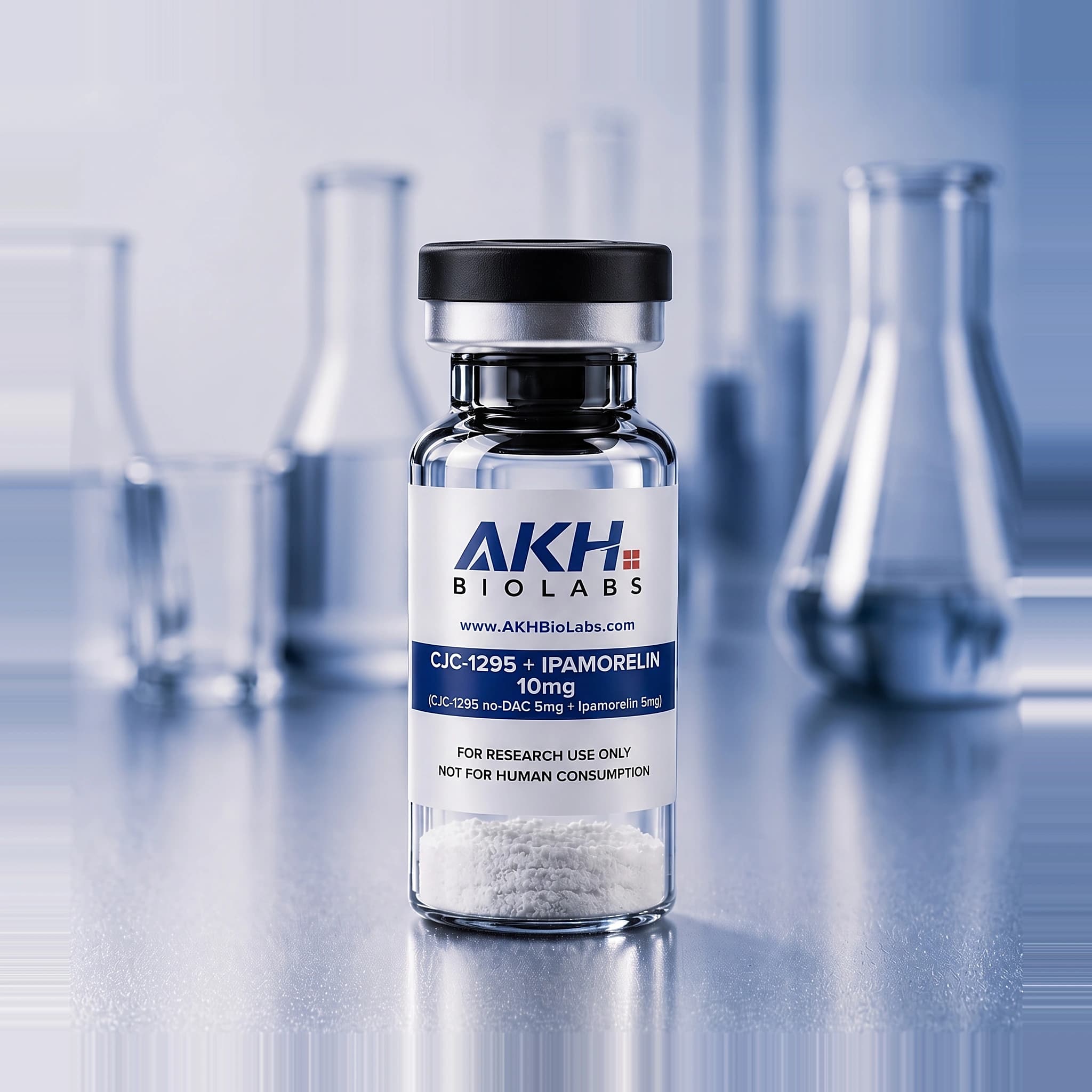
Hormones· Bestseller
In stockCJC-1295 + Ipamorelin
Dual GH Secretagogue Blend
CJC-1295 no DAC and Ipamorelin are supplied as a 5mg + 5mg lyophilised blend for laboratory research. Price is shown in your currency, and its Certificate from a named outside laboratory is published on this page. Not for human or veterinary use.
Size5mg+5mgPurity99.58%
A single-vial pairing of CJC-1295 without DAC (a GHRH receptor analogue) and Ipamorelin (a ghrelin receptor agonist) — the two peptides act on separate but complementary pituitary pathways. In research models the combination is studied for producing larger, cleaner growth-hormone pulses than either compound alone, with no meaningful cortisol or prolactin elevation reported.
€80
Quantity
HPLC verified
9–14 day shipping
Full COA
Worldwide delivery
About this compound
The research profile.
This vial contains two peptides co-lyophilised in a 1:1 mass ratio: 5 mg of CJC-1295 (no-DAC, also written Modified GRF 1-29) and 5 mg of ipamorelin, for 10 mg total. The pairing exists because the two molecules reach growth hormone release through separate receptors — CJC-1295 at the pituitary GHRH receptor, ipamorelin at the ghrelin receptor GHS-R1a.
The rationale traces back to human work from 1990 showing that a growth hormone-releasing peptide and GHRH given together stimulated GH release synergistically, with submaximal doses of each producing more than the sum of their separate effects. Subsequent literature on both classes has kept that combined design as a standard comparator: a GHRH analogue supplies the releasing signal while a secretagogue amplifies the somatotroph response.
Because both components are cleared within hours — the no-DAC construct lacks the albumin-binding group that extends the DAC version to a multi-day half-life, and ipamorelin's terminal half-life is reported at roughly two hours — the combination produces a short pulse rather than a sustained elevation. Published work also reports that GH secretion remains pulsatile even under continuous GHRH-receptor stimulation.
Published research
15 peer-reviewed studies on CJC-1295 + Ipamorelin are summarised in our research library, including 5 published since 2023 — with study designs, reported findings and what the evidence does not establish.
Read the CJC-1295 + Ipamorelin evidence baseFor research purposes only. Not for human consumption, diagnosis, treatment, or prevention of any condition.
Categorised as Hormones — GH secretagogues, recombinant GH and gonadotropins.
Dosing at a glance
What the literature reports.
For research and laboratory use only. Not for human consumption.
Route
Subcutaneous
Frequency
1–2x daily (study protocols)
Reported range
100–300 mcg
Protocol duration
4–12 weeks
100 mcgcombined mass per administration300 mcg
Figures on this page describe the combined draw, not each peptide separately. Because the vial is a 1:1 blend, a 200 mcg combined amount contains roughly 100 mcg of CJC-1295 and 100 mcg of ipamorelin; the calculator shows that split for whatever amount is entered. The per-component figures then sit inside the 100–300 mcg ranges reported for each peptide individually in the cited literature.
Ranges reflect protocols reported in the published literature on CJC-1295 + Ipamorelin — see research citations.
Calculate a dilutionReconstitution & storage
From powder to solution.
- Step 01
Add 2 ml bacteriostatic water
Aim the stream at the vial wall rather than the powder.
- Step 02
Swirl gently — never shake
Rotate the vial until the solution runs clear. Agitation degrades the peptide.
- Step 03
Refrigerate at 2–8 °C
Reconstituted vials belong in the fridge, protected from direct light.
- Step 04
Use within 28 days
Discard any remainder once the stability window closes.
Lyophilised · −20 °CReconstituted · 2–8 °C, 28 days
The 10 mg total mass (5 mg + 5 mg) in 2 ml gives 5 mg/ml combined, or 2.5 mg/ml of each component. Reconstituted solution is typically held at 2–8 °C and protected from light; sealed lyophilised vials are stored at -20 °C.
Reconstitution calculator
10 mg vialmg
ml
mcg
300 mcg = 0.3 mg
Draw
6units · U-100 insulin syringe
- Concentration
- 5 mg/ml
- Draws per vial
- 33
- Cost per draw
- €2.42
A draw at this setting contains approximately 0.15 mg CJC-1295 · 0.15 mg Ipamorelin.
For research and laboratory use only. Not for human consumption.
Laboratory arithmetic for CJC-1295 + Ipamorelin — enter the COA-verified vial content for exact figures. Not medical advice.
Effect timeline
Observed across the research window.
Milestones summarise findings reported in the cited studies. Outcomes vary across models and protocols.
Minutes 0–60
Two receptors, one pulse
Human work reports that submaximal doses of a growth hormone-releasing peptide combined with GHRH stimulate GH release synergistically — the observation the 1:1 blend design is built on.
Hours 2–6
Clearance of both components
Ipamorelin's terminal half-life is reported at about two hours, and the no-DAC GHRH construct lacks the albumin-binding group that extends the DAC version to days, so the combined signal is short-lived.
Week 2
Repeated-administration designs
Published work reports that pulsatile GH secretion persists under continuous GHRH-receptor stimulation, which is why repeated-administration study designs are generally structured around discrete pulses rather than continuous exposure.
Protocol end points
Comparator arms
Most published designs in this class compare a combined arm against each peptide alone, since the synergy claim only holds when both receptor pathways are engaged in the same protocol.
For research and laboratory use only. Not for human consumption.
Scientific research
The published evidence.
The dosing ranges and timeline milestones on this page summarise the peer-reviewed publications below.
References
- 01
Growth hormone (GH)-releasing peptide stimulates GH release in normal men and acts synergistically with GH-releasing hormone. J Clin Endocrinol Metab (1990). PubMed · 2108187
- 02
Ipamorelin, the first selective growth hormone secretagogue. Eur J Endocrinol (1998). PubMed · 9849822
- 03
Prolonged stimulation of growth hormone (GH) and insulin-like growth factor I secretion by CJC-1295, a long-acting analog of GH-releasing hormone, in healthy adults. J Clin Endocrinol Metab (2006). PubMed · 16352683
- 04
Pulsatile secretion of growth hormone (GH) persists during continuous stimulation by CJC-1295, a long-acting GH-releasing hormone analog. J Clin Endocrinol Metab (2006). PubMed · 17018654
Laboratory verification
One Certificate, published unaltered.
The Certificate is a test report from a named laboratory outside AKH, ordered by our manufacturer and shown here exactly as the laboratory issued it. A printed copy ships in every parcel.
- Batch
- 26085
- Test date
- 05 Aug 2026
- Task ID
- #1812381
- Purity
- 99.58%
Results
CJC1295(without DAC)+IPA: 10mg | Purity: 99.58%
Verified by Brown Institute of Biomolecular Research. Scan the full report for every measurement.
Product FAQ
Questions researchers ask.
Pairs well with
Frequently co-studied.
Compounds that appear alongside CJC-1295 + Ipamorelin in the research literature.
For research and laboratory use only. Not for human consumption.
From the blog
Further reading.
- Research notes
CJC no DAC vs CJC with DAC: what the difference is
CJC no DAC and CJC with DAC are two different molecules: the DAC version carries a drug affinity complex that binds albumin and extends its reported half-life to days, while the no-DAC form clears within hours. What the naming means, what the literature actually compared, and which form the published AKH batch record documents.
Read the post - Research notes
What does CJC-1295 do?
CJC-1295 is a synthetic analogue of growth hormone-releasing hormone that acts at the GHRH receptor. This post covers what that means, how CJC-1295 vs sermorelin differs, and what the CJC-1295 ipa pairing is, without dosing or outcome claims.
Read the post - Research notes
CJC-1295 DAC vs CJC-1295 no DAC
The DAC and no-DAC forms of CJC-1295 are different molecules with different published evidence, and a batch certificate of analysis is the document that states which one is in a vial.
Read the post
Hormones