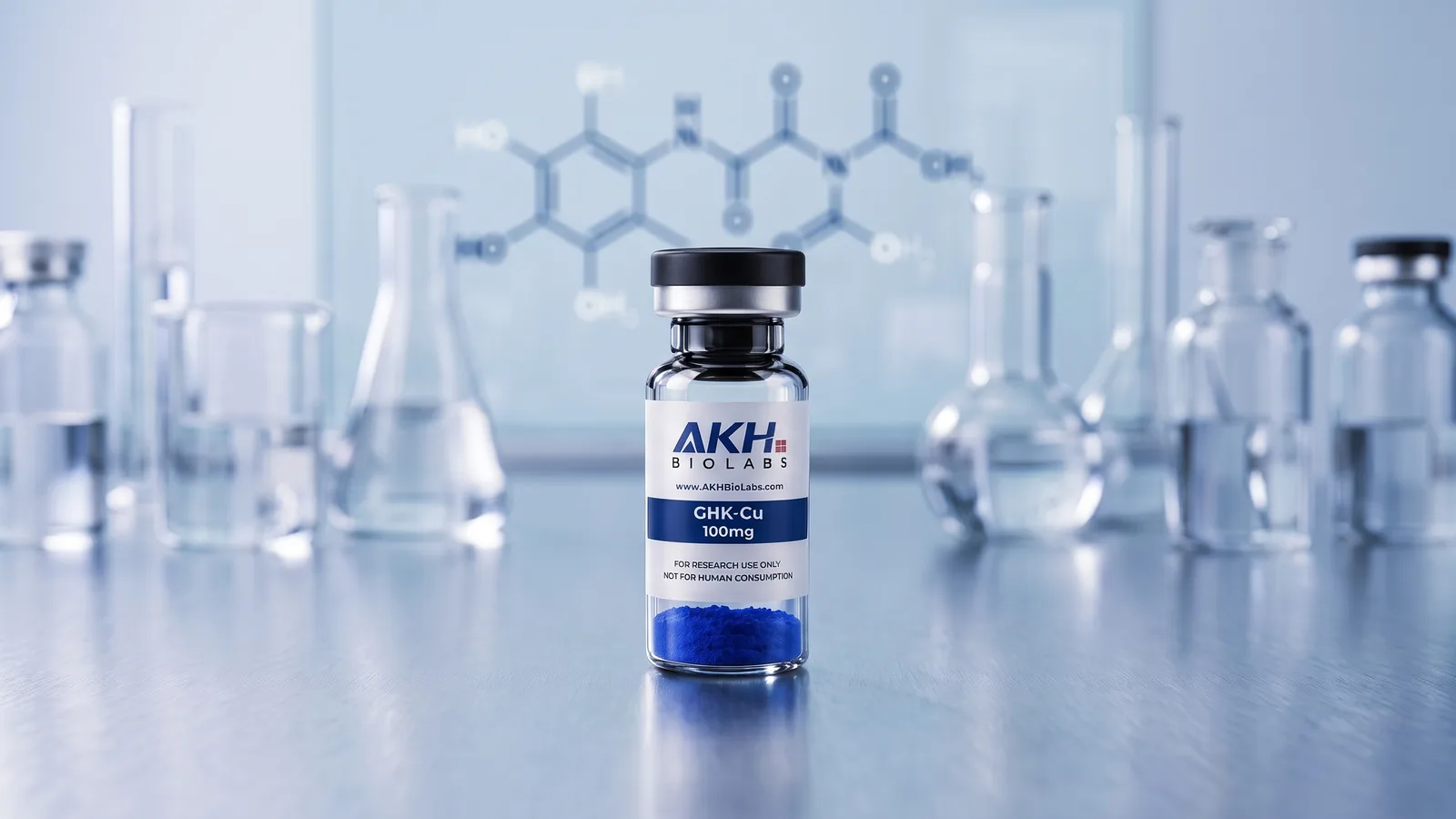
Best ghk cu: how to choose a GHK-Cu listing for laboratory research
A buyer's guide to the best ghk cu listing for laboratory research: the identity fields, the 100mg fill read against the 99.64% purity result, the Certificate for batch 26155, and the storage and delivery terms to confirm before ordering.
The best ghk cu choice for laboratory research is the listing whose identity, stated fill, batch Certificate and storage terms can all be read before an order is placed. That answer treats best as a documentation standard rather than a ranking of sellers, because every one of those fields can be checked on a public page.
This guide is written for laboratory buyers comparing GHK-Cu presentations for in-vitro work. It explains what to look for on a listing, then shows where the GHK-Cu 100mg page publishes the identity fields, the Certificate record, the storage question and the delivery window.
Key takeaways
- GHK-Cu is the copper(II) complex of glycyl-L-histidyl-lysine, so the copper ion belongs to the compound identity rather than to the presentation.
- The stated 100mg fill is a powder mass, while 99.64% is a chromatographic purity result for one batch; the two figures do not convert into each other.
- Batch 26155, tested 03 Aug 2026 by the Brown Institute of Biomolecular Research, is the row to match against the material on arrival.
- The listing states worldwide delivery in 9 to 14 days and supplies the material for laboratory research only.
What GHK-Cu is, and why the name has to carry the copper
GHK-Cu is the copper(II) complex of the tripeptide glycyl-L-histidyl-lysine. The research record gives the molecular formula C14H24CuN6O4, a free-base molecular weight of 403.92 g/mol, PubChem CID 378611 and Cu-GHK as an alternative writing. The product page prints the same formula and describes the compound as a naturally occurring complex of the tripeptide bound to a copper(II) ion.
Two naming checks matter at the buying stage. GHK on its own names the tripeptide without the copper ion, so a page that prints only GHK leaves the supplied complex unstated. AHK-Cu is a separate copper-binding tripeptide with a different sequence and a different research focus, and the research literature describes the two as distinct compounds rather than two grades of one.
The supplied form is 100mg of lyophilised powder for laboratory research. The page states that the material is not for human or veterinary use, which is an intended-use statement rather than a purity claim.
The 100mg fill and the 99.64% purity result answer different questions
The listing states 100mg of lyophilised powder and a purity of 99.64% marked HPLC verified. The two figures describe different quantities.
The research record explains the gap. Lyophilised peptide is normally supplied as an acetate or trifluoroacetate salt and carries residual water, so the mass of powder in a vial is not the same quantity as the molecular weight would suggest, and chromatographic purity does not resolve that difference either. The research record points to guidance on reading a certificate of analysis for that distinction.
The accurate reading records the 100mg as a powder mass and leaves peptide content unanswered. The listing reports no net peptide content figure, so the 100mg is read as the stated powder mass and the peptide content question is left open.
Reading the Certificate: batch 26155
The archive presents every published Certificate as one row: one batch, tested once, on a report ordered by the manufacturer. The page states that it holds 45 published reports in total.
For GHK-cu the row reads batch 26155, purity 99.64%, test date 03 Aug 2026, and laboratory Brown Institute of Biomolecular Research. The product page separately prints 99.64% as HPLC verified and states that a Certificate from a named outside laboratory is published on the page.
The batch number does the linking work. Comparing 26155 with the batch stated on the material ties the measurement to a container, and the laboratory name and test date are read at the same time, because a figure with no issuer and no date cannot be traced back to anything.
Storage terms and the delivery window the listing states
The supplied form is a lyophilised powder, and the product page carries a storage question in its product FAQ. The retrieved page text prints the question without the answer, so the holding condition is confirmed on the page itself rather than inferred from the powder form or from another product's listing.
Delivery is the second commercial term. The page states worldwide delivery in 9 to 14 days, which supplies both a scope and a window to test against the destination country before payment. A window without a scope answers only half the question, and neither half is a quality claim about the batch.
The intended-use statement is the third. The page states that the material is for research purposes only and is not for human consumption, diagnosis, treatment, or prevention of any condition.
What the published GHK-Cu record covers, and what it leaves open
The research record collects the published work rather than arguing it on this page. It lists 15 studies, 10 of them since 2023, with the newest dated 2026, and orders the entries by strength of study design then by recency.
The record describes controlled human evidence as thin and inconsistent. A 2026 PRISMA systematic review searching from database inception located only 20 studies of GHK-Cu as a standalone aesthetic intervention, of which 18 were preclinical and 2 were randomised controlled trials. The record's limitations section states that most published work is in vitro or in animal models, and that the small number of controlled human trials of topical GHK-Cu have produced mixed results.
Where the AKH BioLabs page shows each check
Every field above appears on the GHK-Cu 100mg page: the formula and the 100mg size in the product information block, the 99.64% figure marked HPLC verified beside them, the Certificate reference, the research-use-only statement and the worldwide delivery window.
The same batch appears as one row in the COA archive, so the product page and the archive can be read against each other before an order is placed, and the archive is also where a buyer cross-checks the batch number after delivery.
Common questions.
- What should a laboratory buyer check first on a GHK-Cu listing?
Start with the identity line. GHK-Cu is the copper(II) complex of glycyl-L-histidyl-lysine, formula C14H24CuN6O4, PubChem CID 378611. A listing that prints only GHK leaves the copper complex unstated. The stated size and the Certificate fields are read next.
- How is batch 26155 matched to the GHK-Cu vial that arrives?
The batch number is the linking field. The published record names batch 26155, tested 03 Aug 2026 by the Brown Institute of Biomolecular Research at a stated purity of 99.64%. Comparing that number with the batch on the material ties the report to the container, and the laboratory and test date are read on the same row.
- What does the 100mg figure on the GHK-Cu listing measure?
It is the stated powder mass for the presentation. The 99.64% figure beside it is a chromatographic purity result for one batch, and the research record notes that salt form and residual water mean the powder mass and the peptide mass are different quantities. The listing reports no net peptide content figure.
- Which studies does the GHK-Cu research record count, and how does it grade them?
The record lists 15 studies, 10 since 2023, ordered by strength of study design then recency. It also notes a 2026 PRISMA systematic review that located only 20 studies of GHK-Cu as a standalone aesthetic intervention, of which 18 were preclinical and 2 were randomised controlled trials.