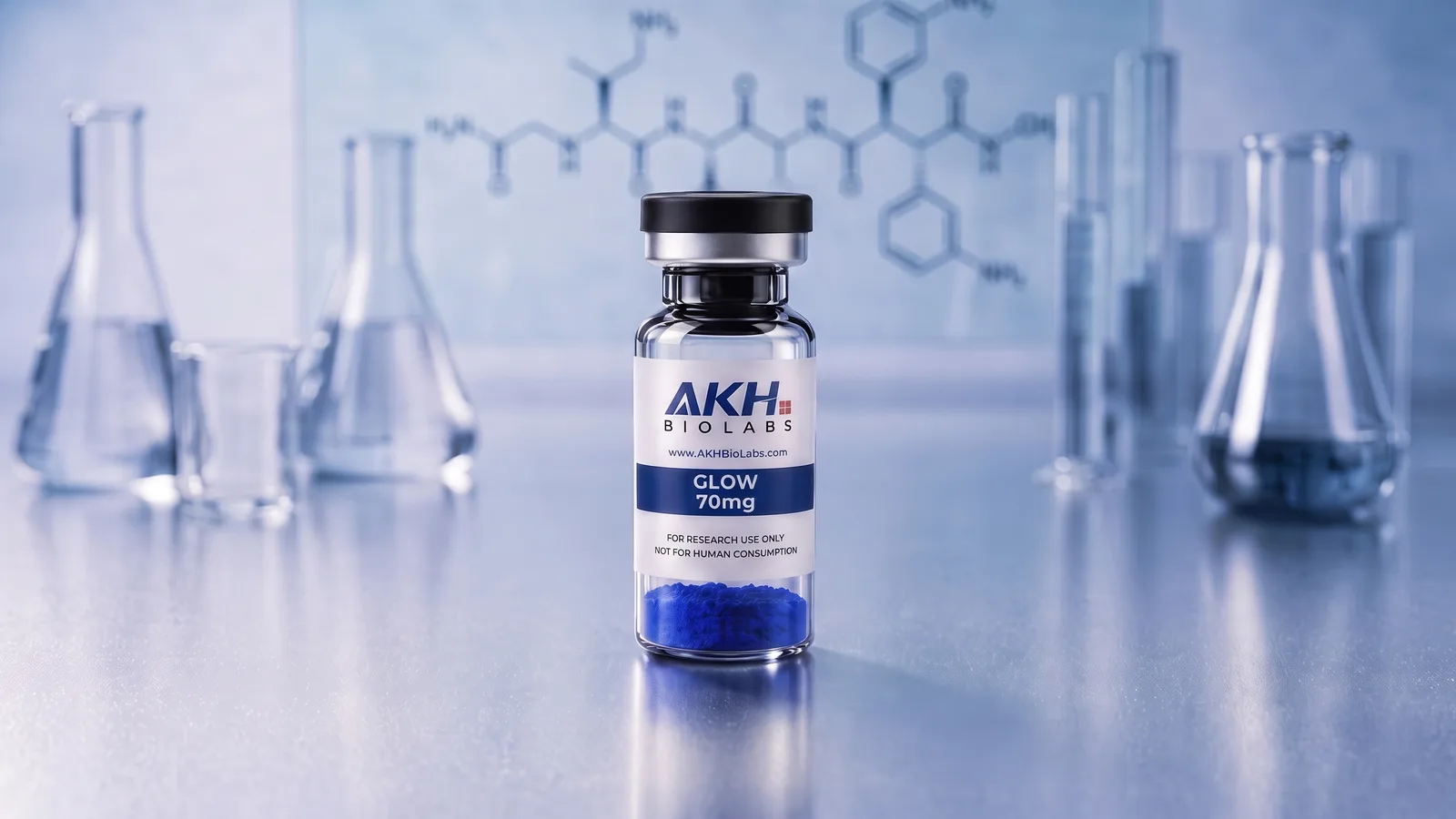
Best glow peptide: how to choose GLOW 70 for research
The best glow peptide choice for a laboratory is the vial whose composition, fill size, certificate and storage terms can all be checked against a public document before an order is placed.
The best glow peptide choice for a laboratory is the vial whose composition, fill size, certificate and storage terms can all be checked against a public document before an order is placed. GLOW 70 is stated as a 70 mg lyophilised blend of GHK-Cu 50 mg, BPC-157 10 mg and TB-500 10 mg, supplied for laboratory research, and the GLOW 70 page publishes each of those fields alongside the certificate for the batch it currently lists.
This guide is written for laboratory buyers and research groups comparing GLOW listings. It covers what the blend is, the four fields that make any listing checkable, how to read the certificate line by line, and where AKH BioLabs' own page shows each field. It does not rank suppliers and it is not a price comparison.
The material is supplied for research use only.
Key takeaways
- GLOW 70 is a 70 mg lyophilised blend stated as GHK-Cu 50 mg, BPC-157 10 mg and TB-500 10 mg.
- Its published certificate covers batch 26144, tested 23 Jul 2026 by the Brown Institute of Biomolecular Research at 99.87% purity.
- A checkable GLOW listing names the composition and total fill, the form and purity figure, a named laboratory with a batch number and test date, and the storage terms.
- The certificate reports a 70 mg fill and a purity figure; it gives no net peptide content number.
- The listing states worldwide delivery in a 9-14 day window and supplies the material for research use only.
What GLOW 70 is stated to contain
GLOW is supplied as a lyophilised (freeze-dried) powder rather than a liquid, which is the form named on the storage line of the listing. The composition line names three peptides with their masses, and the total is given as 70 mg per vial.
The certificate repeats the same three components in a shortened results line, in the form the laboratory issued it. That repetition is useful, because the composition claim and the analytical record can be compared without leaving the page.
A blend is a supply format, not a studied entity. The page states plainly that the research literature it cites reports single molecules rather than proprietary combinations, and that no study result should be read as characterising this vial. The page states that the literature it cites reports single molecules rather than proprietary combinations, and its reference list points to general peptide-in-skin reviews.
| Component as listed | Stated mass per vial |
|---|---|
| GHK-Cu | 50 mg |
| BPC-157 | 10 mg |
| TB-500 | 10 mg |
| Total stated fill | 70 mg |
Four fields that make a GLOW listing checkable
A listing that is clear on one and silent on the others is only partly checkable, which is the distinction the four fields exist to expose.
Composition and total fill
The listing names each component with its mass and states the total. The GLOW page gives three components and a 70 mg total, and the certificate results line repeats the same 70 mg figure.
Form and stated grade
GLOW is a lyophilised powder, and the page labels it HPLC verified with a purity of 99.87%. A purity figure and a fill mass answer different questions, which is why both are needed.
Certificate with a named laboratory, batch number and test date
The GLOW report names the Brown Institute of Biomolecular Research, a laboratory outside AKH, and carries batch 26144, a test date of 23 Jul 2026 and task ID #1812440.
Storage terms and shipping statement
The page gives minus 20 °C for the powder and 2 to 8 °C for the prepared solution with a 28-day window, and states worldwide delivery in 9-14 days.
Reading the GLOW certificate line by line
The certificate block is short enough to read in full. It gives batch 26144, a test date of 23 Jul 2026, task ID #1812440, a purity of 99.87% and the results line Glow(TB+BPC-157+GHK): 70mg | Purity: 99.87%. The page describes the document as a test report from a named laboratory outside AKH, ordered by the manufacturer and shown exactly as the laboratory issued it.
The same batch appears in the archive table, which lists product, batch, purity, test date and laboratory for every published certificate and records 45 published reports. Reading the two side by side is the cheapest check available: the batch number is the field that ties a document to a container, so a page whose batch does not match the vial describes different material.
What the document does not carry is part of the reading too. The results line reports a fill and a purity figure; it gives no net peptide content number, so the 70 mg and the 99.87% are not two views of the same quantity. The archive page notes that how to read the numbers, and what they cannot establish, is covered in the COA guide and the lab glossary.
Storage terms, the printed copy and the shipping window
The storage line on the page reads lyophilised at minus 20 °C and prepared at 2 to 8 °C with a 28-day window, protected from direct light. That line is worth reading before an order rather than after it, since it states the conditions the material is held under.
The page also states that a printed copy of the certificate ships in every parcel, alongside worldwide delivery in a 9-14 day window. The delivery window is a shipping fact rather than a quality claim, and it neither adds to nor replaces the batch record.
Where the AKH GLOW page shows each field
The composition, size and purity sit at the top of the GLOW 70 page: a single line reading GHK-cu 50mg, BPC-157 10mg, TB-500 10mg blend, with the size given as 70mg and the purity as 99.87%.
The rest of the four checks map to fixed places on the same page, which makes the comparison repeatable rather than a matter of reading impressions.
- 01
Composition and fill
The header line and the certificate results line both carry the three components and the 70 mg total.
- 02
Form and grade
The page labels the material HPLC verified and prints the 99.87% purity figure beside the size.
- 03
Certificate
Batch 26144, 23 Jul 2026, Brown Institute of Biomolecular Research, task ID #1812440, with a viewer for the full report.
- 04
Storage
Minus 20 °C for the lyophilised powder, 2 to 8 °C for the prepared solution, a 28-day window and protection from light.
- 05
Intended use
A research-use-only statement on the page, which places the material in a laboratory category rather than any other.
Common questions.
- Which facts make the best glow peptide choice for a laboratory?
Four fields: the composition and total fill, the form and stated purity, a certificate that names an outside laboratory with a batch number and test date, and the storage terms. GLOW 70 answers all four in public, with three components at 70 mg, a 99.87% purity figure, and a certificate for batch 26144 tested 23 Jul 2026 by the Brown Institute of Biomolecular Research.
- Does the GLOW certificate state how much peptide is in the 70mg vial?
It states the fill and a purity figure in one line, Glow(TB+BPC-157+GHK): 70mg | Purity: 99.87%. The 70 mg is the stated fill for the combined blend and the 99.87% is the laboratory's purity result for that batch. No net peptide content figure appears, so the two numbers do not describe the same quantity.
- Does GLOW 70 contain the same four peptides as KLOW?
No. The GLOW page states three components, GHK-Cu 50 mg, BPC-157 10 mg and TB-500 10 mg, at 70 mg total. KLOW is listed separately as an 80 mg blend that adds KPV 10 mg to the same three masses, and its published certificate covers batch 26145, tested 24 Jul 2026.
- Why is the PubMed record titled SPOTlight on GLOW not about this blend?
Because the title is a trial acronym rather than a compound name. The record describes the GLOW randomised double-blind phase 3 trial of zolbetuximab, an antibody directed at Claudin-18.2, in gastric and gastroesophageal junction adenocarcinoma. It names no peptide, no blend and no laboratory sample.
- What storage temperatures does the GLOW listing state?
Minus 20 °C for the lyophilised powder and 2 to 8 °C for the prepared solution, protected from direct light, with a 28-day window stated for the solution. The page pairs those figures with worldwide delivery in a 9-14 day window, which is a shipping statement rather than a storage one.