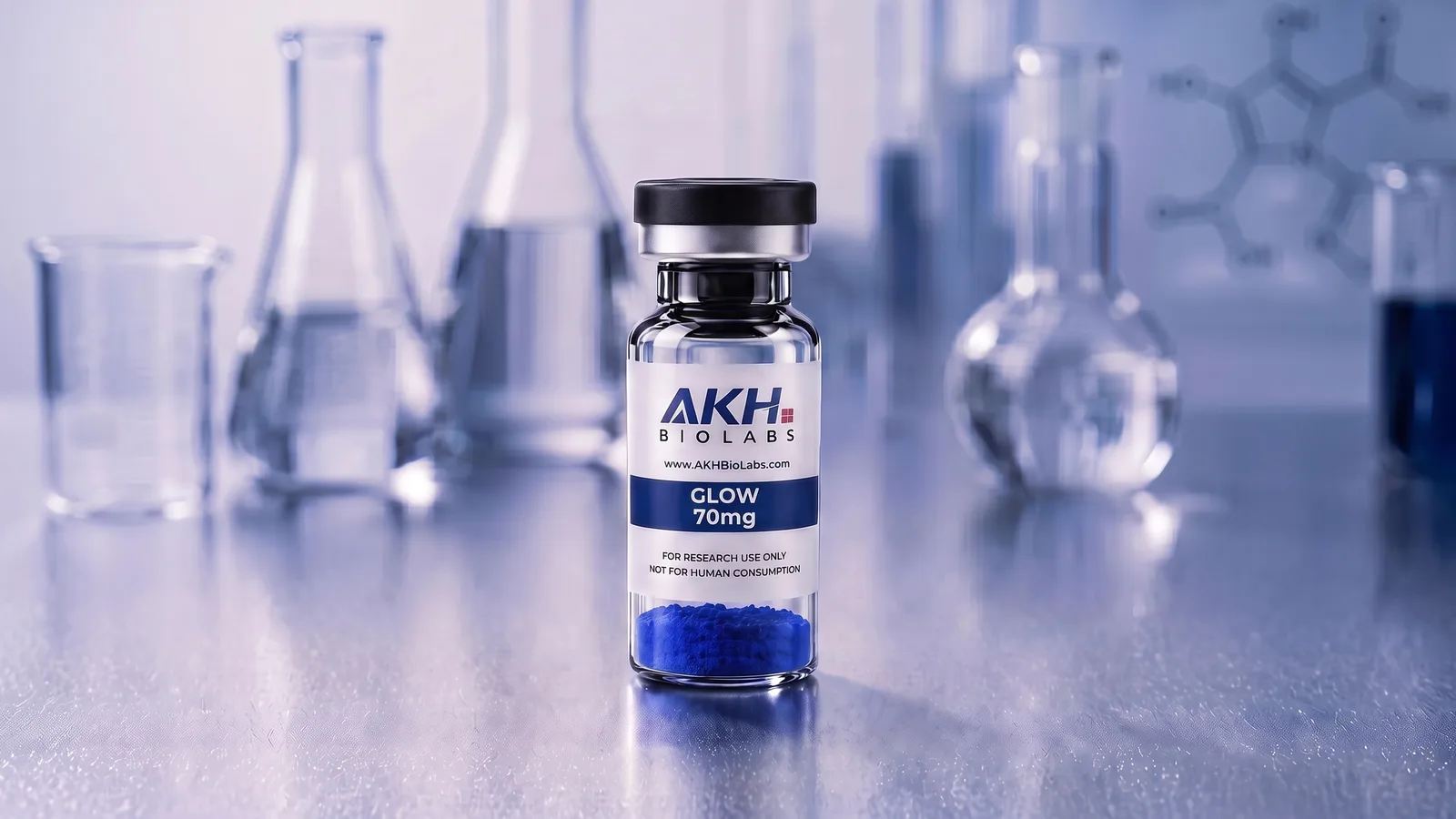
GLOW vs KLOW: how the two blends differ
The glow blend and the KLOW blend share three of their four components. The difference is KPV, and it changes the vial mass, the component ratio and the published batch record.
The glow blend and the KLOW blend differ by exactly one component: KLOW adds KPV, the C-terminal tripeptide of alpha-MSH, to the three peptides both blends share. That single addition changes the vial from 70 mg to 80 mg, shifts the component ratio, and gives each product its own certificate of analysis.
This comparison is written for laboratory researchers who already know the individual compounds and need to understand how the two multi-peptide blends differ in composition and documentation. It covers the stated component lists, the published batch records, and the evidence position for each blend. It does not cover preparation, handling or any use outside laboratory research.
Key takeaways
- GLOW is a three-peptide blend: GHK-Cu 50 mg, BPC-157 10 mg and TB-500 10 mg, 70 mg total per vial.
- KLOW is a four-peptide blend: the same three components plus KPV 10 mg, 80 mg total per vial.
- Both blends keep GHK-Cu as the largest component by mass, at 50 mg in each.
- Each blend has its own published certificate: GLOW batch 26144 at 99.87%, KLOW batch 26145 at 99.82%, both tested by the Brown Institute of Biomolecular Research in July 2026.
- No published study of either multi-peptide combination exists; the evidence base is component-level only.
What each blend contains
The glow blend is a 70 mg lyophilised preparation of three peptides: GHK-Cu at 50 mg, BPC-157 at 10 mg and TB-500 at 10 mg. Lyophilised means the material was dried from a frozen solution under vacuum, which is how peptide powders are normally supplied for laboratory work.
The KLOW blend is an 80 mg lyophilised preparation of four peptides: GHK-Cu at 50 mg, BPC-157 at 10 mg, TB-500 at 10 mg and KPV at 10 mg. The first three components and their masses are identical to the glow blend. KPV is the only addition.
That makes the glow vs klow question simpler than it first appears. The two products are not different formulations built from different starting points. One is a subset of the other, with the same GHK-Cu, BPC-157 and TB-500 masses in both vials.
| Component | GLOW (70 mg) | KLOW (80 mg) |
|---|---|---|
| GHK-Cu | 50 mg | 50 mg |
| BPC-157 | 10 mg | 10 mg |
| TB-500 | 10 mg | 10 mg |
| KPV | Not present | 10 mg |
| Total vial mass | 70 mg | 80 mg |
What KPV adds to the KLOW blend
KPV is the C-terminal tripeptide of alpha-melanocyte-stimulating hormone, written as lysine-proline-valine. The research rationale for including it is that it retains the anti-inflammatory activity of the parent hormone without the pigmentary activity, which is the finding set out in the foundational review of alpha-MSH and its C-terminal tripeptides.
In the KLOW blend, KPV occupies the inflammation side of the component set. The other three components are studied for fibroblast migration and vascular recruitment (BPC-157), actin-mediated cell motility (TB-500) and collagen synthesis and matrix remodelling (GHK-Cu). KPV is the component studied for inflammatory signalling.
The glow blend has no equivalent fourth component. Its three peptides cover migration, motility and matrix remodelling, but not the alpha-MSH-derived inflammation pathway. That is the substantive compositional difference between the two products, and it is the reason the KLOW vial carries an extra 10 mg.
Reading the published batch records side by side
Each blend has one certificate of analysis in the published archive, and the two reports were issued a day apart by the same laboratory. The glow blend certificate covers batch 26144, tested 23 Jul 2026 by the Brown Institute of Biomolecular Research, with a purity of 99.87%. The results string reads "Glow(TB+BPC-157+GHK): 70mg | Purity: 99.87%".
The KLOW certificate covers batch 26145, tested 24 Jul 2026 by the same laboratory, with a purity of 99.82%. Its results string reads "Klow(TB+BPC-157+GHK+KPV): 80mg (10mg/10mg/50mg/10mg) | Purity: 99.82%".
The two results strings are worth comparing directly, because they document the difference in different amounts of detail. The glow string names three components and the total mass. The KLOW string names four components, the total mass, and the per-component breakdown in parentheses. Both are reports from a named laboratory outside AKH, ordered by the manufacturer and published unaltered.
A purity figure on either certificate is a chromatographic peak-area ratio, not a statement of how much peptide is present by weight. The certificate documents identity and purity for the batch it covers; it does not establish that the blend has been studied as a combination.
The evidence position for both blends
Neither multi-peptide combination has been studied as a combination. The KLOW research record states that a systematic search of PubMed and Europe PMC returned no published study of the four-peptide blend in any model, and that no pharmacokinetic, efficacy or safety data exist for the combination. The same absence applies to the three-peptide glow blend.
What exists is component-level literature. GHK-Cu is covered by review work describing copper-peptide effects on collagen synthesis and matrix remodelling. BPC-157 rests largely on rodent studies, with human data limited to two uncontrolled pilots. TB-500 is a fragment-based analogue of thymosin beta-4, and the phase 2 wound trials in that literature used the full-length peptide rather than the fragment. KPV is supported by in vitro and animal anti-inflammatory work with no published human dermatology trial.
Only one published study examines any two of the KLOW components together: a 2026 experiment in 32 rats with Achilles tendon transection and repair, which compared a control group, BPC-157, TB-500 and a combination arm. The authors reported that combined treatment did not confer additional benefit over either peptide given alone. That study concerns tendon rather than skin, and it does not include GHK-Cu or KPV.
The full citation list and the limitations of that literature live on the KLOW research page. This post does not restate them.
How the two blends differ in practice
The choice between the two products turns on whether the fourth component is wanted. A researcher working on the three shared pathways only, without the alpha-MSH-derived inflammation component, has the glow blend as the smaller and simpler vial. A researcher who wants KPV present in the same reconstitution has the KLOW blend.
The trade-off is that adding KPV also changes the ratio. In the glow blend, GHK-Cu is 50 of 70 mg, or roughly 71% of the vial mass. In the KLOW blend, GHK-Cu is 50 of 80 mg, or roughly 63%. The absolute GHK-Cu mass is the same in both; its share of the total is lower once KPV is added.
Both blends are supplied as single combined masses, and the certificates document total vial content. The KLOW certificate additionally states the per-component breakdown; the glow certificate does not. Neither certificate establishes how the components behave together in solution.
- 01
Confirm the component list
Check whether the fourth component, KPV, is present. That is the single compositional difference between the two blends.
- 02
Check the total vial mass
GLOW is 70 mg; KLOW is 80 mg. The 10 mg difference is the KPV fraction.
- 03
Read the batch certificate
Each blend has its own report, with its own batch number, test date and results string. The two are not interchangeable.
- 04
Check the evidence scope
Component-level literature describes the individual peptides, not either combination. No study of the three-peptide or four-peptide blend exists.
Common questions.
- What is the difference between the glow blend and the KLOW blend?
The KLOW blend contains one additional peptide, KPV, at 10 mg. Both blends contain GHK-Cu 50 mg, BPC-157 10 mg and TB-500 10 mg. That makes GLOW a 70 mg three-peptide vial and KLOW an 80 mg four-peptide vial, with the same masses of the three shared components.
- Is glow vs klow just a difference in vial size?
No. The 10 mg size difference is the KPV fraction, so the two vials differ in component count as well as total mass. The glow blend has three components; the KLOW blend has four. The three shared components carry identical masses in both.
- Do the glow blend and the KLOW blend have separate certificates of analysis?
Yes. The glow blend certificate covers batch 26144, tested 23 Jul 2026 by the Brown Institute of Biomolecular Research at 99.87% purity. The KLOW certificate covers batch 26145, tested 24 Jul 2026 by the same laboratory at 99.82% purity. Each report documents its own batch.
- Has either multi-peptide blend been studied as a combination?
No. The KLOW research record states that a systematic search returned no published study of the four-peptide blend in any model, and no combination data exist. The same absence applies to the three-peptide glow blend. The available literature is component-level, describing the individual peptides rather than either blend.
- Which component is the largest by mass in both blends?
GHK-Cu, at 50 mg in each vial. It is roughly 71% of the 70 mg glow blend and roughly 63% of the 80 mg KLOW blend. The absolute GHK-Cu mass is the same in both; its share of the total falls once KPV is added.