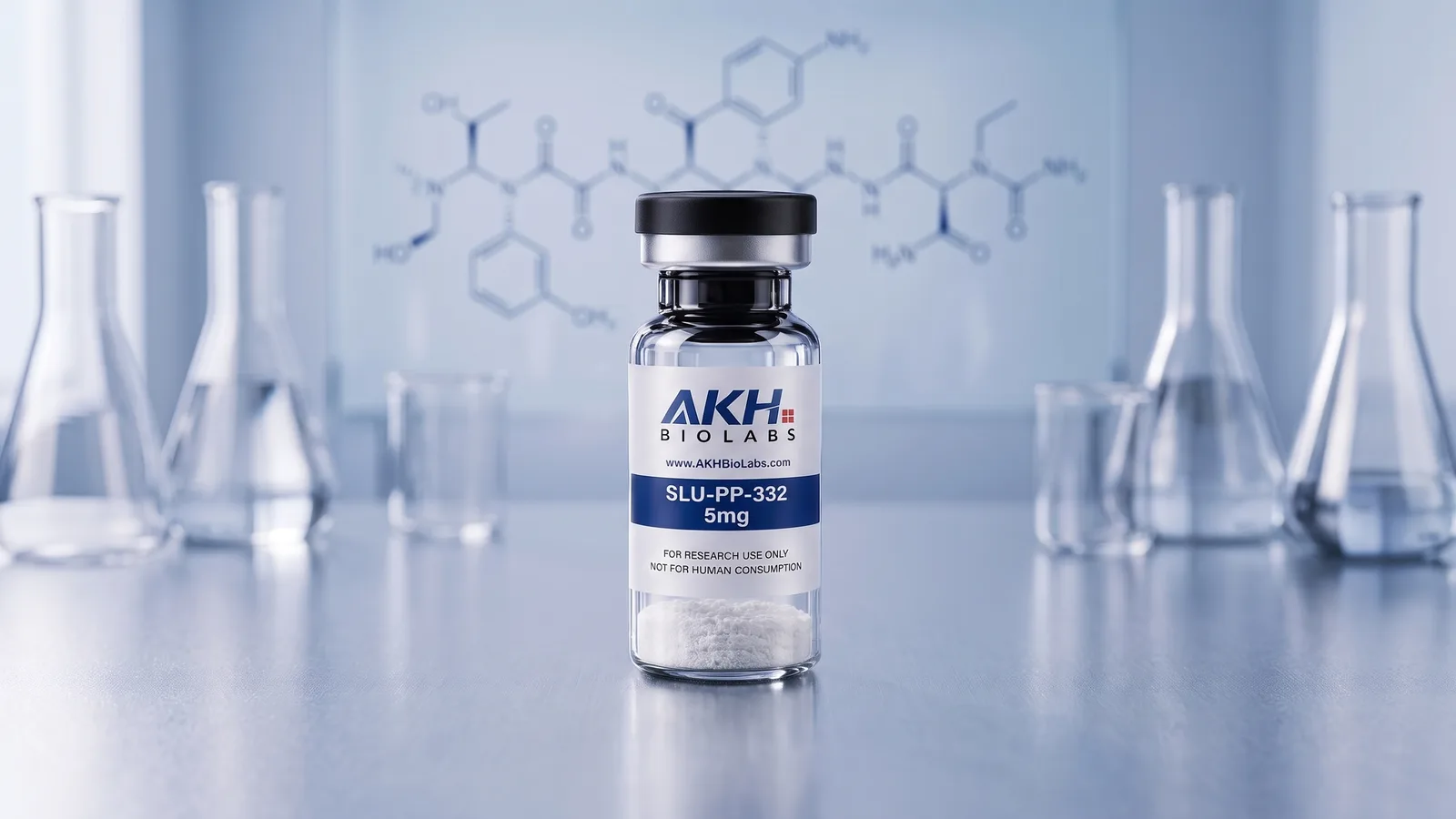
Best slu pp 332: how to choose for laboratory research
How to choose SLU-PP-332 for laboratory research: the identity fields, the 5mg fill read against the 99.73% purity result, the batch 26200 certificate, and what the listing leaves unstated.
The best slu pp 332 for laboratory research is the listing whose compound identity, stated fill, certificate from a named outside laboratory and intended-use statement can each be checked before an order is placed. The SLU-PP-332 product page at AKH BioLabs publishes those fields for a 5mg presentation, with a 99.73% purity figure marked HPLC verified and a certificate for batch 26200.
This guide is written for laboratory buyers, procurement staff and research groups who compare SLU-PP-332 listings on documents rather than on claims. It covers what the compound is, how the fill and purity fields differ, what the batch record carries, what the page says about storage and intended use, and where each field appears.
Key takeaways
- SLU-PP-332 is a synthetic small molecule with the formula C20H15F3N2O3, described on the listing as a pan-agonist of the estrogen-related receptors ERRα, ERRβ and ERRγ, and not a peptide.
- The 5mg figure is the stated fill and the 99.73% figure is a chromatographic purity result for one batch; neither states how much of the vial mass is the compound.
- The archive row records batch 26200, tested 31 Jul 2026 by the Brown Institute of Biomolecular Research, a laboratory outside AKH.
- The research record counts 13 published studies and states that no human clinical trial of SLU-PP-332 has been published or registered, with no human pharmacokinetic or safety data available.
- A certificate documents measurements for one sample and confers no regulatory status; the listing supplies the material for research use only.
What the identity line on a SLU-PP-332 listing has to state
SLU-PP-332 is a synthetic small molecule, and the product page gives its molecular formula as C20H15F3N2O3. The same page describes it as a pan-agonist of the estrogen-related receptors (ERRα, ERRβ and ERRγ), a family of orphan nuclear receptors that act as transcriptional regulators of oxidative metabolism. An agonist is a molecule that activates a receptor; a pan-agonist is one active at all three subtypes. The listing attributes the compound to Saint Louis University and classifies it as an exercise mimetic, a label the page ties to the published research record rather than to a human-use claim.
One peer-reviewed paper is supplied as external support for that class description. The abstract of A Synthetic ERR Agonist Alleviates Metabolic Syndrome, listed in J Pharmacol Exp Ther in 2024, describes SLU-PP-332 as an agonist for the estrogen-related receptor (ERR)α, β, and γ nuclear receptors. Its findings belong to the evidence record at /research/slu-pp-332 rather than to this buying guide.
Identity comes first because every other field depends on it. The page states the formula, the receptor description and the presentation, and it presents the compound as a small molecule rather than a peptide. A listing that omits those identity fields leaves the checkable part unstated, and a purity figure elsewhere on the page cannot repair that.
Grade and size: the 5mg fill read against the 99.73% purity result
Two fields sit close together on the listing and are easily read as a single claim. They answer different questions, and a buyer who separates them gets two usable facts instead of one vague one.
| Field on the listing | What it describes | What it does not state |
|---|---|---|
| 5mg | The stated fill for the presentation | How much of that mass is the compound |
| 99.73%, marked HPLC verified | A chromatographic purity result for one batch | A mass fraction of the vial contents |
| C20H15F3N2O3 | The molecular formula of the compound | The quantity present in the vial |
What the page leaves unstated
No net content figure appears beside the fill. A buyer recording the quantity question therefore marks it unanswered rather than combining the 5mg and the 99.73% into a single statement about how much compound a vial holds.
Why the formula is not a quantity
A molecular formula identifies the molecule. It says nothing about how much of that molecule a given vial contains, and it cannot be converted into a vial mass without measurements the page does not report.
Reading the batch record for SLU-PP-332
A certificate of analysis records what a named sample was tested for and what the result was. The archive describes each of its rows as one Certificate covering one batch, tested once, by a named laboratory outside AKH, on a report ordered by the manufacturer.
The row for this product reads: SLU-PP-332, batch 26200, purity 99.73%, test date 31 Jul 2026, laboratory Brown Institute of Biomolecular Research. The product page links the full report beside the same purity figure.
Read the batch number first. It ties the document to a container, and a report naming a different batch describes different material even when the purity figure matches. The test date records when the measurement was made and the laboratory name records who made it.
A certificate is not a regulatory approval. The row carries product, batch, purity, test date and laboratory, and nothing in those fields addresses sterility, a manufacturing standard or a compound's behaviour in a living system.
Storage and intended use: what the page states and what it leaves open
The retrieved page text for this product gives the formula, the 5mg fill, the 99.73% purity figure, the supply terms and the research-use-only statement, and it prints no holding temperature. That makes the term a field to confirm on the page before ordering, rather than one this article can quote.
Intended use is stated explicitly. The page carries the line: For research purposes only. Not for human consumption, diagnosis, treatment, or prevention of any condition. That sentence describes the supply category, and it sits alongside the certificate rather than being replaced by it.
Two practical consequences follow. The certificate is not the place to look for a holding condition, because it carries batch measurements rather than handling instructions. And the intended-use line does not describe packing or shelf life, so those questions stay with the listing text.
Where the AKH BioLabs SLU-PP-332 page shows each check
Every field described above appears in public on the SLU-PP-332 catalogue page: the formula C20H15F3N2O3, the ERRα, ERRβ and ERRγ description, the 5mg fill, the 99.73% purity figure marked HPLC verified, a Full COA link, the worldwide delivery window of 9 to 14 days and the research-use-only line.
The same batch appears in the COA archive, where the row names batch 26200, the test date of 31 Jul 2026 and the Brown Institute of Biomolecular Research beside the 99.73% figure. Comparing the product page with the archive row before ordering, then matching the batch number with the material on arrival, is the step that closes the check.
Current stock is shown on the page rather than stated here, and the review record displayed there, 4.7 on Trustpilot from 28 reviews, describes service across past orders rather than the identity or purity of any batch.
Common questions.
- How is a SLU-PP-332 listing for research checked before purchase?
Begin with the identity line, then read the stated fill, the certificate fields and the intended-use line. For the AKH listing that means the formula C20H15F3N2O3 with the ERRα, ERRβ and ERRγ description, a 5mg presentation, a certificate naming batch 26200 and the Brown Institute of Biomolecular Research, and a research-use-only statement. The same batch appears in the COA archive.
- What does the 99.73% purity figure on SLU-PP-332 cover?
It is a chromatographic purity result for one batch, recorded in the archive beside batch 26200 and the 31 Jul 2026 test date. The 5mg figure is a separate field, and the page reports no net content figure.
- Does the SLU-PP-332 product page state a storage temperature?
The retrieved page text prints the formula, the 5mg fill, the purity figure, the delivery window and the research-use-only statement, and it carries no holding temperature. That leaves storage as a field to confirm on the page before ordering. A certificate records measurements for one sample, so it does not supply a holding condition either.
- Which batch and laboratory are recorded on the published SLU-PP-332 record?
Batch 26200, tested 31 Jul 2026 by the Brown Institute of Biomolecular Research at a stated purity of 99.73%. The archive presents one row per Certificate, and the batch number is the field that ties a report to a container. A report naming a different batch describes different material, whatever purity figure it carries.
- What does the research record say about human data for SLU-PP-332?
The record counts 13 published studies and states that no human clinical trial of SLU-PP-332 has been published or registered, with no human pharmacokinetic or safety data available. The listing therefore supplies a research-use-only material, and its intended-use line excludes human use. The published work catalogued there is preclinical.