AKH Signature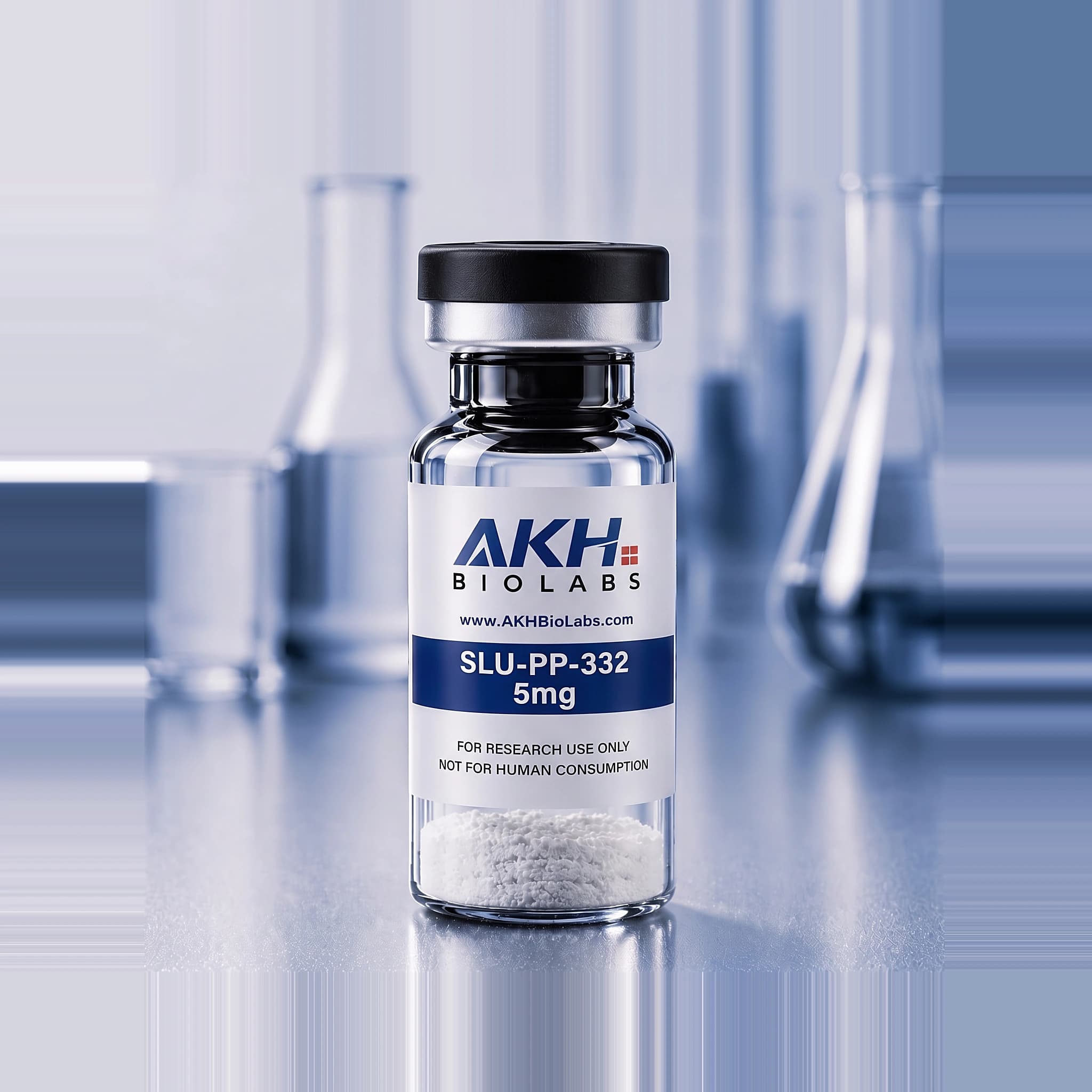
Performance· AKH Signature
Sold outSLU-PP-332
ERR Agonist Exercise Mimetic
Size5mgPurity99.73%FormulaC20H15F3N2O3
SLU-PP-332 is a synthetic small-molecule pan-agonist of the estrogen-related receptors (ERRα, ERRβ, ERRγ), developed at Saint Louis University. It is classified as an "exercise mimetic" because it activates the same mitochondrial-biogenesis and fatty-acid-oxidation gene programmes triggered by aerobic training, and is studied in preclinical endurance and metabolic models.
€60
Quantity
HPLC verified
9–14 day shipping
Full COA
Worldwide delivery
About this compound
The research profile.
SLU-PP-332 is a synthetic small molecule — not a peptide — developed as a pan-agonist of the estrogen-related receptors ERRα, ERRβ, and ERRγ. It emerged from a medicinal-chemistry programme that converted an ERRβ/γ-selective agonist scaffold into compounds active at all three subtypes, and it is now widely used as a chemical probe for ERR activation.
The ERRs are orphan nuclear receptors that act as transcriptional regulators of oxidative metabolism, partnering with PGC-1α to drive mitochondrial biogenesis, fatty-acid oxidation, and the oxidative-fibre gene programme in skeletal muscle. Published work characterises SLU-PP-332 as inducing an ERRα-dependent acute aerobic exercise transcriptional response in muscle, and separate genetic work has mapped the same receptor to myofibre aerobic transformation and fuel efficiency.
The evidence base is strictly preclinical. All published in vivo characterisation of this compound has been performed in rodents by parenteral administration — the molecule is explicitly described in the literature as lacking oral bioavailability, which prompted the development of a chemically distinct successor. There are no human clinical trials of SLU-PP-332, no human pharmacokinetic data, and no established human dose.
Published research
13 peer-reviewed studies on SLU-PP-332 are summarised in our research library, including 13 published since 2023 — with study designs, reported findings and what the evidence does not establish.
Read the SLU-PP-332 evidence baseFor research purposes only. Not for human consumption, diagnosis, treatment, or prevention of any condition.
Categorised as Performance — Mitochondrial and cellular-energy research compounds.
Dosing at a glance
What the literature reports.
For research and laboratory use only. Not for human consumption.
Route
Subcutaneous
Frequency
1–2x daily (rodent study schedules)
Reported range
250–1000 mcg
Protocol duration
2–4 weeks
250 mcgper administration1000 mcg
Published in vivo work is rodent-only and reported per kilogram of bodyweight, most commonly around 50 mg per kg given intraperitoneally once or twice daily. The 250–1000 mcg per-administration figures shown here are the amounts described in research-community protocol documentation and have no clinical basis — no human pharmacokinetic data exist for this molecule.
Ranges reflect protocols reported in the published literature on SLU-PP-332 — see research citations.
Calculate a dilutionReconstitution & storage
From powder to solution.
- Step 01
Add 1 ml bacteriostatic water
Aim the stream at the vial wall rather than the powder.
- Step 02
Swirl gently — never shake
Rotate the vial until the solution runs clear. Agitation degrades the peptide.
- Step 03
Refrigerate at 2–8 °C
Reconstituted vials belong in the fridge, protected from direct light.
- Step 04
Use within 28 days
Discard any remainder once the stability window closes.
Lyophilised · −20 °CReconstituted · 2–8 °C, 28 days
A 5 mg vial in 2 ml gives 2.5 mg/ml. SLU-PP-332 is a small molecule rather than a peptide and has limited aqueous solubility; published in vitro and in vivo work uses DMSO-containing vehicle systems, so laboratories should confirm dissolution visually before use.
Reconstitution calculator
5 mg vialmg
ml
mcg
500 mcg = 0.5 mg
Draw
10units · U-100 insulin syringe
- Concentration
- 5 mg/ml
- Draws per vial
- 10
- Cost per draw
- €6.00
For research and laboratory use only. Not for human consumption.
Laboratory arithmetic for SLU-PP-332 — enter the COA-verified vial content for exact figures. Not medical advice.
Effect timeline
Observed across the research window.
Milestones summarise findings reported in the cited studies. Outcomes vary across models and protocols.
Start
Acute transcriptional response
The characterising study reports induction of an ERRα-dependent acute aerobic exercise gene programme in skeletal muscle within hours of administration in mice.
Week 1
Mitochondrial and respiratory measures
Preclinical work describes increased mitochondrial function and cellular respiration in treated rodent muscle across the first days of repeated administration.
Week 2–4
Whole-body metabolic end points
Metabolic-syndrome models in mice have assessed energy expenditure, fatty-acid oxidation, and body-composition measures over two-to-four-week administration periods.
End point
Scope of the evidence
All published end points for this molecule are drawn from rodent and cell-based experiments; the medicinal-chemistry record describes the parent scaffold and its subtype selectivity, and no clinical study has been reported.
For research and laboratory use only. Not for human consumption.
Scientific research
The published evidence.
The dosing ranges and timeline milestones on this page summarise the peer-reviewed publications below.
References
- 01
Synthetic ERRα/β/γ Agonist Induces an ERRα-Dependent Acute Aerobic Exercise Response and Enhances Exercise Capacity. ACS Chem Biol (2023). PubMed · 36988910
- 02
A Synthetic ERR Agonist Alleviates Metabolic Syndrome. J Pharmacol Exp Ther (2024). PubMed · 37739806
- 03
Modulation of estrogen-related receptors subtype selectivity: Conversion of an ERRβ/γ selective agonist to ERRα/β/γ pan agonists. Bioorg Chem (2020). PubMed · 32683181
- 04
ERRα fosters running endurance by driving myofiber aerobic transformation and fuel efficiency. Mol Metab (2023). PubMed · 37802398
Laboratory verification
One Certificate, published unaltered.
The Certificate is a test report from a named laboratory outside AKH, ordered by our manufacturer and shown here exactly as the laboratory issued it. A printed copy ships in every parcel.
- Batch
- 26200
- Test date
- 31 Jul 2026
- Task ID
- #1812496
- Purity
- 99.73%
Results
SLU-PP-332: 5mg | Purity: 99.73%
Verified by Brown Institute of Biomolecular Research. Scan the full report for every measurement.
Product FAQ
Questions researchers ask.
Pairs well with
Frequently co-studied.
Compounds that appear alongside SLU-PP-332 in the research literature.
For research and laboratory use only. Not for human consumption.
Performance