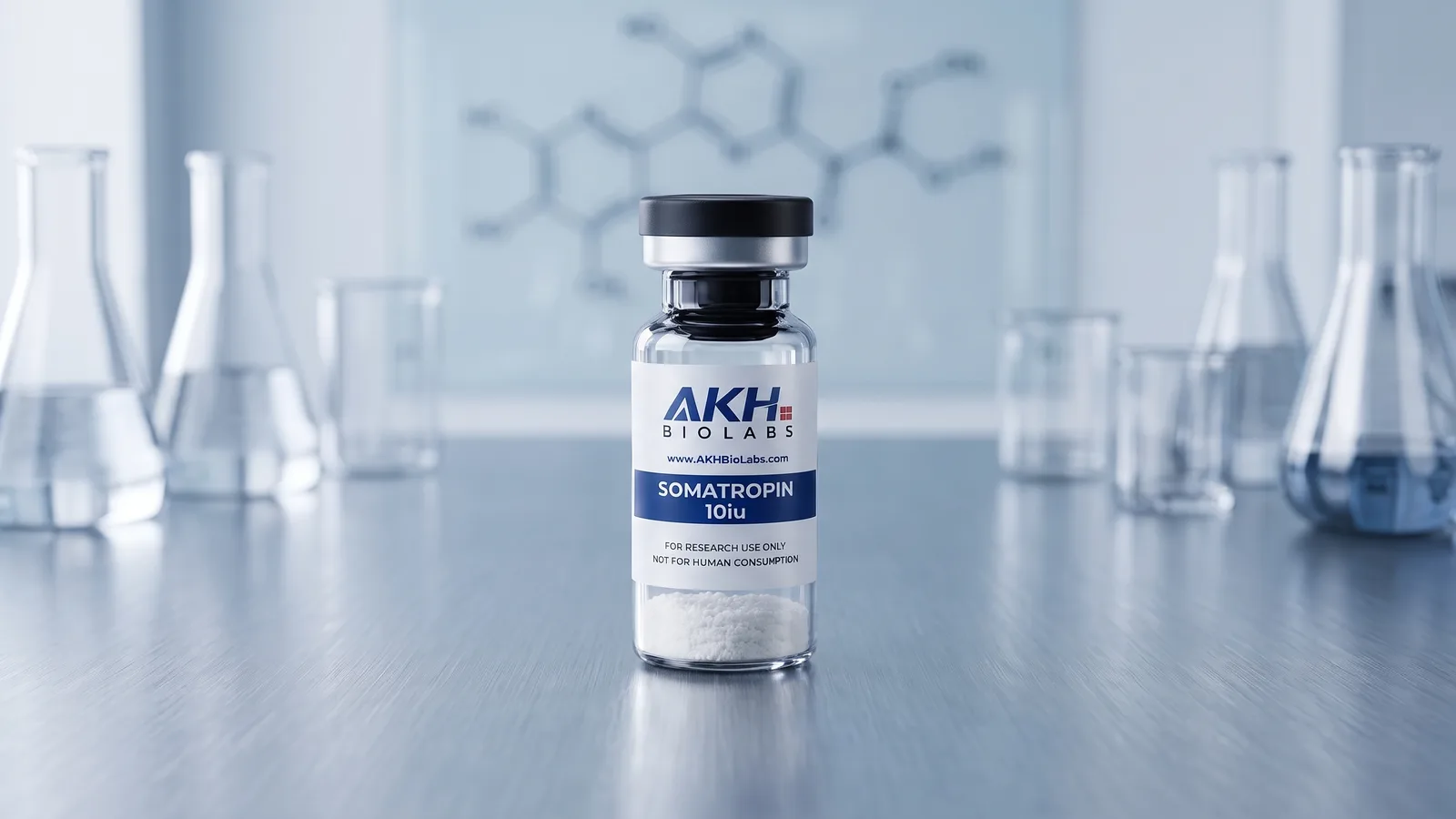
Best somatropin: how to choose for research
Choosing the best somatropin for laboratory research comes down to four checkable fields: what the material is, the grade and size supplied, the Certificate published for the batch, and the stated storage and shipping terms.
The best somatropin for research is the listing whose identity, grade, size, Certificate and storage terms can all be read and checked before ordering, not the one with the loudest claim. Somatropin is recombinant human growth hormone, a 191-amino-acid single-chain polypeptide produced in engineered host cells rather than extracted from tissue, and the 191AA designation distinguishes it from the 192-amino-acid met-hGH constructs used in early recombinant work.
This guide is written for laboratory buyers comparing research-use-only listings. It sets out what to check on a product page, in what order, and where each field appears on the Somatropin 100 IU listing. Nothing here is a statement about human use; the material is supplied strictly for laboratory research.
Key takeaways
- Somatropin is a 191-amino-acid recombinant polypeptide, and the 191AA label is a sequence-length claim rather than a second compound.
- A Certificate of Analysis (COA) is a report from a named laboratory outside the seller, ordered by the manufacturer, and it documents one batch rather than a product line.
- A chromatographic purity figure is a peak-area ratio from the chromatogram, not a statement of how much of the vial mass is peptide.
- The batch number is the field that ties a report to a physical vial, so it matters more than the purity figure when the two are read together.
- Storage terms and shipping windows are separate from the Certificate and should be read on the listing itself.
What somatropin is, and why the 191AA label matters
Somatropin is recombinant human growth hormone: a 191-amino-acid single-chain polypeptide identical in sequence to the pituitary hormone, produced in engineered host cells rather than extracted from tissue. The 191AA designation distinguishes it from the 192-amino-acid met-hGH constructs used in early recombinant work, so the label is a sequence-length claim rather than a second compound.
That distinction matters when comparing listings, because the same catalogue page can carry a full-chain product and a shortened fragment under similar names. The 176-191 fragment is a 16-residue window at the C-terminal end of the same parent protein, and AOD-9604 is that fragment under a catalogue name. A buyer comparing somatropin against a fragment is comparing two different molecules, not two sizes of one.
Full chain
Somatropin is the 191-residue recombinant polypeptide, sequence-identical to the pituitary hormone.
Fragment
The 176-191 fragment is a 16-residue C-terminal region of the same parent protein, catalogued separately as AOD-9604.
Secretagogues
GHRH analogues and ghrelin-receptor agonists prompt release of stored hormone rather than supplying the hormone itself, so they are a different class.
Grade, size and what the listing states
Research-use-only (RUO) is an intended-use statement rather than a purity grade. It says the material is supplied for laboratory work and not for human or veterinary use. It does not say the material is untested, and it does not say the material is a medicine. The two questions are separate, and a listing that is clear on one and vague on the other is only partly checkable.
Size is the second field. The Somatropin listing states a ten-vial kit at 10 IU per vial, 100 IU total, with the 240 IU presentation shown as sold out. The IU unit is a potency convention for this compound class rather than a mass, which is why the listing pairs it with a formula and a stated fill rather than a milligram figure alone.
| Field | What it answers | Where it appears |
|---|---|---|
| Identity | Which molecule the listing describes | Product name and compound description |
| Grade | What the material is supplied for | Research-use-only statement |
| Size | How much material and in what format | Size selector and kit description |
| Certificate | What was measured, on which batch, by which laboratory | COA viewer on the product page |
| Storage and shipping | How the material is handled and delivered | Product information and shipping terms |
Reading the Certificate on a somatropin listing
A Certificate of Analysis (COA) is a report from a named laboratory outside the seller, ordered by the manufacturer, and it documents one batch rather than a product line. The Somatropin listing carries a report for batch 26072, tested 23 Jul 2026 by the Brown Institute of Biomolecular Research, with a purity of 99.93% and the results string "HGH: 10iu | Purity: 99.93%".
The purity figure is a chromatographic result, which is a peak-area ratio taken from the chromatogram. It states what share of the detected material is the target peak, not what share of the vial mass is the peptide. Salt form and residual water both sit between the two, which is why net peptide content is measured separately. The batch number is the field that ties the document to a physical vial, so a report whose batch does not match the material being supplied describes a different batch regardless of the figure it carries.
The archive at /lab/coa lists every published certificate by product, batch, purity, test date and laboratory, which is what makes the comparison possible across products rather than within one page.
Storage terms and shipping windows
Storage is a separate question from identity and purity, and it splits into two problems. Lyophilised powder tolerates months or years in storage under suitable conditions, while the same peptide in solution has a much shorter working window. The Somatropin listing supplies the material as a lyophilised powder kit, so the powder terms apply until the material is brought into solution.
Shipping is the last field. The listing states worldwide delivery in a 9 to 14 day window. That is a shipping fact rather than a quality claim, and it should be read alongside the batch record for the product being ordered rather than instead of it.
A short checklist before ordering
The four fields below can each be read from a public page before ordering and checked again on arrival. Working through them in order avoids the common failure of comparing purity figures across listings whose batches, laboratories or test dates are not stated.
- 01
Confirm the molecule
Check that the listing names somatropin or recombinant human growth hormone 191AA, and that it is not a fragment or a secretagogue under a similar name.
- 02
Confirm the grade and size
Read the research-use-only statement and the size selector together, so the format and the quantity are both clear before ordering.
- 03
Read the Certificate
Check the batch number, the test date, the laboratory name and the results string. The batch number is the field that ties the report to the vial.
- 04
Check storage and shipping
Read the stated storage terms for the powder form and the stated delivery window, and treat both as separate from the Certificate.
Where each field appears on the Somatropin page
The Somatropin 100 IU listing shows the compound description, the formula C990H1528N262O300S7, the 100 IU kit format and the Certificate for batch 26072 in one place. The COA viewer on that page opens the report itself, and the archive at /lab/coa shows the same batch alongside every other published certificate for comparison.
The wider evidence record for the compound, including the published literature and its limits, sits at /research/somatropin-240iu rather than on the product page. That separation is deliberate: the product page answers what is being supplied and how it was measured, and the research record answers what the published work covers.
Common questions.
- What makes the best somatropin for laboratory research?
The listing whose identity, grade, size, Certificate and storage terms can all be read and checked before ordering. Somatropin is recombinant human growth hormone, a 191-amino-acid polypeptide, and the 191AA label is a sequence-length claim rather than a second compound. A listing that is clear on one field and vague on the others is only partly checkable.
- Does a somatropin Certificate of Analysis state how much peptide is in the vial?
No. The report for batch 26072 carries the results string "HGH: 10iu | Purity: 99.93%". The 10iu is the stated fill and the 99.93% is a chromatographic purity result, which is a peak-area ratio rather than a mass fraction. Lyophilised material is normally supplied as a salt with residual water, so net peptide content is measured separately.
- Why does the batch number matter more than the purity figure on a somatropin report?
The batch number is the field that ties the document to the physical vial. A report with a high purity figure but a batch that does not match the material being supplied describes a different batch. The purity figure states what was measured; the batch number states which material the measurement applies to.
- Is somatropin the same as the 176-191 fragment?
No. Somatropin is the full 191-amino-acid recombinant chain, sequence-identical to the pituitary hormone. The 176-191 fragment is a 16-residue C-terminal region of the same parent protein, catalogued separately as AOD-9604. The two names describe different lengths of the same parent protein rather than two sizes of one product.
- How should lyophilised somatropin be stored before use?
The listing supplies the material as a lyophilised powder kit, and a dry powder tolerates months or years of storage under suitable conditions while the same peptide in solution has a much shorter working window. The storage terms stated on the listing apply to the powder form, and the answer changes once the material is brought into solution.