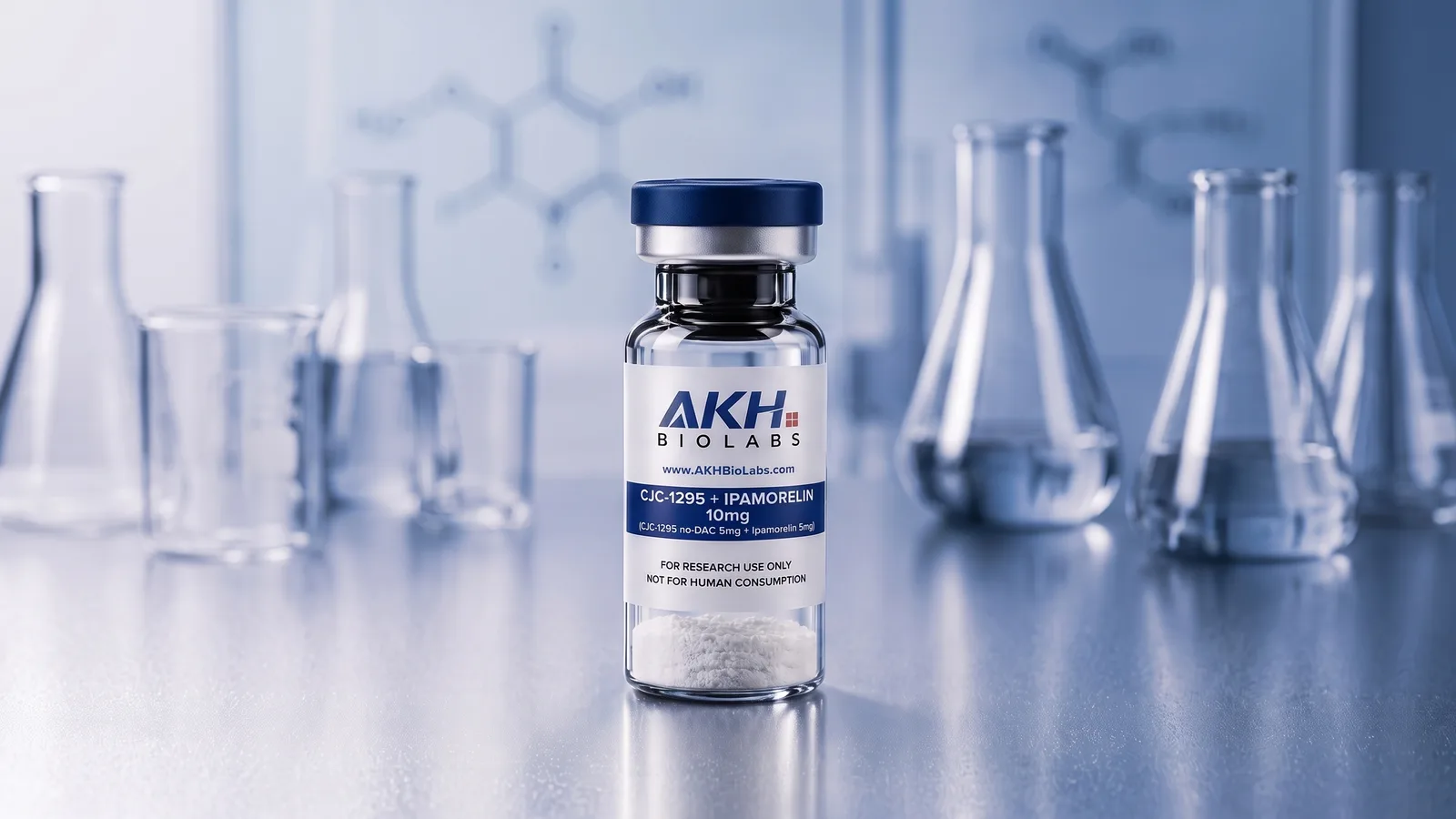
CJC-1295 without DAC plus ipamorelin: what the pairing is
CJC-1295 without DAC plus ipamorelin is a two-peptide research pairing: a GHRH receptor analogue and a ghrelin receptor agonist supplied together, usually co-lyophilised in one vial. This explainer covers what each component is, why they are studied as a pair, and where the published evidence record lives.
CJC-1295 without DAC plus ipamorelin is a pairing of two distinct growth hormone secretagogues, supplied together as a single co-lyophilised vial for laboratory research. The two molecules act at different receptors: CJC-1295 without DAC is an analogue of growth hormone-releasing hormone (GHRH) acting at the GHRH receptor, while ipamorelin is a selective agonist at the ghrelin receptor, GHS-R1a.
This article is written for researchers and laboratory readers who encounter cjc and ipamorelin in catalogue listings, certificates of analysis or literature searches and want a plain account of what the combination is, how the two components differ, and why they appear together in published work. It does not restate the evidence base for either compound; that record lives on the CJC-1295 + Ipamorelin research page and the Ipamorelin research page, and this post links there rather than duplicating it.
Key takeaways
- CJC-1295 without DAC and ipamorelin are two separate molecules with two separate receptor targets, not one compound.
- CJC-1295 without DAC is also written Modified GRF 1-29; the no-DAC form lacks the albumin-binding group that extends the DAC version's circulation time.
- Ipamorelin is a synthetic pentapeptide characterised in 1998 as a selective GHS-R1a agonist that released growth hormone without the ACTH and cortisol response reported for earlier secretagogues.
- The pairing is studied because the two receptor pathways interact more than additively, a finding first reported in human work in 1990.
- No peer-reviewed clinical trial administering CJC-1295 together with ipamorelin has been identified; the evidence is component-level.
What cjc and ipamorelin are as a pairing
The pairing is a research concept rather than a single molecule. CJC-1295 without DAC and ipamorelin are two peptides that reach growth hormone release through different receptors, and they are supplied together because published work reports that the two pathways interact more than additively.
In the catalogue, the pairing appears as a co-lyophilised blend. One AKH BioLabs listing describes a 5 mg + 5 mg vial, 10 mg total, in which the two peptides are present in a 1:1 mass ratio. Lyophilised means the material is dried from a frozen solution under vacuum, which is the standard way peptide powder is stabilised for storage.
The two components are not interchangeable and are not the same molecule under two names. CJC-1295 without DAC is a GHRH receptor analogue; ipamorelin is a ghrelin receptor agonist. A certificate of analysis for the blend names both, which is how the composition is documented.
CJC-1295 without DAC: the GHRH receptor side
CJC-1295 without DAC is also written Modified GRF 1-29. It is an analogue of growth hormone-releasing hormone, the endogenous signal that acts at the pituitary GHRH receptor.
The distinction between the DAC and no-DAC forms matters for reading the literature. The DAC version carries a drug-affinity complex that binds albumin, which extends how long the peptide persists in circulation. The no-DAC form lacks that group, so the two are distinct molecules and a pharmacokinetic figure measured for one does not describe the other.
The principal human dataset for CJC-1295 comes from a 2006 randomised placebo-controlled ascending-dose study in healthy adults, which used the DAC-modified analogue. Reviews of this literature record the frequent substitution of unmodified CJC-1295 for the DAC-modified analogue that was actually studied. The CJC-1295 research page carries the full citation record.
Ipamorelin: the ghrelin receptor side
Ipamorelin is a synthetic pentapeptide, meaning a chain of five amino acids. It was characterised in 1998 as an agonist at the growth hormone secretagogue receptor 1a (GHS-R1a), the same receptor the endogenous ligand ghrelin binds.
The 1998 paper describes ipamorelin as the first selective growth hormone secretagogue: it released growth hormone with potency and efficacy comparable to GHRP-6, but unlike earlier peptides in the class it did not release ACTH or cortisol at levels significantly different from those seen after GHRH stimulation, even at amounts more than 200-fold higher than the GH-releasing threshold. That separation is the basis for the word selective.
Human pharmacokinetic modelling describes a terminal half-life of approximately two hours, with a single discrete episode of growth hormone release. The Ipamorelin research page carries the full citation record.
Why cjc no dac ipamorelin designs appear in the literature
The rationale for studying the two together traces to human work from 1990, which reported that a growth hormone-releasing peptide and GHRH given together stimulated growth hormone release synergistically, with submaximal amounts of each producing more than the sum of their separate effects. That finding is the foundational human demonstration of the GHRH-plus-secretagogue interaction.
Because the two molecules act at different receptors, a combined design engages both pathways in the same protocol. The CJC-1295 + Ipamorelin research page notes that most published designs in this class compare a combined arm against each peptide alone, since the interaction claim only holds when both receptor pathways are engaged.
The pairing is therefore a standard comparator in this literature rather than a novel construct. It appears in catalogue listings and in review articles that survey growth hormone secretagogues and GHRH analogues together.
What the evidence does and does not establish
No peer-reviewed clinical trial administering CJC-1295 together with ipamorelin has been identified. A PubMed query intersecting both peptide names returned only narrative reviews, doping-control analytical methods and product-quality analyses, with no interventional study of the pair. The combination therefore remains untested for efficacy, safety, dose-response and long-term endocrine consequences in humans.
The available evidence is component-level. Randomised human studies exist for CJC-1295 and for ipamorelin evaluated separately, and an older body of human work established that the GHRH and ghrelin receptor pathways interact more than additively. Recent 2024-2026 literature addressed the combination almost exclusively as an unapproved, compounded product used outside regulated medicine, and characterised its clinical evidence base as absent rather than negative.
A 2026 critical review of peptide and peptide-analog use in sport and bodybuilding lists both ipamorelin as a growth hormone secretagogue and CJC-1295 as a growth hormone-releasing hormone analogue among agents promoted for muscle growth, fat metabolism, recovery and anti-inflammatory effects. The same review states that the clinical evidence supporting peptide use in sport is limited, that most published studies examine therapeutic applications under controlled regimens rather than the combined protocols common in bodybuilding, and that peptides remain experimental substances with poorly defined long-term risks.
How the pairing is documented on a certificate
A certificate of analysis for a two-peptide blend records both components in a single results line. One published AKH BioLabs batch, batch 26085 tested 05 Aug 2026 by the Brown Institute of Biomolecular Research, carries the results string "CJC1295(without DAC)+IPA: 10mg | Purity: 99.58%".
The parenthetical declares the form, the "+IPA" names the second component, and the 10 mg figure is the total blend mass. The certificate is a test report from a named laboratory outside AKH, ordered by the manufacturer and shown as the laboratory issued it. The certificate of analysis glossary entry explains what the document covers, and the guide to reading a certificate of analysis walks through the fields.
Common questions.
- What is CJC-1295 without DAC plus ipamorelin?
It is a pairing of two growth hormone secretagogues supplied together, usually as one co-lyophilised vial. CJC-1295 without DAC is a GHRH receptor analogue lacking the albumin-binding group of the DAC version; ipamorelin is a selective agonist at the ghrelin receptor GHS-R1a. They act at different receptors, which is the basis for studying them as a pair.
- Is cjc no dac ipamorelin the same as CJC-1295 with DAC?
No. The DAC version carries a drug-affinity complex that binds albumin, which extends how long the peptide persists in circulation. The no-DAC form, also written Modified GRF 1-29, lacks that group. They are distinct molecules, and a pharmacokinetic figure measured for one does not describe the other.
- Is cjc without dac ipamorelin a single compound?
No. It is two separate peptides supplied together, usually co-lyophilised in one vial. CJC-1295 without DAC is a GHRH receptor analogue and ipamorelin is a ghrelin receptor agonist. A certificate of analysis for the blend names both components in a single results line, which is how the composition is documented.
Sources
- 01Ipamorelin, the first selective growth hormone secretagogue.
- 02A new era of doping? Use of peptide and peptide-analog drugs in recreational and professional sport and bodybuilding: a critical review.
- 03Buy CJC-1295 No DAC + Ipamorelin 5mg+5mg · AKH BioLabs
- 04CJC-1295 + Ipamorelin research — published studies and evidence · AKH BioLabs
- 05Buy Ipamorelin 10mg: Batch COA · AKH BioLabs
- 06Ipamorelin research — published studies and evidence · AKH BioLabs