Bestseller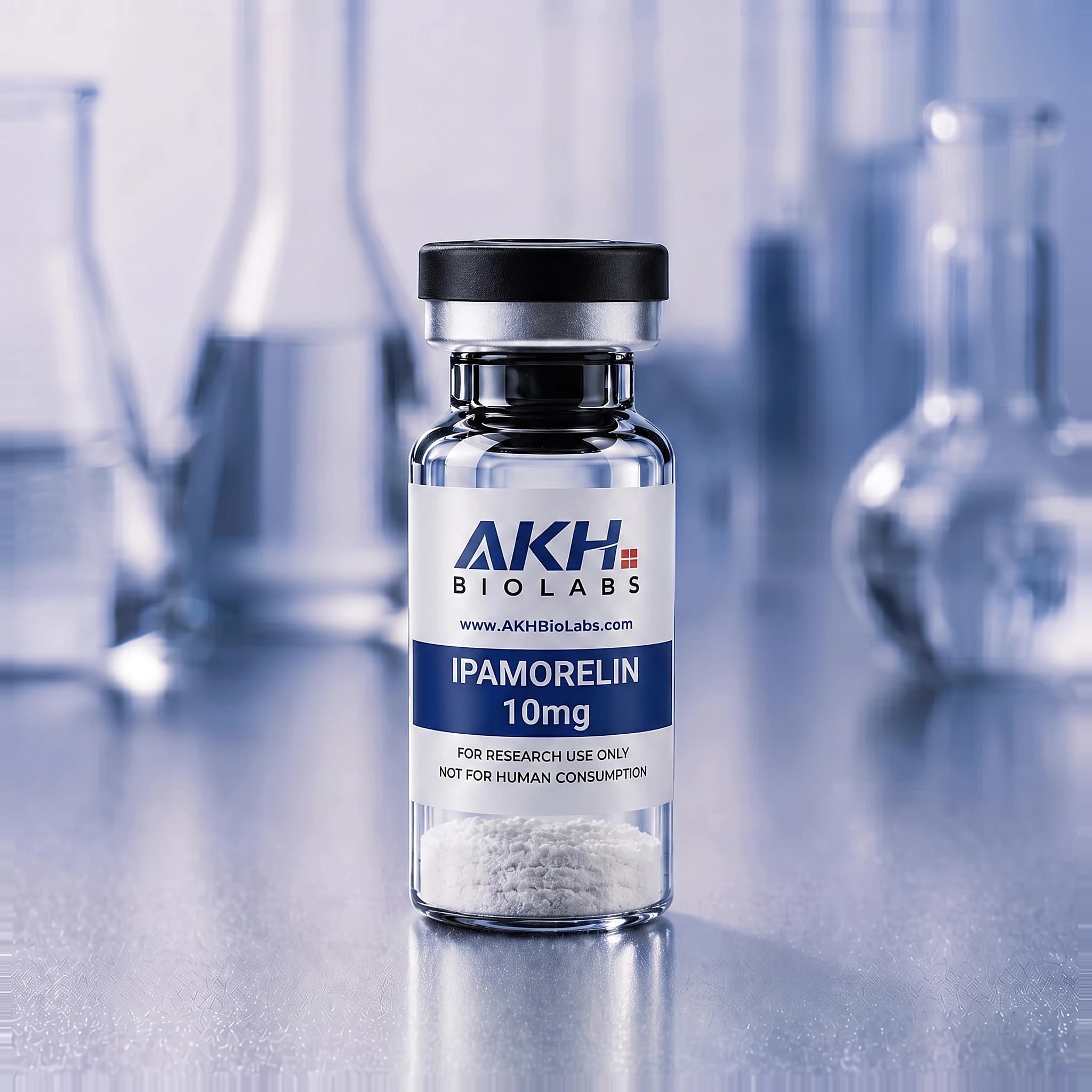
Hormones· Bestseller
In stockIpamorelin
Ipamorelin Acetate
Ipamorelin acetate is supplied as 10mg lyophilised powder for laboratory research. Price is shown in your currency, and its Certificate from a named outside laboratory is published on this page. Not for human or veterinary use.
Size10mgPurity99.58%FormulaC38H49N9O5
Ipamorelin is a synthetic pentapeptide that binds the ghrelin receptor (GHS-R1a) in the pituitary, prompting pulsed release of endogenous growth hormone in research models. It is regarded as one of the cleanest growth hormone secretagogues studied to date because, unlike older peptides in its class, it does not appear to elevate cortisol or prolactin in published assays.
€55
Quantity
HPLC verified
9–14 day shipping
Full COA
Worldwide delivery
About this compound
The research profile.
Ipamorelin is a synthetic pentapeptide (Aib-His-D-2-Nal-D-Phe-Lys-NH2) developed from a series of compounds lacking the central Ala-Trp dipeptide of growth hormone-releasing peptide-1. It acts as an agonist at the growth hormone secretagogue receptor (GHS-R1a) — the same receptor the endogenous ligand ghrelin binds — and stimulates somatotroph release of growth hormone in pituitary cell and whole-animal models.
The characteristic that defines it in the literature is selectivity. The original characterisation reported growth hormone release with a potency and efficacy comparable to GHRP-6, but without the concurrent release of ACTH and cortisol seen with earlier secretagogues at equivalent doses. That separation is why it is described as the first selective growth hormone secretagogue rather than simply another GHRP analogue.
Human pharmacokinetic modelling describes a short terminal half-life of roughly two hours, with a single discrete episode of growth hormone release peaking well under an hour after administration and declining exponentially thereafter. Because it works through a receptor distinct from the GHRH receptor, ipamorelin is frequently co-studied with GHRH analogues, where secretagogue and releasing-hormone pathways have been reported to act synergistically.
Published research
15 peer-reviewed studies on Ipamorelin are summarised in our research library, including 9 published since 2023 — with study designs, reported findings and what the evidence does not establish.
Read the Ipamorelin evidence baseFor research purposes only. Not for human consumption, diagnosis, treatment, or prevention of any condition.
Categorised as Hormones — GH secretagogues, recombinant GH and gonadotropins.
Dosing at a glance
What the literature reports.
For research and laboratory use only. Not for human consumption.
Route
Subcutaneous
Frequency
1–3x daily (study protocols)
Reported range
100–300 mcg
Protocol duration
4–12 weeks
100 mcgper administration300 mcg
Rodent work reports 18–450 mcg per day split across three subcutaneous administrations, and the human pharmacokinetic study dosed by infusion on a nmol/kg basis. The 100–300 mcg figures shown are the per-administration amounts that appear most often in the published protocols; they describe research designs, not guidance for people.
Ranges reflect protocols reported in the published literature on Ipamorelin — see research citations.
Calculate a dilutionReconstitution & storage
From powder to solution.
- Step 01
Add 2 ml bacteriostatic water
Aim the stream at the vial wall rather than the powder.
- Step 02
Swirl gently — never shake
Rotate the vial until the solution runs clear. Agitation degrades the peptide.
- Step 03
Refrigerate at 2–8 °C
Reconstituted vials belong in the fridge, protected from direct light.
- Step 04
Use within 28 days
Discard any remainder once the stability window closes.
Lyophilised · −20 °CReconstituted · 2–8 °C, 28 days
Reconstituted solution is typically held at 2–8 °C and protected from light; sealed lyophilised vials are stored at -20 °C.
Reconstitution calculator
10 mg vialmg
ml
mcg
300 mcg = 0.3 mg
Draw
6units · U-100 insulin syringe
- Concentration
- 5 mg/ml
- Draws per vial
- 33
- Cost per draw
- €1.67
For research and laboratory use only. Not for human consumption.
Laboratory arithmetic for Ipamorelin — enter the COA-verified vial content for exact figures. Not medical advice.
Effect timeline
Observed across the research window.
Milestones summarise findings reported in the cited studies. Outcomes vary across models and protocols.
Minutes 0–60
Single pulse of GH release
Human pharmacokinetic modelling describes one discrete episode of growth hormone release peaking at roughly 0.67 hours, then declining exponentially back toward baseline across all doses studied.
Hours 2–6
Clearance and receptor selectivity
The terminal half-life is reported at about two hours. The original characterisation notes that ACTH and cortisol were not meaningfully elevated at doses producing substantial GH release, which is the selectivity claim attached to this compound.
Week 2
Repeated-administration models
In rats given subcutaneous ipamorelin three times daily for 15 days, investigators recorded dose-dependent differences in longitudinal bone growth rate and body weight against vehicle controls.
Protocol end points
Combination study designs
Secretagogue and GHRH pathways have been reported to act synergistically on GH release in human work, which is why many published designs pair a GHS-R agonist with a GHRH analogue rather than studying either alone.
For research and laboratory use only. Not for human consumption.
Scientific research
The published evidence.
The dosing ranges and timeline milestones on this page summarise the peer-reviewed publications below.
References
- 01
Ipamorelin, the first selective growth hormone secretagogue. Eur J Endocrinol (1998). PubMed · 9849822
- 02
Ipamorelin, a new growth-hormone-releasing peptide, induces longitudinal bone growth in rats. Growth Horm IGF Res (1999). PubMed · 10373343
- 03
Pharmacokinetic-pharmacodynamic modeling of ipamorelin, a growth hormone releasing peptide, in human volunteers. Pharm Res (1999). PubMed · 10496658
- 04
Growth hormone (GH)-releasing peptide stimulates GH release in normal men and acts synergistically with GH-releasing hormone. J Clin Endocrinol Metab (1990). PubMed · 2108187
Laboratory verification
One Certificate, published unaltered.
The Certificate is a test report from a named laboratory outside AKH, ordered by our manufacturer and shown here exactly as the laboratory issued it. A printed copy ships in every parcel.
- Batch
- 26102
- Test date
- 29 Jul 2026
- Task ID
- #1812398
- Purity
- 99.58%
Results
Ipamorelin: 10mg | Purity: 99.58%
Verified by Brown Institute of Biomolecular Research. Scan the full report for every measurement.
Product FAQ
Questions researchers ask.
Pairs well with
Frequently co-studied.
Compounds that appear alongside Ipamorelin in the research literature.
For research and laboratory use only. Not for human consumption.
From the blog
Further reading.
- Research notes
Tesamorelin with ipamorelin: what the combination is
Tesamorelin with ipamorelin is a pairing of two different growth-hormone secretagogue classes, a stabilised GHRH analogue and a selective ghrelin-receptor agonist, and the supplied literature characterises each compound separately rather than studying the pair as a fixed blend.
Read the post - Research notes
What does CJC-1295 do?
CJC-1295 is a synthetic analogue of growth hormone-releasing hormone that acts at the GHRH receptor. This post covers what that means, how CJC-1295 vs sermorelin differs, and what the CJC-1295 ipa pairing is, without dosing or outcome claims.
Read the post - Research notes
CJC-1295 DAC vs CJC-1295 no DAC
The DAC and no-DAC forms of CJC-1295 are different molecules with different published evidence, and a batch certificate of analysis is the document that states which one is in a vial.
Read the post
Hormones