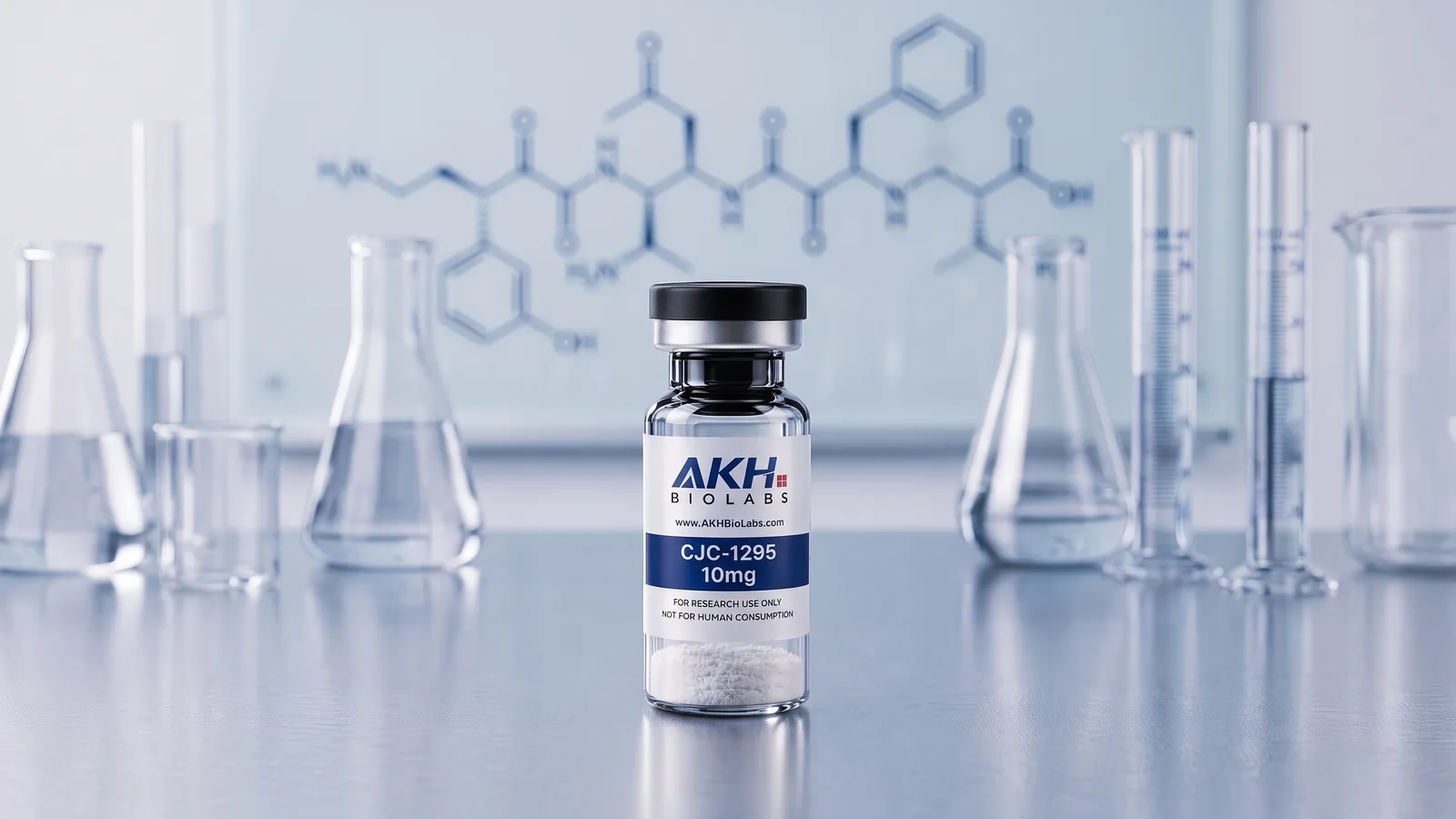
CJC no DAC vs CJC with DAC: what the difference is
CJC no DAC and CJC with DAC are two different molecules: the DAC version carries a drug affinity complex that binds albumin and extends its reported half-life to days, while the no-DAC form clears within hours. What the naming means, what the literature actually compared, and which form the published AKH batch record documents.
CJC no DAC is the growth hormone-releasing hormone analogue without the drug affinity complex modification, and CJC with DAC is the same analogue sequence carrying that modification. The difference is one added chemical group, and it changes how long the molecule persists in circulation: the DAC version binds covalently to circulating albumin, while the no-DAC form does not.
The two names describe two distinct molecules rather than two grades of one product. That distinction matters because the published human pharmacokinetic data belong to the DAC construct, and the research record states plainly that those figures should not be read onto the no-DAC form. This article is written for laboratory researchers and procurement readers who need the naming question answered before they read a certificate or a paper, and it links down to the evidence record rather than restating it.
Key takeaways
- CJC no DAC and CJC with DAC are two different molecules, not two purities of one compound.
- The DAC (drug affinity complex) is a maleimide group that binds covalently to circulating albumin; the no-DAC form lacks it.
- The research record reports a half-life of 5.8 to 8.1 days for the DAC construct and states that the no-DAC form clears within hours.
- The principal human trial dataset used the DAC-modified analogue, and reviews record the frequent substitution of the unmodified form for the one actually studied.
- The published AKH CJC-1295 batch record documents the no-DAC form: batch 26082, tested 02 Aug 2026 by the Brown Institute of Biomolecular Research, results string "CJC 1295 no DAC: 10mg | Purity: 99.94%".
What the drug affinity complex actually is
DAC stands for drug affinity complex. In the CJC-1295 literature it refers to a maleimidopropionyl linker attached to the peptide that forms a covalent bond with circulating albumin, the most abundant protein in plasma. Albumin has a long circulation time of its own, and a peptide bound to it is carried along rather than cleared quickly.
The research record for CJC-1295 describes the mechanism directly: the DAC form carries a maleimidopropionyl linker that forms a covalent drug affinity complex with circulating albumin, extending the plasma half-life to roughly one to two weeks and producing sustained elevation of growth hormone and IGF-1. The same record states that the non-DAC form, more accurately termed modified GRF(1-29), lacks the linker and retains only the tetrasubstituted backbone modifications that resist dipeptidyl peptidase-IV cleavage, giving a short duration of action comparable to sermorelin.
So the two forms share a backbone. Both are built on the N-terminal 29-amino-acid fragment of human GHRH, and both carry amino-acid substitutions that slow enzymatic breakdown. The difference sits entirely in the linker, and the linker is what determines how long the molecule stays in circulation.
Why the two forms are named differently
The naming is descriptive rather than arbitrary. CJC-1295 with DAC names the construct that includes the albumin-binding group. CJC-1295 no DAC, also written Modified GRF 1-29, names the same GHRH analogue sequence without it. The AKH BioLabs product page for the compound states that the vial supplied is the no-DAC form, also written as Modified GRF (1-29), and that it omits the drug affinity complex.
The alternative name, Modified GRF 1-29, is a sequence description rather than a brand. It points to the GHRH(1-29) fragment with modifications, which is what the molecule is. The CJC-1295 label is the catalogue name attached to the same sequence.
The naming collision is where most confusion starts. A search for CJC-1295 returns material about both forms, and a pharmacokinetic figure quoted without a form label is ambiguous. The research record addresses this directly, noting that the published DAC pharmacokinetics describe the DAC construct and should not be read onto the no-DAC form.
What the published literature does and does not compare
The human data are confined to the DAC form. The research record states that human data are confined to a small number of phase I and phase II studies of the DAC form conducted between 2005 and 2009, which established dose-dependent, prolonged growth hormone and IGF-1 elevation with preserved growth hormone pulsatility. The principal trial, published in 2006, used the analogue bearing a drug-affinity complex for albumin binding.
No head-to-head comparison of the two forms in humans was identified. The research record states that no peer-reviewed randomised controlled trial of the non-DAC modified GRF(1-29) form was located, and that most literature published since 2019 concerns anti-doping detection methodology or narrative reviews of unapproved peptide use rather than new clinical data.
The 2026 review literature places CJC-1295 among unapproved peptides marketed for sports medicine use. One such review, indexed as PMID 41966639, contrasts regulator-approved peptide drugs with a parallel market of unapproved compounds and reports that although animal models suggested activity for several agents, rigorous human safety data remained scarce for most unapproved peptides. A separate 2026 critical review, indexed as PMID 41880199, notes that most published studies examine therapeutic applications under controlled regimens rather than the combined protocols common in bodybuilding, and that the clinical evidence supporting peptide use in sport is limited.
The practical consequence is that a figure measured for one form does not describe the other. The research record states that the published DAC pharmacokinetics, a 5.8 to 8.1 day half-life with plasma growth hormone raised for six days or more after a single administration, describe the DAC construct and are not transferable to no-DAC material.
| Property | CJC-1295 with DAC | CJC-1295 no DAC |
|---|---|---|
| Albumin-binding linker | Present (maleimidopropionyl) | Absent |
| Alternative name | CJC-1295 | Modified GRF 1-29 |
| Reported half-life | 5.8 to 8.1 days | Clears within hours |
| Growth hormone signal | Sustained elevation over days | Short pulse |
| Human trial data | Small phase I and II studies, 2005 to 2009 | No peer-reviewed randomised controlled trial located |
Reading the batch record for the no-DAC form
A certificate of analysis is where the form of a specific batch is documented. The published AKH CJC-1295 certificate covers batch 26082, tested 02 Aug 2026 by the Brown Institute of Biomolecular Research, with a purity of 99.94%. The results string reads "CJC 1295 no DAC: 10mg | Purity: 99.94%", and the parenthetical form declaration is the part that answers the DAC question for that batch.
The same pattern appears on the co-lyophilised blend certificate. Batch 26085, tested 05 Aug 2026 by the same laboratory, carries the results string "CJC1295(without DAC)+IPA: 10mg | Purity: 99.58%". The parenthetical declares the form, the "+IPA" names the second component, and the 10mg figure is the total blend mass.
The archive at /lab/coa lists every published certificate by product, batch, purity, test date and laboratory. Each row is one certificate for one batch, tested once by a named laboratory outside AKH. The form declaration sits in the results line, which is why reading that line rather than the product name alone is the reliable check.
What 1756-cjc refers to
The string 1756-cjc is a search form rather than a chemical name. It does not appear in the research record, the product page or the certificate text for this compound, and no source consulted here defines it as a distinct molecule or catalogue entry.
The most likely reading is a fragment of a catalogue or batch reference typed into a search field, in the same way that other compounds in this market accumulate shorthand strings that do not match their formal names. The research record for CJC-1295 lists the identifiers that do carry meaning: CAS 446262-90-4, PubChem CID 91971820, and the alternative written form CJC 1295.
For a reader who arrived through that string, the useful answer is that the compound it points to is CJC-1295, and the form question is answered by the DAC distinction rather than by the string itself. The batch number and test date on a certificate, not the search shorthand, identify the material.
What the evidence does not establish
The research record sets out the limits plainly. Long-term safety, effects on body composition, lean mass, sleep or recovery, glucose tolerance during sustained IGF-1 elevation, and any clinical outcome endpoint remain unestablished for both forms. The compound holds no marketing authorisation in any jurisdiction and appears on the World Anti-Doping Agency Prohibited List.
For the no-DAC form specifically, the gap is wider. No peer-reviewed randomised controlled trial of modified GRF(1-29) was located, so essentially all human data pertain to the DAC-conjugated compound. A reader comparing the two forms is comparing one molecule with a small human dataset against another with no comparable human dataset at all.
The 2026 review literature reinforces the point from a different direction. The critical review indexed as PMID 41880199 concludes that peptides remain experimental substances with poorly defined long-term risks, and that the largely unregulated supply chain compounds the problem because products are often mislabeled or contaminated. That finding applies to the market rather than to any single batch, and it is the reason a batch-specific certificate is the checkable document.
Common questions.
- What is the difference between cjc no dac and cjc with dac?
CJC with DAC carries a maleimidopropionyl linker that forms a covalent drug affinity complex with circulating albumin, which the research record reports extends the plasma half-life to roughly one to two weeks. CJC no DAC, also written Modified GRF 1-29, lacks that linker and clears within hours. They are distinct molecules, and a pharmacokinetic figure measured for one does not describe the other.
- What does 1756-cjc mean?
The string 1756-cjc does not appear in the research record, the product page or the certificate text for this compound, and no source consulted here defines it as a distinct molecule or catalogue entry. It reads as a search shorthand rather than a chemical name. The identifiers that do carry meaning for this compound are CAS 446262-90-4 and PubChem CID 91971820.
Sources
- 01A new era of doping? Use of peptide and peptide-analog drugs in recreational and professional sport and bodybuilding: a critical review.
- 02Safety and Efficacy of Approved and Unapproved Peptide Therapies for Musculoskeletal Injuries and Athletic Performance.
- 03COA archive — every batch we have published · AKH BioLabs
- 04Buy CJC-1295 No DAC 10mg: Batch COA · AKH BioLabs
- 05CJC-1295 research — published studies and evidence · AKH BioLabs
- 06Buy CJC-1295 No DAC + Ipamorelin 5mg+5mg · AKH BioLabs
- 07CJC-1295 + Ipamorelin research — published studies and evidence · AKH BioLabs