Popular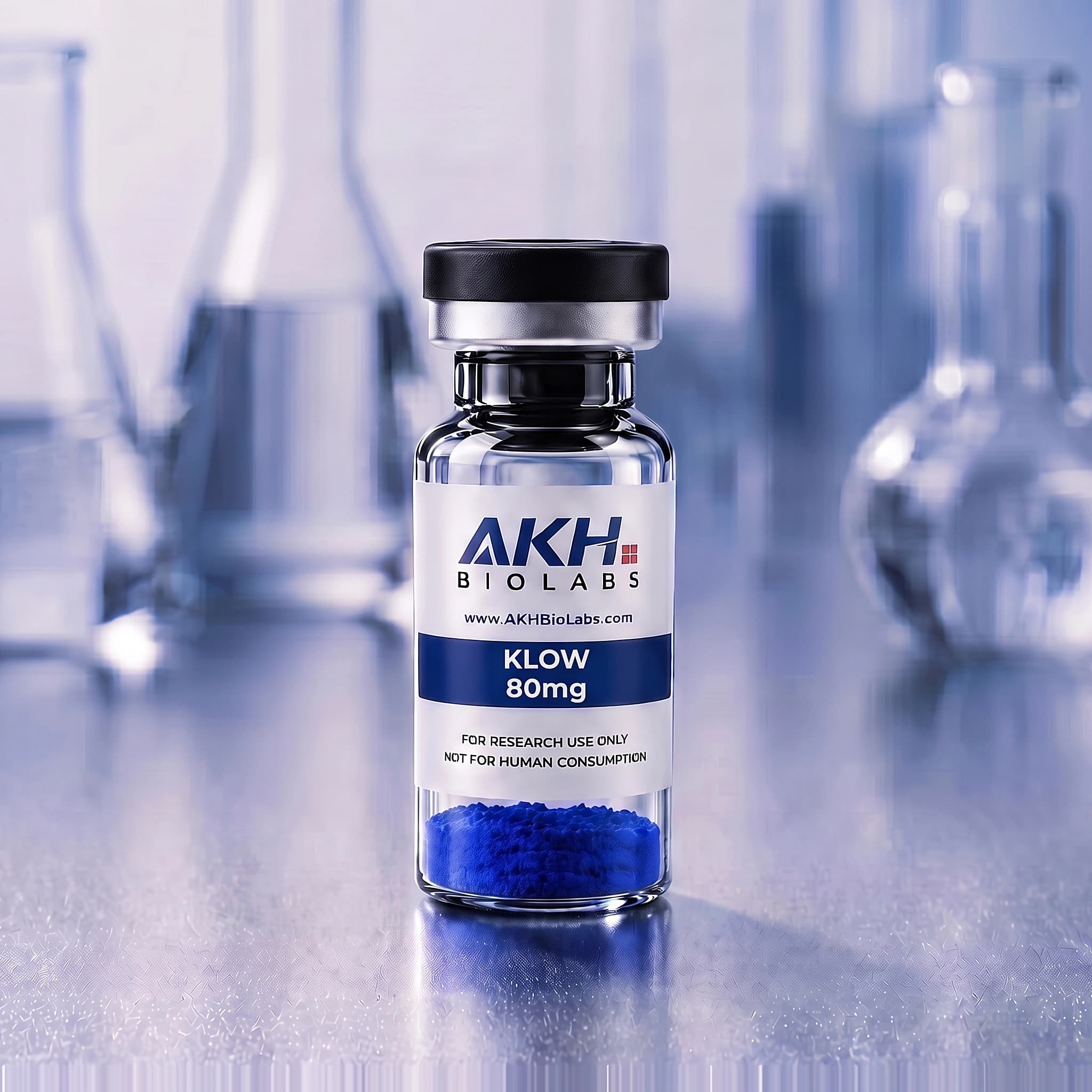
Skin· Popular
In stockKLOW
GHK-cu 50mg, BPC-157 10mg, TB-500 10mg, KPV 10mg blend
Klow is an 80mg lyophilised blend of GHK-Cu 50mg, BPC-157 10mg, TB-500 10mg and KPV 10mg for laboratory research. Price is shown in your currency, and its Certificate from a named outside laboratory is published on this page. Not for human or veterinary use.
Size80mgPurity99.82%
An AKH BioLabs exclusive four-peptide research blend formulated around skin, recovery and anti-inflammatory pathways. Each compound is studied individually for tissue repair, extracellular matrix remodelling or inflammatory signalling; the blend allows researchers to investigate how these pathways interact in a single reconstitution.
€94
Quantity
HPLC verified
9–14 day shipping
Full COA
Worldwide delivery
About this compound
The research profile.
KLOW is a four-component research blend combining BPC-157 (10 mg), TB-500 (10 mg), GHK-Cu (50 mg), and KPV (10 mg) in a single 80 mg vial. Each component occupies a different, overlapping niche in the tissue-repair literature: BPC-157 is a gastric-juice-derived pentadecapeptide studied for fibroblast migration, vascular recruitment, and growth-factor-receptor expression across tendon, ligament, and gut models.
TB-500 is a synthetic fragment of thymosin beta-4, the major actin-sequestering peptide in mammalian cells; wound models report accelerated re-epithelialisation, keratinocyte migration, and angiogenesis with thymosin beta-4 administration. GHK-Cu — the blend's largest component by mass — contributes the copper-peptide axis: collagen synthesis, balanced matrix-metalloproteinase expression, and the broad remodelling gene signature described in the copper-peptide reviews.
KPV, the C-terminal tripeptide of alpha-MSH, rounds out the blend on the inflammatory side: it retains the anti-inflammatory activity of the parent hormone without its melanotropic effects, with published work describing PepT1-mediated cellular uptake and reduced inflammatory signalling in epithelial and immune-cell models. The blend's rationale in the research literature is this complementarity — migration and vascular recruitment, actin-mediated motility, matrix remodelling, and inflammation resolution addressed by four different mechanisms in one vial.
Published research
16 peer-reviewed studies on KLOW Blend are summarised in our research library, including 10 published since 2023 — with study designs, reported findings and what the evidence does not establish.
Read the KLOW Blend evidence baseFor research purposes only. Not for human consumption, diagnosis, treatment, or prevention of any condition.
Categorised as Skin — Copper peptides and compounds for dermal research.
Dosing at a glance
What the literature reports.
For research and laboratory use only. Not for human consumption.
Route
Subcutaneous
Frequency
Once daily
Reported range
4–10 mg
Protocol duration
4–6 weeks
4 mgcombined blend per administration10 mg
Doses for this blend are expressed as combined milligrams of all four peptides. Each draw carries the components in the vial's fixed 10:10:50:10 ratio — an 8 mg draw, for example, contains 1 mg BPC-157, 1 mg TB-500, 5 mg GHK-Cu, and 1 mg KPV. The calculator below shows this per-component breakdown for any dose entered.
Ranges reflect protocols reported in the published literature on KLOW Blend — see research citations.
Calculate a dilutionReconstitution & storage
From powder to solution.
- Step 01
Add 3 ml bacteriostatic water
Aim the stream at the vial wall rather than the powder.
- Step 02
Swirl gently — never shake
Rotate the vial until the solution runs clear. Agitation degrades the peptide.
- Step 03
Refrigerate at 2–8 °C
Reconstituted vials belong in the fridge, protected from direct light.
- Step 04
Use within 28 days
Discard any remainder once the stability window closes.
Lyophilised · −20 °CReconstituted · 2–8 °C, 28 days
The reconstituted blend shows a blue tint from its GHK-Cu fraction — this is expected.
Reconstitution calculator
80 mg vialmg
ml
mg
8 mg = 8000 mcg
Draw
30units · U-100 insulin syringe
- Concentration
- 26.67 mg/ml
- Draws per vial
- 10
- Cost per draw
- €9.40
A draw at this setting contains approximately 1 mg BPC-157 · 1 mg TB-500 · 5 mg GHK-Cu · 1 mg KPV.
For research and laboratory use only. Not for human consumption.
Laboratory arithmetic for KLOW — enter the COA-verified vial content for exact figures. Not medical advice.
Effect timeline
Observed across the research window.
Milestones summarise findings reported in the cited studies. Outcomes vary across models and protocols.
Start
Migration and motility signals
The earliest reported effects of the component peptides are cellular: thymosin beta-4 stimulates keratinocyte migration within days in wound models, and BPC-157 studies describe early fibroblast responses on a similar timescale.
Week 2
Vascular recruitment and granulation
BPC-157 vessel-recruitment effects and thymosin beta-4-associated angiogenesis are described over the second week in the respective injury models.
Week 4
Matrix remodelling
Copper-peptide studies place collagen deposition and balanced metalloproteinase activity in the multi-week window, the phase GHK-Cu contributes to the blend's rationale.
Week 6
Protocol end points
Component studies — including the KPV inflammation models — typically conclude endpoint comparisons in the four-to-six-week range, which most blend research protocols mirror.
For research and laboratory use only. Not for human consumption.
Scientific research
The published evidence.
The dosing ranges and timeline milestones on this page summarise the peer-reviewed publications below.
References
- 01
Novel Cytoprotective Mediator, Stable Gastric Pentadecapeptide BPC 157. Vascular Recruitment and Gastrointestinal Tract Healing. Curr Pharm Des (2018). PubMed · 29879879
- 02
Thymosin beta4 accelerates wound healing. J Invest Dermatol (1999). PubMed · 10469335
- 03
GHK Peptide as a Natural Modulator of Multiple Cellular Pathways in Skin Regeneration. Biomed Res Int (2015). PubMed · 26236730
- 04
PepT1-mediated tripeptide KPV uptake reduces intestinal inflammation. Gastroenterology (2008). PubMed · 18061177
Laboratory verification
One Certificate, published unaltered.
The Certificate is a test report from a named laboratory outside AKH, ordered by our manufacturer and shown here exactly as the laboratory issued it. A printed copy ships in every parcel.
- Batch
- 26145
- Test date
- 24 Jul 2026
- Task ID
- #1812441
- Purity
- 99.82%
Results
Klow(TB+BPC-157+GHK+KPV): 80mg (10mg/10mg/50mg/10mg) | Purity: 99.82%
Verified by Brown Institute of Biomolecular Research. Scan the full report for every measurement.
Product FAQ
Questions researchers ask.
Pairs well with
Frequently co-studied.
Compounds that appear alongside KLOW in the research literature.
For research and laboratory use only. Not for human consumption.
Skin