HCG research chemical: what the term means
The phrase hcg research chemical describes a catalogue category and an intended use, not a purity or identity claim. What the label does and does not assert, for HCG and for retatrutide.
An hcg research chemical is a catalogue designation for human chorionic gonadotropin supplied for laboratory work rather than for human or veterinary use, and the same designation applies to a retatrutide research chemical. The label describes the intended use of the material, not its purity, its identity or its regulatory status.
That distinction matters because the phrase is often read as a quality claim. It is not one. A research-chemical listing says what the material is for; a certificate of analysis says what the material is. The two documents answer different questions, and neither substitutes for the other.
This article is written for laboratory buyers, procurement staff and researchers who encounter the term in catalogue copy and want to know what it commits the supplier to. It covers what the designation means for HCG and retatrutide specifically, how it differs from a purity figure, and where the underlying evidence for each compound is recorded.
Key takeaways
- A research-chemical label states intended use, not purity, identity or approval status.
- HCG and retatrutide sit in different regulatory positions: HCG is an approved medicine in clinical use, while retatrutide remains investigational.
- The purity figure on a certificate is a chromatographic peak-area ratio, not a statement of how much peptide is in the vial by weight.
- The checkable parts of a listing are the batch number, the test date, the named laboratory and the results string.
- The evidence record for each compound lives on its research page, not in the catalogue listing.
What the research-chemical designation actually covers
The term research chemical is a supply category. It marks material that is sold for in-vitro and laboratory investigation and is explicitly not intended for human or veterinary use. On the AKH BioLabs catalogue, both the HCG listing and the retatrutide listing carry that framing in the product description.
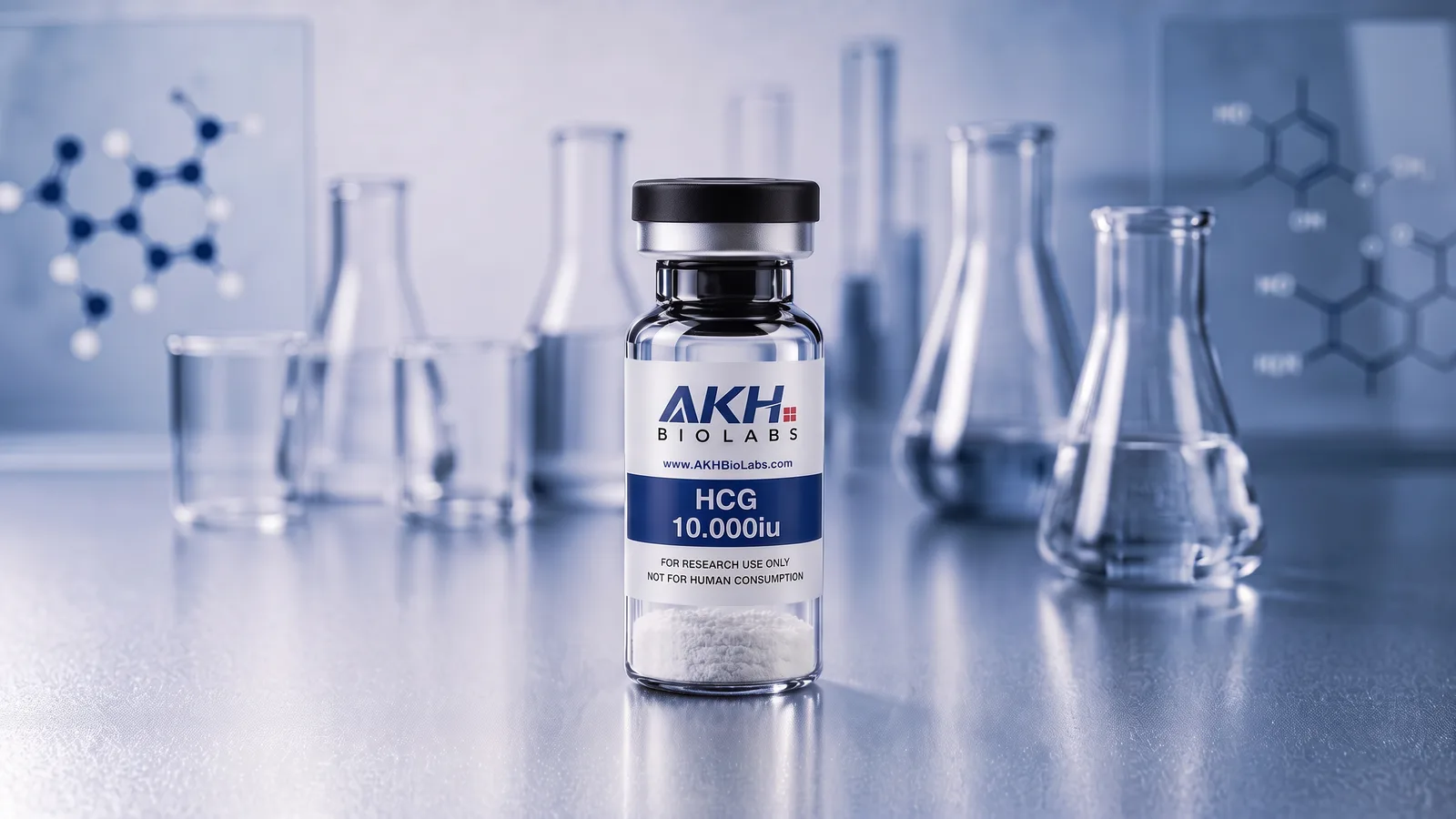
The HCG product page states that the compound is supplied as 10,000 IU lyophilised powder for laboratory research and adds that it is not for human or veterinary use. The retatrutide page uses the same construction, describing 30mg lyophilised powder for in-vitro and laboratory research and closing with the same exclusion.
Nothing in that wording speaks to how pure the material is or whether the identity has been confirmed. Those are separate claims, made on a separate document. The designation is a scope statement: it tells the buyer what the supplier intends the material to be used for, and by implication what the supplier is not representing it as.
HCG and retatrutide sit in different regulatory positions
The research-chemical label is applied to compounds whose underlying regulatory status differs widely, and that difference survives the shared catalogue framing.
Human chorionic gonadotropin is not an investigational molecule. The HCG research record describes it as a heterodimeric placental glycoprotein hormone that shares an alpha subunit with LH, FSH and TSH and signals through the luteinizing hormone/chorionic gonadotropin receptor. The same record notes that urinary-derived hCG and recombinant choriogonadotropin alfa are approved agents used in assisted reproduction and in male hypogonadotropic hypogonadism, and that serum hCG measurement is a core diagnostic assay in pregnancy monitoring and gestational trophoblastic disease.
Retatrutide is at the opposite end of that spectrum. The retatrutide research record states that as of August 2026 the compound was not an approved medicine in any jurisdiction. It is described there as an investigational single-peptide triple agonist of the GIP, GLP-1 and glucagon receptors, with a registrational phase 3 programme and a separate TRANSCEND programme described in published design papers.
A single catalogue label therefore covers an approved medicine and an unapproved investigational compound. The label does not flatten that difference, and it should not be read as doing so. What the two listings share is the intended-use framing, not a regulatory category.
Why the label is not a purity or identity claim
A purity figure and a research-use designation come from different places and assert different things. The designation is catalogue copy. The purity figure is a measurement reported by a laboratory.
On the AKH BioLabs listings, the certificate is described as a test report from a named laboratory outside AKH, ordered by the manufacturer and shown as the laboratory issued it. That description is the useful part, because it names the party that produced the measurement and the party that requested it.
The HCG listing carries batch 26162, tested 10 Aug 2026 by the Brown Institute of Biomolecular Research, with a purity of 99.82% and the results string "HCG: 10000iu | Purity: 99.82%". The retatrutide listing carries batch 26138, tested 10 Aug 2026 by the same laboratory, with a purity of 99.86% and the results string "RT: 30mg | Purity: 99.86%".
Those figures are measurements for those batches. They are not properties of the research-chemical category, and they do not transfer to a different batch. The batch number and test date are what tie a figure to a specific lot of material.
| Attribute | Research-chemical designation | Certificate of analysis |
|---|---|---|
| What it states | Intended use of the material | Measured results for one batch |
| Who produces it | The supplier, in catalogue copy | A named laboratory outside the supplier |
| Does it vary by batch | No | Yes, each batch has its own report |
| Does it confirm identity | No | It reports what the laboratory measured |
| Does it address purity | No | It carries the purity figure for that batch |
What a purity figure on a certificate measures
A chromatographic purity figure is a peak-area ratio taken from the chromatogram. It reports the proportion of the detected signal that belongs to the main peak. It is not a statement of how much of the vial mass is the compound of interest.
That gap has a physical cause. Lyophilised material is normally supplied as a salt and carries residual water, so the mass of powder in a vial differs from the mass of the compound itself. Net peptide content is a separate measurement that accounts for the difference, and it is not the same number as the purity percentage.
For HCG the units differ again. The HCG listing is labelled in international units rather than milligrams, and the results string reads "HCG: 10000iu | Purity: 99.82%". The unit reflects how the material is quantified for this compound, not a conversion from a mass figure.
The practical consequence is that a purity figure answers one question well and several others not at all. It does not confirm identity, it does not state peptide mass, and it does not describe the counterion. Those are separate determinations.
Reading a research-chemical listing in practice
The checkable parts of a listing are the ones that can be traced to a document. A buyer comparing two suppliers of the same compound has more to work with than the headline purity number.
The batch number identifies the specific lot. The test date places the measurement in time. The laboratory name identifies who ran the analysis and whether that party has a commercial stake in the result. The results string is the laboratory's own summary line, reproduced as issued.
Where a listing carries a certificate, the certificate itself is the document to read, not the summary of it. The AKH BioLabs certificate archive holds the published reports, and the guide to reading a certificate of analysis walks through the fields in order.
- 01
Identify the batch
Find the batch number on the listing and confirm the certificate carries the same one. A figure without a batch reference cannot be tied to a specific lot.
- 02
Check the test date
The date places the measurement. It also shows whether the report is the newest one for that product or an earlier lot still on file.
- 03
Name the laboratory
The laboratory that produced the report should be named. Independence is a question about who ran the analysis, not about how the result is described.
- 04
Read the results string as issued
The results line is the laboratory's own summary. It should be reproduced rather than paraphrased, because the wording carries the units and the form declaration.
- 05
Separate the use statement from the measurement
The research-use designation and the certificate answer different questions. Reading one as evidence for the other is where most confusion starts.
Where the compound evidence is recorded
A catalogue listing is not an evidence record. It states what is supplied and under what conditions. The published literature for each compound is summarised separately, with study designs, reported findings and the limits of what the evidence establishes.
The HCG research record covers the compound's receptor pharmacology, its approved clinical uses and the controlled evidence on the compound in weight management, which the record states does not support such use. The retatrutide research record covers the phase 1, phase 2 and phase 3 literature and sets out what remains unestablished, including long-term safety and durability of effect after discontinuation.
Both records link each entry to its source so a finding can be checked against the paper rather than taken on the supplier's word. That is the layer where compound claims belong. The catalogue layer answers a narrower question: what is in the vial and what is it for.
Common questions.
- What is an hcg research chemical?
It is a catalogue designation for human chorionic gonadotropin supplied for laboratory work rather than for human or veterinary use. The AKH BioLabs listing describes the material as 10,000 IU lyophilised powder for laboratory research and states that it is not for human or veterinary use. The designation describes intended use, not purity or identity.
- Is a retatrutide research chemical the same category as HCG?
Both carry the same intended-use framing, but the compounds sit in different regulatory positions. HCG is an approved medicine in clinical use, as the HCG research record describes. Retatrutide remains investigational, and the retatrutide research record states that as of August 2026 it was not an approved medicine in any jurisdiction. The shared label does not flatten that difference.
- Does the research-chemical label mean the material is unregulated or untested?
No. The label describes intended use. Testing is a separate matter documented on a certificate of analysis, which reports measurements for a specific batch. The HCG listing carries batch 26162, tested 10 Aug 2026 by the Brown Institute of Biomolecular Research at 99.82% purity. The designation and the certificate are different documents answering different questions.
- What does an hcg research chem listing tell a buyer about purity?
Nothing directly. The listing states the form, the quantity and the intended use. The purity figure appears on the certificate for a specific batch, not on the category label. For HCG the published figure is 99.82% for batch 26162, and that number applies to that batch rather than to the product line as a whole.
- Why does the purity figure not state how much compound is in the vial?
Because chromatographic purity is a peak-area ratio from the chromatogram, not a mass fraction. Lyophilised material is normally supplied as a salt and carries residual water, so the powder mass differs from the compound mass. Net peptide content is a separate measurement, and for HCG the quantity is expressed in international units rather than milligrams.
Sources
- 01Human chorionic gonadotropin tests.
- 02Determination of human chorionic gonadotropin.
- 03Buy Retatrutide 30mg (GLP-3, Reta): Price & COA · AKH BioLabs
- 04Retatrutide research — published studies and evidence · AKH BioLabs
- 05Buy HCG 10,000 IU: Batch COA · AKH BioLabs
- 06HCG research — published studies and evidence · AKH BioLabs