AKH Signature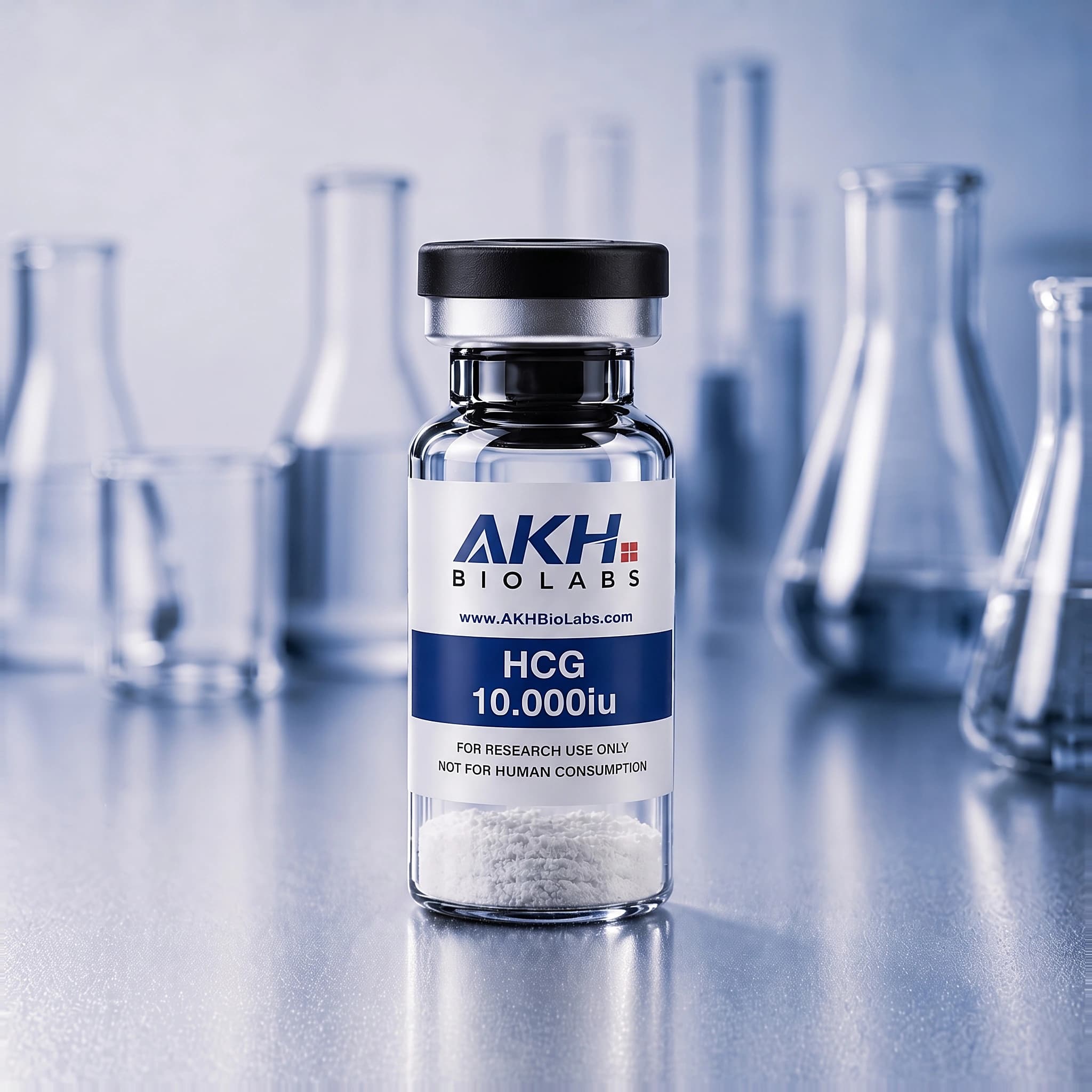
Hormones· AKH Signature
In stockHCG
Human Chorionic Gonadotropin
HCG, human chorionic gonadotropin, is supplied as 10,000 IU lyophilised powder for laboratory research. Price is shown in your currency, and its Certificate from a named outside laboratory is published on this page. Not for human or veterinary use.
Size10000 IUPurity99.82%FormulaBiological Preparation
Human Chorionic Gonadotropin, a glycoprotein hormone composed of α and β subunits that activates the LH/CG receptor. Studied for its roles in corpus luteum support, progesterone signalling, and ovulation triggering in reproductive endocrinology research.
€70
Quantity
HPLC verified
9–14 day shipping
Full COA
Worldwide delivery
About this compound
The research profile.
Human chorionic gonadotropin is a glycoprotein heterodimer built from an alpha subunit shared with LH, FSH and TSH, and a hormone-specific beta subunit. The beta subunit carries a C-terminal peptide extension bearing additional O-linked carbohydrate chains, and that extension is the structural reason hCG persists in circulation far longer than luteinising hormone despite acting at the same receptor.
Both hormones bind the LH/hCG receptor on Leydig cells in the testis and theca cells in the ovary, where signalling drives steroidogenesis. Functionally, hCG therefore acts as a long-acting LH surrogate — the property that makes it a standard tool in endocrine research where sustained LH-receptor stimulation is the experimental variable. Reviews of the molecule stress that the term "hCG" covers several distinct molecular species with different cells of origin and different functions, which matters when interpreting assay results.
Because hCG supplies LH-like activity and no FSH activity, published work has repeatedly used it to isolate the two signals. A 1986 study administering hCG alone to normal men reported that sperm concentration fell relative to the control period, which the investigators interpreted as evidence that normal FSH levels are necessary for quantitatively normal spermatogenesis — an experimental dissociation rather than a treatment result.
Published research
15 peer-reviewed studies on HCG are summarised in our research library, including 12 published since 2023 — with study designs, reported findings and what the evidence does not establish.
Read the HCG evidence baseFor research purposes only. Not for human consumption, diagnosis, treatment, or prevention of any condition.
Categorised as Hormones — GH secretagogues, recombinant GH and gonadotropins.
Dosing at a glance
What the literature reports.
For research and laboratory use only. Not for human consumption.
Route
Subcutaneous
Frequency
2–3x weekly (study protocols)
Reported range
250–1000 IU
Protocol duration
Weeks to many months, depending on protocol
250 IUper administration1000 IU
Endocrine research protocols span a wide range. The 1986 dissociation study administered 5,000 IU intramuscularly twice weekly for seven months, while later review literature describes considerably smaller amounts given two to three times weekly. The 250–1,000 IU per-administration figures shown reflect that smaller end of the reported range; all figures describe research protocols.
Ranges reflect protocols reported in the published literature on HCG — see research citations.
Calculate a dilutionReconstitution & storage
From powder to solution.
- Step 01
Add 2 ml bacteriostatic water
Aim the stream at the vial wall rather than the powder.
- Step 02
Swirl gently — never shake
Rotate the vial until the solution runs clear. Agitation degrades the peptide.
- Step 03
Refrigerate at 2–8 °C
Reconstituted vials belong in the fridge, protected from direct light.
- Step 04
Use within 28 days
Discard any remainder once the stability window closes.
Lyophilised · −20 °CReconstituted · 2–8 °C, 28 days
A 10,000 IU vial in 2 ml gives 5,000 IU/ml — a concentrated solution, so small draws are common and the calculator warning for very small syringe volumes is worth watching. Larger water volumes reduce the concentration and make small amounts easier to measure. Reconstituted solution is held at 2–8 °C and protected from light.
Reconstitution calculator
10000 IU vialIU
ml
IU
Draw
10units · U-100 insulin syringe
- Concentration
- 5000 IU/ml
- Draws per vial
- 20
- Cost per draw
- €3.50
For research and laboratory use only. Not for human consumption.
Laboratory arithmetic for HCG — enter the COA-verified vial content for exact figures. Not medical advice.
Effect timeline
Observed across the research window.
Milestones summarise findings reported in the cited studies. Outcomes vary across models and protocols.
Hours 0–24
LH/hCG receptor engagement
Binding at the LH/hCG receptor on Leydig and theca cells initiates the steroidogenic signalling cascade. The extended C-terminal peptide on the beta subunit is what keeps that signal running longer than native LH.
Days 2–7
Sustained receptor stimulation
The prolonged circulating half-life relative to LH is why published protocols space administrations across days rather than dosing continuously, and why the molecule is used where sustained receptor stimulation is the experimental variable.
Months 3–7
The FSH dissociation experiment
In the 1986 study, seven months of hCG alone in normal men was accompanied by a fall in mean sperm concentration from about 88 to 22 million per ml relative to the control period — the observation that established FSH as necessary for quantitatively normal spermatogenesis.
Protocol end points
Combined gonadotropin designs
Because hCG supplies LH-like activity only, review literature describes protocols pairing it with an FSH-containing preparation when both signals are required by the study design.
For research and laboratory use only. Not for human consumption.
Scientific research
The published evidence.
The dosing ranges and timeline milestones on this page summarise the peer-reviewed publications below.
References
- 01
Biological functions of hCG and hCG-related molecules. Reprod Biol Endocrinol (2010). PubMed · 20735820
- 02
Chronic human chorionic gonadotropin administration in normal men: evidence that follicle-stimulating hormone is necessary for the maintenance of quantitatively normal spermatogenesis in man. J Clin Endocrinol Metab (1986). PubMed · 3084535
- 03
Indications for the use of human chorionic gonadotropic hormone for the management of infertility in hypogonadal men. Transl Androl Urol (2018). PubMed · 30159241
Laboratory verification
One Certificate, published unaltered.
The Certificate is a test report from a named laboratory outside AKH, ordered by our manufacturer and shown here exactly as the laboratory issued it. A printed copy ships in every parcel.
- Batch
- 26162
- Test date
- 10 Aug 2026
- Task ID
- #1812458
- Purity
- 99.82%
Results
HCG: 10000iu | Purity: 99.82%
Verified by Brown Institute of Biomolecular Research. Scan the full report for every measurement.
Product FAQ
Questions researchers ask.
Pairs well with
Frequently co-studied.
Compounds that appear alongside HCG in the research literature.
For research and laboratory use only. Not for human consumption.
Hormones