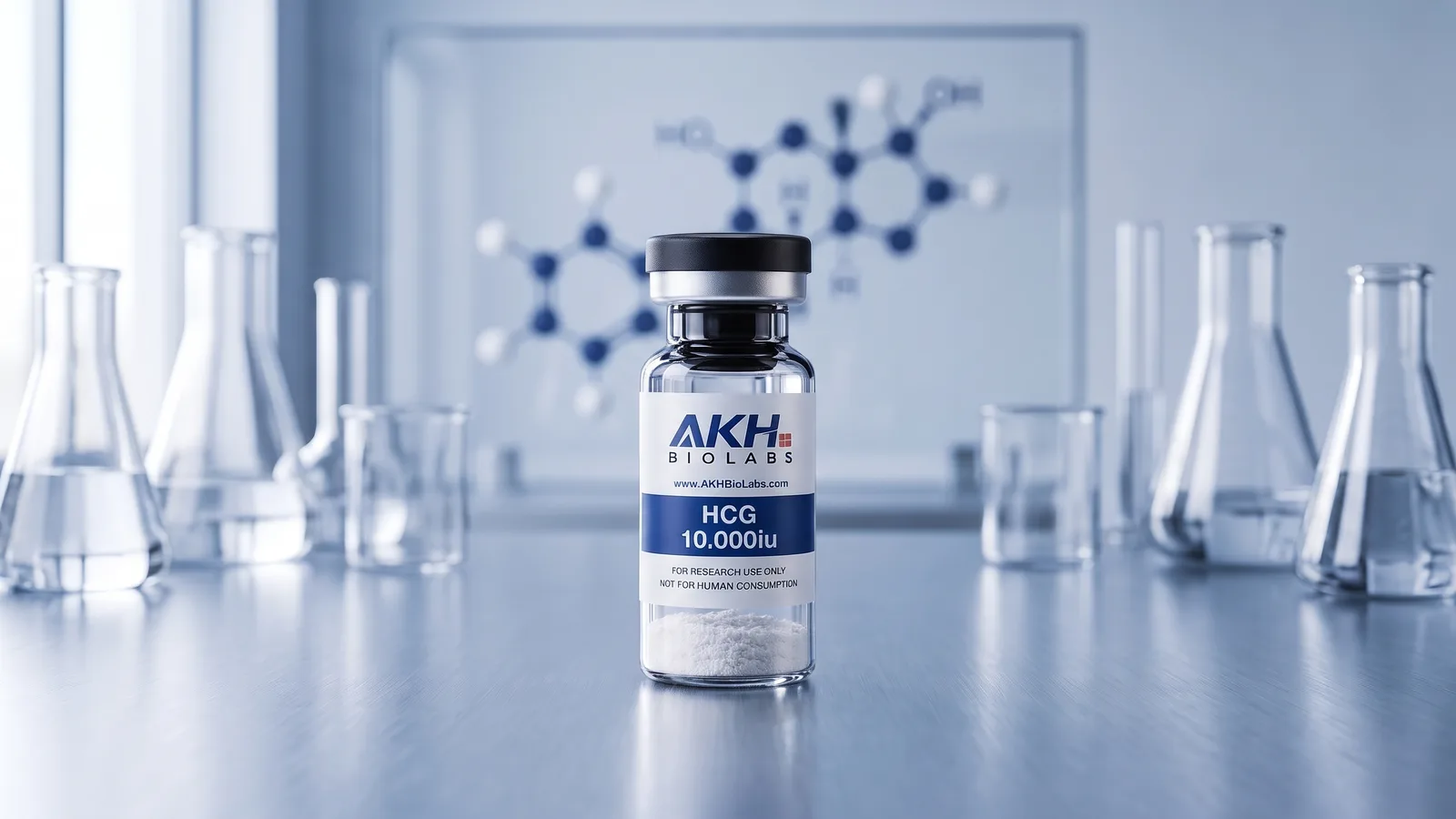
HCG UK: what to check before ordering
An hcg uk buyer's guide: the four public fields that make an HCG listing checkable, the Certificate and purity figure shown on the product page, and how those details appear there.
For an hcg uk search, the buying answer is a seller that publishes a Certificate from a named laboratory outside the seller for that exact product, states the identity and purity that report gives, states the form and the delivery scope, and shows a public review record with its count.
This article is written for laboratory buyers comparing research-use-only listings, and nothing in it describes human or veterinary use. The HCG 10000 IU page publishes each of those fields for its 10000 IU presentation, so it works as a worked example rather than a recommendation.
Key takeaways
- HCG is listed as 10000 IU lyophilised powder for laboratory research: a glycoprotein preparation rather than a short synthetic peptide with a milligram fill.
- The product page states a purity of 99.82% marked HPLC verified and links a Certificate from a named outside laboratory.
- Fill, purity and regulatory status answer three separate questions, and none of them converts into another.
- The Certificate is linked from the product page, so the document can be checked against the listing.
The four fields that make an HCG listing checkable
Four things can be read from public pages without contacting the seller. The first is a Certificate published for that exact product rather than a document reused across a catalogue. The second is the identity and purity the report states. The third is the form and fill supplied. The fourth is the delivery scope together with a public review record, read with the number of reviews behind the score.
The fourth is the weakest of the four, and saying so is part of using it. A review score records service across past orders. It does not state identity, purity or fill, and it cannot be checked against a laboratory report, so it sits beside the certificate rather than in place of it.
- 01
Exact-product Certificate
The report should name the compound and the presentation offered. A document for a different product or a different fill does not describe the material being ordered.
- 02
Identity and stated purity
The AKH BioLabs page names Human Chorionic Gonadotropin and gives 99.82% marked HPLC verified, with the Certificate from a named outside laboratory on the same page.
- 03
Form and fill
The page states 10000 IU lyophilised powder. International units describe a biological preparation rather than a milligram mass, and lyophilised means freeze-dried.
- 04
Delivery and review record
The page states worldwide delivery in 9 to 14 days and shows 4.7 on Trustpilot from 30 reviews, with a stated reshipment or full-refund policy. Neither field states identity or purity.
Why an HCG identity line is not one molecule
The product page describes HCG as a glycoprotein hormone composed of alpha and beta subunits that activates the LH/CG receptor, and its formula field reads Biological Preparation rather than a molecular formula. A 2009 review of hCG tests makes the underlying point directly: human chorionic gonadotropin is not a single biological molecule. It separates regular hCG, hyperglycosylated hCG and a hyperglycosylated free beta subunit, each with different cells of origin, and it notes that most automated commercial laboratory tests, point-of-care tests and over-the-counter tests detect only regular hCG.
A 2013 review approaches the same problem from the measurement side, stating that assay of hCG is complicated by the occurrence of different molecular forms, which are detected to various degrees by different assays. It describes intact heterodimeric hCG as the main form in circulation and the free beta subunit as a minor plasma form, and it records that most of what appears in urine is broken down to a core fragment which is the main immunoreactive form there.
The practical consequence for a buyer is to read identity and purity as separate fields. The page supplies the subunit description and the stated presentation; the certificate supplies one measurement for one batch. A chromatographic purity result describes the detected material in that batch, does not enumerate which molecular forms are present, and says nothing about biological activity.
The published Certificate covers one batch
The product page states that a Certificate from a named outside laboratory is on the page and gives a stated purity of 99.82%. The product page presents that figure as HPLC verified and links the full report. The Certificate is described as coming from a named outside laboratory.
The Certificate is from a named outside laboratory and is linked from the product page. The page also gives the product's stated purity, form and fill. Those are the details the page makes available for checking.
Two figures on that line measure two different things. The 10000 IU is the stated fill, expressed in international units because HCG is a biological preparation. The 99.82% is a chromatographic purity result, a peak-area ratio taken from the chromatogram rather than a mass fraction. A mass-based content figure would be a separate measurement, and the page reports none, so the two should not be combined into a statement about how much protein a vial holds.
What an hcg buy online search should land on
An hcg buy online search should land on a product page that publishes the four fields above, not on a category page that repeats a compound name. The phrase buy hcg peptide is market shorthand rather than a chemical description: HCG is a glycoprotein hormone built from alpha and beta subunits, not a short synthetic peptide, and the page states a biological preparation rather than a molecular formula.
That distinction changes what a listing should show. A page describing this material should give the presentation in international units, name the compound in full and publish a certificate for it. A page that presents HCG as a synthetic peptide with a milligram fill and a molecular formula has not described the material in the terms the product page uses, and the mismatch is a reason to read the certificate before anything else.
The AKH BioLabs page states the presentation as 10000 IU lyophilised powder, gives a purity of 99.82% marked HPLC verified, carries the certificate link, states worldwide delivery in 9 to 14 days and displays 4.7 on Trustpilot from 30 reviews. It also states that the material is supplied for laboratory research and is not for human or veterinary use.
Before ordering: matching the vial to the record
The sequence is short: the research-use-only statement first, then the exact product and its stated fill, then the certificate for the batch. The product page links the Certificate and also states the product's form and fill.
On the HCG 10000 IU page those fields sit together: the 10000 IU presentation, the 99.82% figure marked HPLC verified, the certificate link, the delivery window and the intended-use statement. The price is shown there rather than here, and the delivery scope covers destinations outside the country of dispatch.
What the certificate does not settle is whether HCG suits a particular study, and it confers no regulatory status. Those questions belong to the research record at /research/hcg, which lists 40 published studies, 15 of them since 2023, for a compound it tags as an approved drug. That tag describes the compound's regulatory history; the catalogue entry describes a research-use-only listing, and the two statements sit on different pages for different purposes.
Common questions.
- How is an HCG listing checked before an hcg buy online order?
Four public fields: a certificate for that exact product, the identity and stated purity it carries, the form and fill printed on the page, and the delivery scope with a review count. For the AKH listing those read as a 10000 IU size, a stated purity of 99.82% marked HPLC verified, a Certificate from a named outside laboratory, and worldwide delivery in 9 to 14 days.
- What should be confirmed before deciding to buy hcg peptide for research?
That the listing describes a glycoprotein preparation in international units, publishes a Certificate from a named outside laboratory, and states the delivery scope. A page that instead gives a milligram fill and a molecular formula has described a different kind of material, and the certificate is the document that settles which one is supplied.
- Which fields on the HCG certificate for batch 26162 can be verified?
The compound name, the stated fill in international units, and the purity figure. The page states a 10000 IU size and a purity of 99.82% marked HPLC verified, and the Certificate is from a named outside laboratory. The product page links the full Certificate, so the document can be checked against the listed product details.
- Does the 10000 IU figure on an HCG vial state a protein mass?
No. The 10000 IU is the stated fill, written in international units because HCG is a biological preparation rather than a synthetic peptide measured by mass. The 99.82% is a chromatographic purity result, a peak-area ratio from the chromatogram. A mass-based content figure would be a separate measurement, and the page reports none.
- Why do hCG immunoassays differ in which forms they detect?
Because hCG is not a single biological molecule. The 2009 review separates regular hCG, hyperglycosylated hCG and a hyperglycosylated free beta subunit, and notes that most automated commercial tests detect only regular hCG. The 2013 review adds that different molecular forms are detected to various degrees by different assays, which is why assay specificity is a documented limitation.