How does tirzepatide work at the receptor level?
A receptor-level explanation of how tirzepatide works, covering GIP and GLP-1 engagement, imbalanced and biased dual agonism, and the boundary between pharmacology and clinical evidence.
How does tirzepatide work? The cited pharmacology paper describes tirzepatide as a dual agonist, meaning one peptide that activates two incretin receptors (receptors for gut-derived hormones involved in metabolic signalling): the glucose-dependent insulinotropic polypeptide (GIP) receptor and the glucagon-like peptide-1 (GLP-1) receptor, with greater receptor occupancy at GIP than at GLP-1 and biased signalling at the GLP-1 receptor.
This article explains the receptor mechanism for readers who need the pharmacology rather than a classification answer. It separates what the 2020 paper reports about occupancy and signalling from what a mechanism can and cannot establish, and it points to the compound evidence record for the trial literature.
Key takeaways
- Tirzepatide is LY3298176, a synthetic peptide described as a dual GIP and GLP-1 receptor agonist; the dual label names two receptors, not two molecules.
- The paper's occupancy analysis found greater GIP receptor engagement than GLP-1 receptor engagement, which is what imbalanced refers to.
- At the GLP-1 receptor, the paper reports bias toward cAMP generation over β-arrestin recruitment and weaker receptor internalisation than native GLP-1.
- The findings come from occupancy modelling, signalling assays and primary islet experiments, not from clinical endpoints.
- The registered trial literature is a separate evidence layer, summarised at /research/tirzepatide.
What the dual agonist label means at the receptor level
An agonist is a molecule that binds a receptor and activates it. GIP and GLP-1 are separate receptors for separate gut-derived hormones, so a dual agonist engages two receptor types from one molecule.
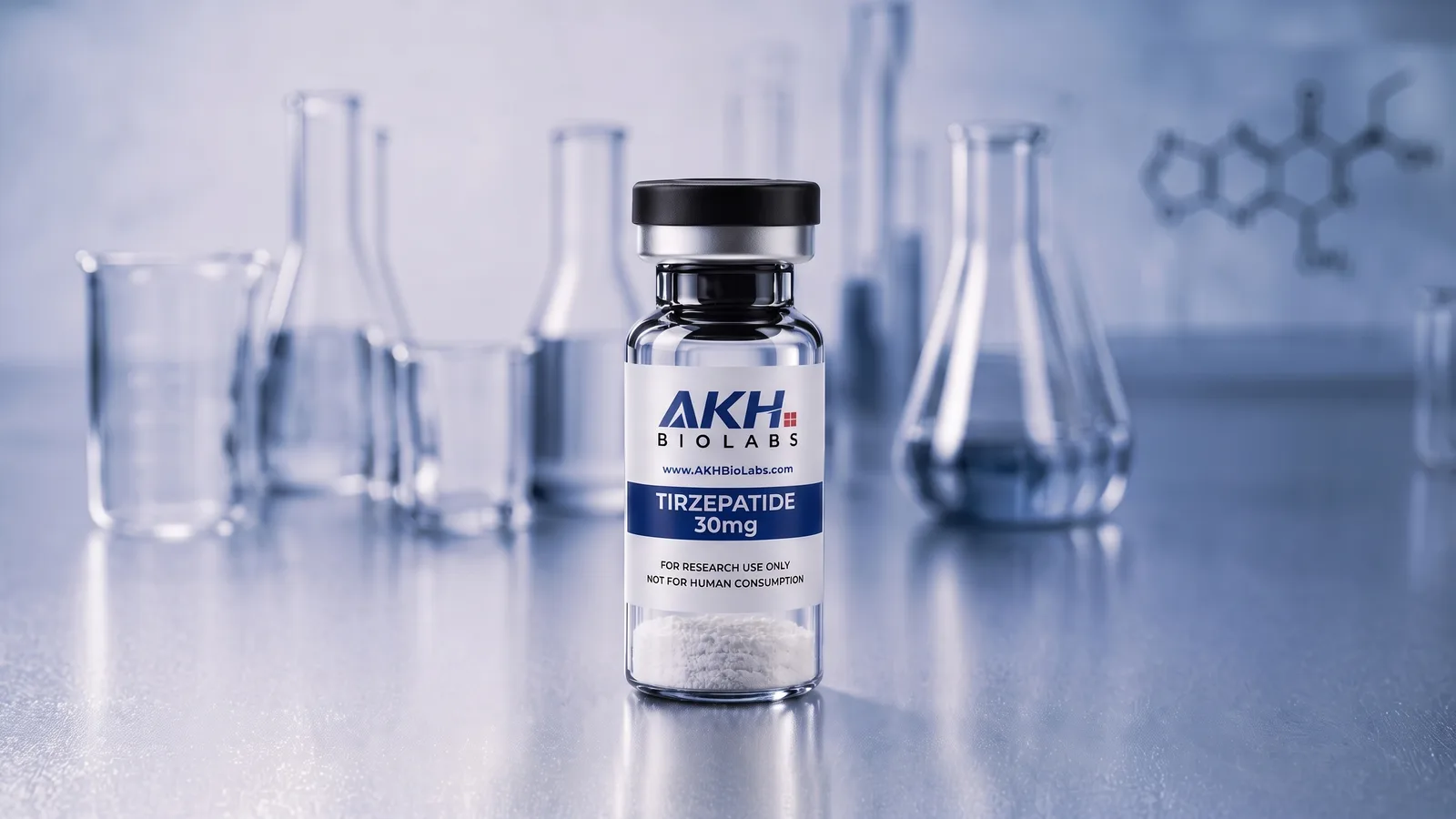
Tirzepatide, development code LY3298176, is described in the product record as a synthetic single-molecule peptide that activates both receptors. The same record describes a 39-amino-acid peptide built on a GIP backbone. That detail matters because the dual label is not a statement that two peptides are present; it describes one peptide with activity at two receptors.
The cited 2020 paper frames tirzepatide as a dual GIP and GLP-1 receptor agonist and reports signalling studies comparing its actions with native GIP and GLP-1. Its answer has two parts: an imbalance in receptor engagement and a bias in GLP-1 receptor signalling.
Imbalanced occupancy: GIP engagement exceeds GLP-1 engagement
Occupancy, in the paper, is the calculated degree to which each receptor is engaged. The paper established a method for calculating occupancy of each receptor, then compared engagement. The analysis found a greater degree of engagement for the GIP receptor than the GLP-1 receptor, which the authors describe as corroborating an imbalanced mechanism of action.
Imbalanced is a comparative statement about the two receptors. It does not mean the GLP-1 receptor is untouched, and it does not mean GIP activity is the only relevant activity. It means the balance of engagement favours GIP in the model used.
Occupancy modelling is not a direct measurement of every tissue in a living organism. It is a pharmacological calculation, and the paper's conclusions about imbalance should be read at that level.
| Receptor | What the cited paper reports | What that does not mean |
|---|---|---|
| GIP receptor | Greater engagement than the GLP-1 receptor in the occupancy analysis; tirzepatide mimics native GIP in signalling. | That GIP activity alone explains every pharmacological effect. |
| GLP-1 receptor | Bias toward cAMP generation over β-arrestin recruitment; weaker drive of receptor internalisation than native GLP-1. | That the GLP-1 receptor is not engaged. |
Biased agonism at the GLP-1 receptor: cAMP versus β-arrestin
Biased agonism means a ligand activates one downstream pathway more than another after binding the same receptor. At the GLP-1 receptor, the paper reports that tirzepatide favours cAMP generation over β-arrestin recruitment and drives less GLP-1 receptor internalisation than GLP-1.
The paper also reports that tirzepatide has a weaker ability than native GLP-1 to drive GLP-1 receptor internalisation. At the GIP receptor, by contrast, the paper states that tirzepatide mimics the actions of native GIP. That contrast is the core of the biased and imbalanced description.
In primary islet experiments, using isolated islet cells, the paper reports that β-arrestin1 limited the response to GLP-1 but not to GIP or tirzepatide. The authors suggest this difference is relevant to the signalling profile. The result is an in vitro observation, not a clinical endpoint.
Why receptor engagement is not a clinical claim
Receptor pharmacology answers a narrow question: what does the molecule do at these two receptors, and through which pathways? It does not answer whether a clinical outcome follows, how large any effect would be, or which participants would respond. Those questions belong to trials.
The cited paper presents the combination of GIP imbalance and distinct GLP-1 signalling as a possible explanation for the compound's pharmacological profile. The word may matters. A mechanism is a hypothesis-generating description, not a result about human health.
The trial literature is summarised at /research/tirzepatide, which lists published studies by design and records what the evidence does not establish. This post does not restate those findings.
Two limits follow. A receptor-level explanation cannot rank tirzepatide against another compound without comparative data. And a description of dual agonism cannot establish clinical effect on its own.
What a batch certificate adds, and what it does not
A certificate of analysis (COA) reports measurements for one batch. The certificate published with the tirzepatide product page covers batch 26124, tested 27 Jul 2026 by the Brown Institute of Biomolecular Research, with a purity figure of 99.9% and the results string 'TR: 30mg | Purity: 99.90%'. The report is from a named laboratory outside AKH, ordered by the manufacturer and shown as issued.
Those fields report the stated vial fill and a purity figure for that batch. They do not report receptor occupancy, cAMP generation, β-arrestin recruitment or internalisation. A certificate and a pharmacology paper are different kinds of evidence, and neither substitutes for the other.
The product record describes the material as lyophilised (freeze-dried) powder for laboratory research and states that it is not for human or veterinary use.
Common questions.
- How does tirzepatide work at the GIP and GLP-1 receptors?
The cited paper describes one peptide engaging both receptors, with greater occupancy at GIP than at GLP-1. At GLP-1 it favours cAMP generation over β-arrestin recruitment and drives less receptor internalisation than native GLP-1. At GIP it mimics native GIP in the signalling assays. These are pharmacological findings, not clinical outcomes.
- What does biased agonism mean for tirzepatide?
Biased agonism means a ligand does not activate every downstream pathway of a receptor equally. At the GLP-1 receptor, the cited paper reports a bias toward cAMP generation over β-arrestin recruitment, with weaker receptor internalisation than native GLP-1. The term describes signalling selectivity, not a clinical result.
- Why is tirzepatide called an imbalanced dual agonist?
Imbalanced refers to the relative engagement of the two receptors. The cited occupancy analysis found greater GIP receptor engagement than GLP-1 receptor engagement. Dual refers to the two receptors; imbalanced refers to the unequal emphasis between them. The label is mechanistic and does not imply a clinical ranking.
- Does receptor occupancy data prove how tirzepatide works in humans?
No. Occupancy modelling and cell-signalling assays describe pharmacological behaviour under experimental conditions. They do not establish clinical effect or response rates. Human evidence comes from trials, which the compound evidence record summarises separately. A mechanism can be consistent with trial findings without proving them.
- Does a tirzepatide certificate of analysis report receptor activity?
No. The certificate for batch 26124, tested 27 Jul 2026 by the Brown Institute of Biomolecular Research, reports the stated fill and a purity figure in the results string 'TR: 30mg | Purity: 99.90%'. Receptor occupancy and signalling are measured in pharmacology experiments, not on a batch certificate.