Is tirzepatide a GLP-1?
Tirzepatide activates the GLP-1 receptor, but it also activates the GIP receptor, so it is a dual GIP and GLP-1 receptor agonist rather than a GLP-1 drug in the same class as semaglutide. Tirzepatide/glycine is a label used on compounded products, and glycine is not an ingredient of the approved medicine.
Is tirzepatide a GLP-1? Partly. Tirzepatide activates the GLP-1 receptor, so it is a GLP-1 receptor agonist, but the same molecule also activates the GIP receptor. That makes it a dual GIP and GLP-1 receptor agonist, a different class from single-target GLP-1 drugs such as semaglutide.
The second question that comes up in the same searches, tirzepatide/glycine, has nothing to do with receptors. It is a label found on compounded tirzepatide products. Glycine does not appear in the ingredient list of the approved medicine.
This note is for researchers and laboratory buyers who want both answers stated plainly, with the sources. The clinical trial record lives on the tirzepatide research page and is not repeated here.
Key takeaways
- Tirzepatide is a single 39-amino-acid peptide that activates two receptors, GIP and GLP-1, so it is a dual agonist rather than a GLP-1 agonist alone.
- Published pharmacology describes it as imbalanced towards the GIP receptor, with a biased signalling profile at the GLP-1 receptor.
- GLP-1, GLP1 and GLP 1 are the same abbreviation, for glucagon-like peptide-1.
- Tirzepatide/glycine is a compounded-product label. The approved medicine contains tirzepatide, sodium chloride, sodium phosphate dibasic heptahydrate and water, with no glycine.
- The FDA declared the tirzepatide shortage resolved, and the temporary allowance for compounded copies ended in March 2025.
Is tirzepatide a GLP1 or a dual agonist?
GLP-1, also written GLP1 or GLP 1, stands for glucagon-like peptide-1, a gut hormone, and for the receptor it acts on. A GLP-1 receptor agonist is a compound that activates that receptor. Semaglutide is the best-known example: it targets the GLP-1 receptor and nothing else.
Tirzepatide was designed differently. The 2018 discovery paper describes LY3298176, the development code for tirzepatide, as a 39-amino-acid peptide built on the GIP sequence and carrying a fatty acid side chain that extends its time in circulation. It activates both the GIP receptor and the GLP-1 receptor from one molecule. So the accurate answer to whether tirzepatide is a GLP-1 is that it is a GLP-1 receptor agonist and a GIP receptor agonist at the same time.
The balance between the two is not equal. A 2020 pharmacology study in JCI Insight titled its finding directly: tirzepatide is an imbalanced and biased dual agonist. Its activity at the GIP receptor is close to that of native GIP, while its activity at the GLP-1 receptor is weaker than native GLP-1 and favours one signalling pathway, cAMP production, over beta-arrestin recruitment.
| Compound | Receptors activated | Class |
|---|---|---|
| Semaglutide | GLP-1 | Selective GLP-1 receptor agonist |
| Tirzepatide | GIP and GLP-1 | Dual GIP and GLP-1 receptor agonist |
| Retatrutide | GIP, GLP-1 and glucagon | Triple receptor agonist |
Why tirzepatide gets called a GLP-1
The label is partly right. The GLP-1 receptor is one of tirzepatide's two targets, and news coverage tends to group every incretin-based medicine under the GLP-1 heading. Searches then shorten the phrase further, to glp-1 tirzepatide or is tirzepatide a glp1.
The clearest sign that the two classes are different is that they have been tested against each other. The SURPASS-2 trial, published in the New England Journal of Medicine in 2021, randomised 1,879 adults with type 2 diabetes to once-weekly tirzepatide or semaglutide 1 mg for 40 weeks. Tirzepatide was non-inferior and superior on the change in HbA1c, and body weight fell more in the tirzepatide groups. A head-to-head trial against a GLP-1 drug exists because tirzepatide is something else.
What does tirzepatide/glycine mean?
Tirzepatide/glycine is a product label used by compounding pharmacies and the telehealth services that sell their products. It names a compounded preparation that combines tirzepatide with glycine, the smallest amino acid. It is not a second drug and it is not a different receptor class.
The approved medicine does not contain glycine. The prescribing information on DailyMed lists tirzepatide plus sodium chloride, sodium phosphate dibasic heptahydrate and water, with hydrochloric acid or sodium hydroxide used to adjust the pH. Multi-dose presentations add benzyl alcohol, glycerin and phenol as preservatives. A product that adds glycine therefore has a different formula from the approved one. We found no published study testing whether adding glycine changes how tirzepatide acts at either receptor.
The background is regulatory. Tirzepatide was on the FDA drug shortage list from December 2022, which temporarily allowed pharmacies to compound copies. The FDA later declared the shortage resolved, and its period of enforcement discretion ended in March 2025. Since then pharmacies may not regularly compound essentially copies of the approved product, and compounded tirzepatide, with or without glycine, has never been FDA-approved.
What a tirzepatide certificate of analysis shows
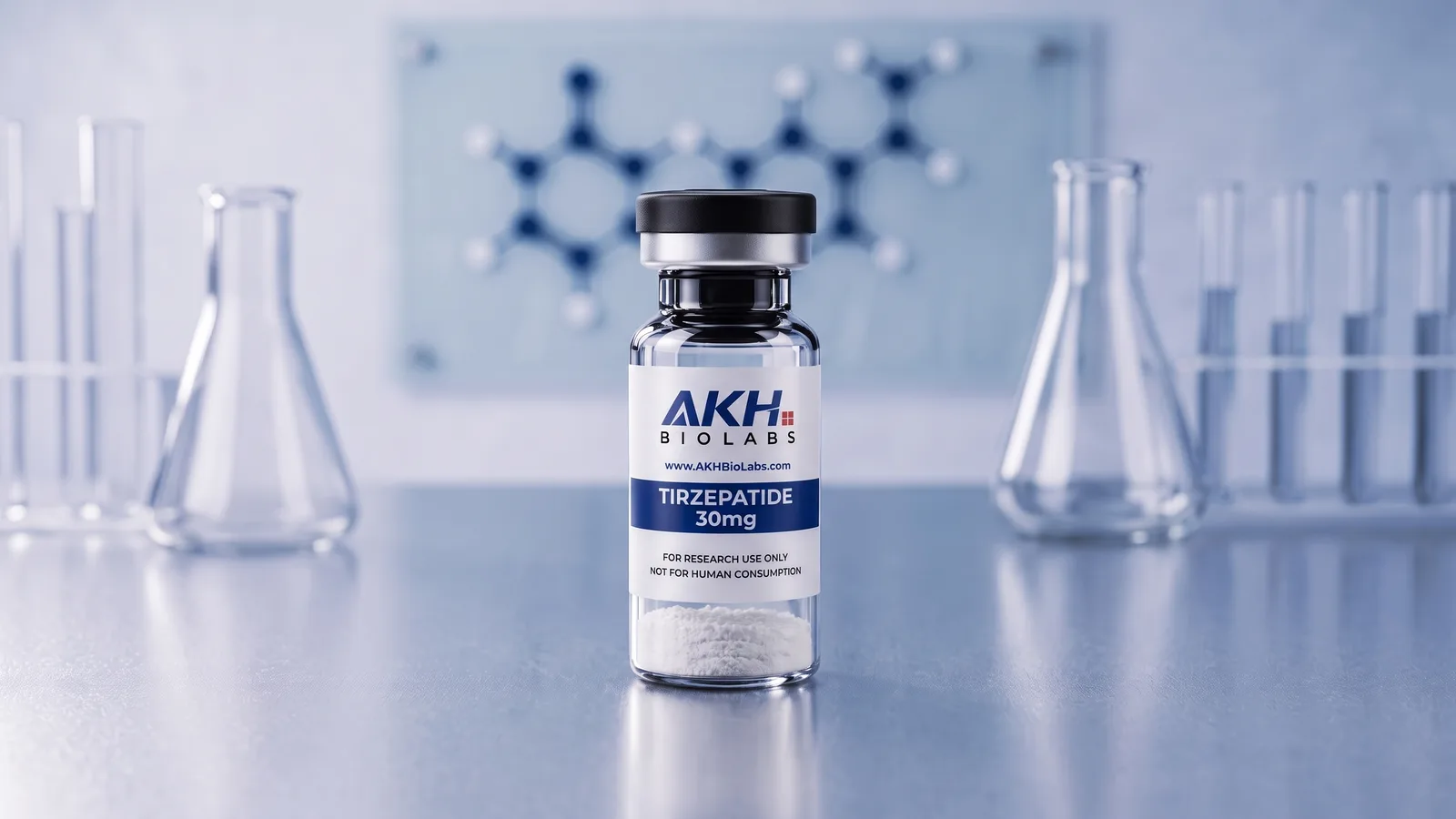
AKH BioLabs supplies tirzepatide as a research material, not as a medicine. The certificate published for the 30mg listing covers batch 26124, tested on 27 July 2026 by the Brown Institute of Biomolecular Research, with the results line "TR: 30mg | Purity: 99.90%". The 10mg listing carries batch 26121, tested on 24 July 2026, at 99.94%.
A certificate records what was measured in one batch: identity, fill mass and chromatographic purity. It does not answer the receptor-class question, and it says nothing about glycine, because the research material is tirzepatide alone.
Common questions.
- Is tirzepatide a GLP1 agonist?
Partly. Tirzepatide activates the GLP-1 receptor, so it is a GLP-1 receptor agonist, but it also activates the GIP receptor. That makes it a dual GIP and GLP-1 receptor agonist, a different class from single-target drugs such as semaglutide.
- Is tirzepatide the same as semaglutide?
No. Semaglutide activates only the GLP-1 receptor. Tirzepatide activates the GIP and GLP-1 receptors. The two were compared head to head in the SURPASS-2 trial, which randomised 1,879 adults with type 2 diabetes for 40 weeks.
- Does the approved tirzepatide medicine contain glycine?
No. The DailyMed prescribing information lists tirzepatide, sodium chloride, sodium phosphate dibasic heptahydrate and water, with pH adjusters, and benzyl alcohol, glycerin and phenol in multi-dose presentations. Glycine appears only in compounded products sold as tirzepatide/glycine.
- Is compounded tirzepatide with glycine FDA-approved?
No. Compounded tirzepatide has never been FDA-approved, with or without glycine. The FDA declared the tirzepatide shortage resolved, and its temporary allowance for compounded copies ended in March 2025.
Sources
- 01LY3298176, a novel dual GIP and GLP-1 receptor agonist for the treatment of type 2 diabetes mellitus: From discovery to clinical proof of concept. Mol Metab, 2018.
- 02Tirzepatide is an imbalanced and biased dual GIP and GLP-1 receptor agonist. JCI Insight, 2020.
- 03Tirzepatide versus Semaglutide Once Weekly in Type 2 Diabetes (SURPASS-2). N Engl J Med, 2021.
- 04Mounjaro (tirzepatide) prescribing information and medication guide, DailyMed
- 05FDA clarifies policies for compounders as national GLP-1 supply begins to stabilize. U.S. Food and Drug Administration
- 06Tirzepatide 30mg product page and batch certificate, AKH BioLabs