LL 37 UK: what to check before ordering LL-37 for research
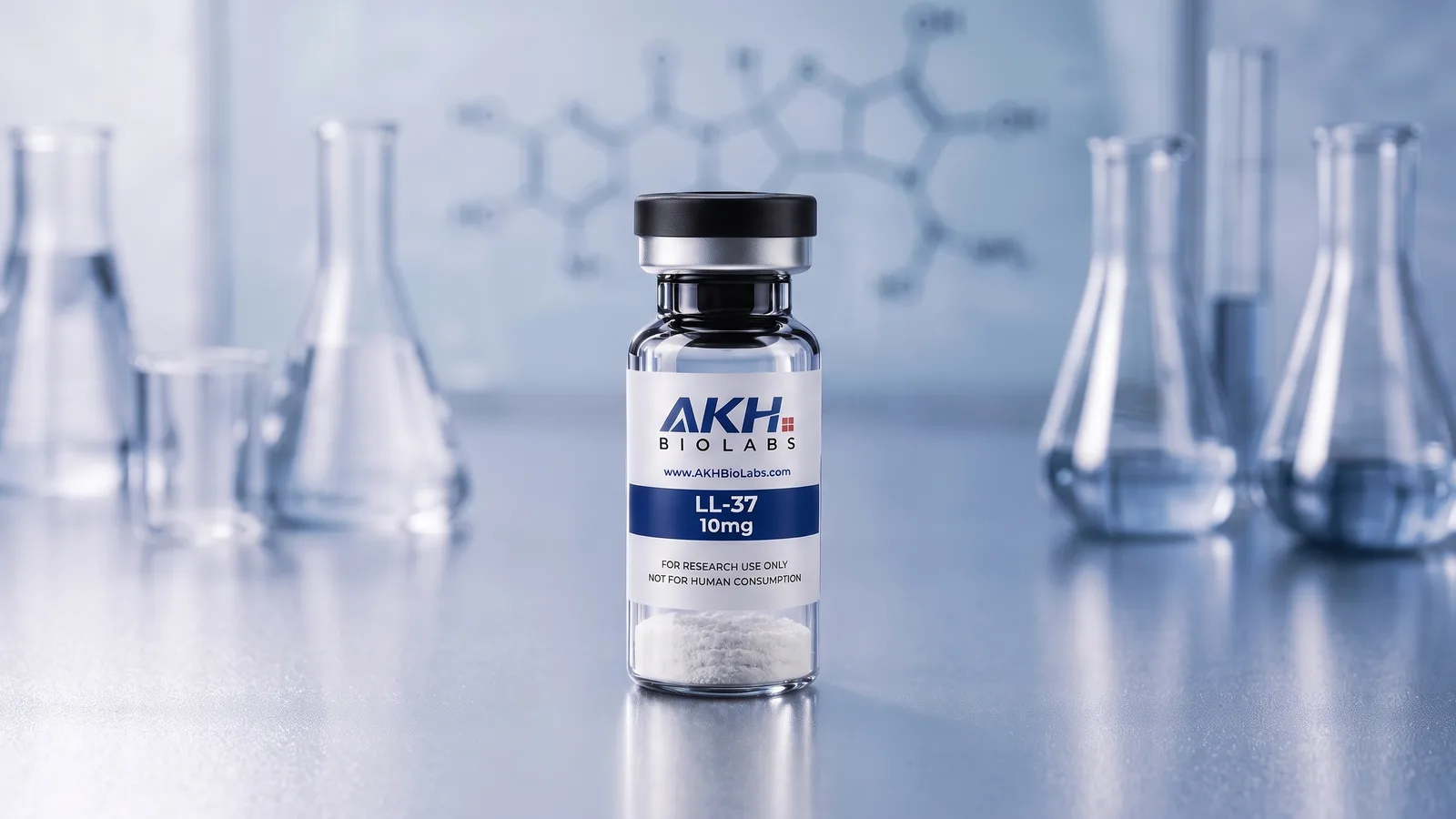
An ll 37 uk buying decision comes down to four public facts, and the AKH BioLabs LL-37 page shows the identity field, a certificate status of pending, a stated worldwide delivery window and a review record.
An ll 37 uk search is really a question about which seller can be checked before payment, and the answer takes the same four facts for any research peptide listing: a certificate published for that exact product from a named laboratory outside the seller, the identity and purity that report gives, delivery to the destination country, and a review record read with its review count. The AKH BioLabs LL-37 page carries a certificate status of pending rather than a published purity figure, so the identity field, the delivery term and the review record are the parts that can be read before an order is placed.
This article is written for laboratory buyers comparing listings, and it keeps the buying checks separate from the compound's evidence record, which lives at /research/ll-37. Each check below is stated as the field it is, with the limits that field carries.
Key takeaways
- Four checks settle a pre-order decision: a certificate for the exact product from a named outside laboratory, the identity and purity it reports, delivery to the destination country, and a review record read with its count.
- The AKH BioLabs LL-37 page states a 10mg presentation, the formula C205H340N60O53 and a certificate status of pending, with delivery stated as worldwide in 9 to 14 days.
- A chromatographic purity figure is a peak-area ratio for the detected material, not a statement of how much peptide sits in the vial.
- The published LL-37 record is largely in vitro and animal work; no LL-37 product is approved, and human interventional data are limited to a small number of formulated products.
The four checks that make an ll 37 vendor listing checkable
A certificate of analysis is a report issued by a testing laboratory for one batch of material. For a pre-order check, the report has to be published by the seller for the exact product on offer, and it has to name the laboratory that produced the measurement. A document that shows a purity figure without a batch number, a test date and a laboratory name cannot be tied to a container.
The remaining three checks are quicker to read than the first. Identity fields state which molecule the material is, the delivery term states where the seller ships and over what window, and the review record states how past orders went. None of the four replaces another, and a listing that is clear on one and vague on the others is only partly checkable.
A product-specific certificate
The document should name the compound and sit on the page for that product. A report covering a product family rather than the material offered is not tied to the vial in question.
Identity and purity as reported
The identity fields say which molecule the report covers, and the purity figure records a chromatographic result for one batch. Both describe the batch the report was issued for.
Delivery to the destination country
A stated shipping scope and timeline is a commercial fact. It settles whether the material can reach the destination and says nothing about its identity.
A review record read with its count
A rating is a service record covering past orders, so it is read alongside the number of reviews behind the score rather than on its own.
What the AKH BioLabs LL-37 page publishes
The product page lists LL-37 as a 10mg presentation of the human cathelicidin antimicrobial peptide, with the certificate status shown as pending and no purity figure claimed. The identity field printed on the page is the molecular formula C205H340N60O53, and the presentation is marked as limited stock. Delivery is stated as worldwide in 9 to 14 days, and the page displays a 4.7 Trustpilot rating from 28 reviews.
The research record adds identifiers that the product page does not print: CAS 154947-66-7, PubChem CID 16198951 and a molecular weight of 4493 g/mol. Those figures come from the PubChem record for the compound and describe the free base rather than the material in a vial. The product page also states that the material is supplied for research purposes only and is not for human consumption, diagnosis, treatment, or prevention of any condition.
Purity, identity and quantity are three different questions
Three separate questions get collapsed into one when a listing shows a percentage. A chromatographic purity figure states what share of the detected material sits in the target peak. It does not state how much of the vial mass is the peptide, because lyophilised peptide is normally supplied as an acetate or trifluoroacetate salt and carries residual water, and the chromatographic result does not resolve that difference.
The stated size is a third quantity again. A 10mg presentation describes the fill offered for that listing, not a net peptide content figure. Net peptide content accounts for the salt and the water, and it is measured separately when it is reported at all.
| Field on a listing | What it states | What it does not settle |
|---|---|---|
| Stated size (for example 10mg) | The fill offered for that presentation | How much of the vial mass is peptide |
| Chromatographic purity figure | The share of detected material in the target peak | The mass of peptide in the vial |
| Molecular formula and CAS number | The identity of the free base | The salt form or residual water of a batch |
| Stated delivery window | The shipping scope and timing offered | Identity or purity of the material |
What the LL-37 research record covers, and what it does not
LL-37 is the only human cathelicidin antimicrobial peptide: a 37-residue amphipathic alpha helix cleaved from the hCAP18 precursor encoded by the CAMP gene, expressed by neutrophils, monocytes and epithelial cells and induced by 1,25-dihydroxyvitamin D3. The research record lists 21 published studies, 13 of them since 2023 with the newest dated 2026, and orders them by strength of study design and then by recency.
The record is candid about the limits. Reported activity runs through direct membrane permeabilisation of microbes, neutralisation of lipopolysaccharide, and receptor-mediated chemotaxis and immunomodulation, and the effect is described as concentration and context dependent. Most of the literature is in vitro or animal work; human interventional data are limited to a small number of formulated products, and the largest controlled trial was negative on its primary analysis. No LL-37 product is approved, and elevated LL-37 is implicated as a pathogenic driver in rosacea, psoriasis and atherosclerosis as well as a host-defence effector.
Before ordering: where each check sits
A pre-order check runs in the same order each time. Read the identity fields first, then the certificate status, then the delivery term, then the review record. Where a report has been published, the batch number is the field that ties it to the container that arrives, so the number on the report and the number on the vial should match.
The product page for LL-37 carries the identity field, the pending certificate status, the worldwide delivery window of 9 to 14 days and the review record, and the research record at /research/ll-37 is where the published studies are listed rather than restated here.
Two of those fields are commercial and two are analytical, and they do not substitute for one another. A delivery window says nothing about identity or purity, and a rating describes service across past orders. Where a certificate has not yet been published, the honest position is that the analytical check is outstanding, and the page states that status rather than filling the gap with a figure.
Common questions.
- Which identity fields does the LL-37 page publish before a certificate is issued?
The product page states the molecular formula C205H340N60O53 and the 10mg presentation, with the certificate status shown as pending. The research record adds CAS 154947-66-7, PubChem CID 16198951 and a molecular weight of 4493 g/mol, noting that those figures describe the free base taken from the PubChem record rather than the powder in a vial.
- What does the stated 10mg size on LL-37 describe?
It describes the fill offered for that presentation. It is not a net peptide content figure. Lyophilised peptide is normally supplied as an acetate or trifluoroacetate salt and carries residual water, so the mass of powder in a vial and the mass of peptide are different quantities, and net peptide content is measured separately when it is reported.
- Does the LL-37 listing state a delivery window for UK addresses?
The page states worldwide delivery in a 9 to 14 day window, which covers destinations in the United Kingdom and elsewhere. That is a commercial statement about reach and timing. It belongs beside the certificate record and the identity fields rather than in place of them.
- How much human interventional data exists for LL-37?
Little, and the record says so. Human interventional data are limited to a small number of formulated products, the largest controlled trial was negative on its primary analysis, and no LL-37 product is approved. The great majority of the published literature is in vitro or animal work.
- Is the formula C205H340N60O53 the mass of powder in a vial?
No. It is the molecular formula of the free base as recorded in the PubChem entry for the compound. Salt form and residual water sit between the formula and the vial contents, and a chromatographic purity result does not resolve that difference either, which is why the two figures answer different questions.