Semax vendor: the checks before an order
A semax vendor is checkable when four public facts line up: an exact-product Certificate from a named outside laboratory, consistent identity and purity fields, delivery to the destination country, and a review record read with its volume.
A semax vendor is best judged on four public facts: a Certificate from a named outside laboratory (a certificate of analysis, or COA) for that exact product, the identity and purity the report states, delivery to the destination country, and a review record read with its volume. A vendor that publishes all four can be checked before payment and rechecked on arrival; a listing that publishes fewer leaves the buyer with a claim rather than a record.
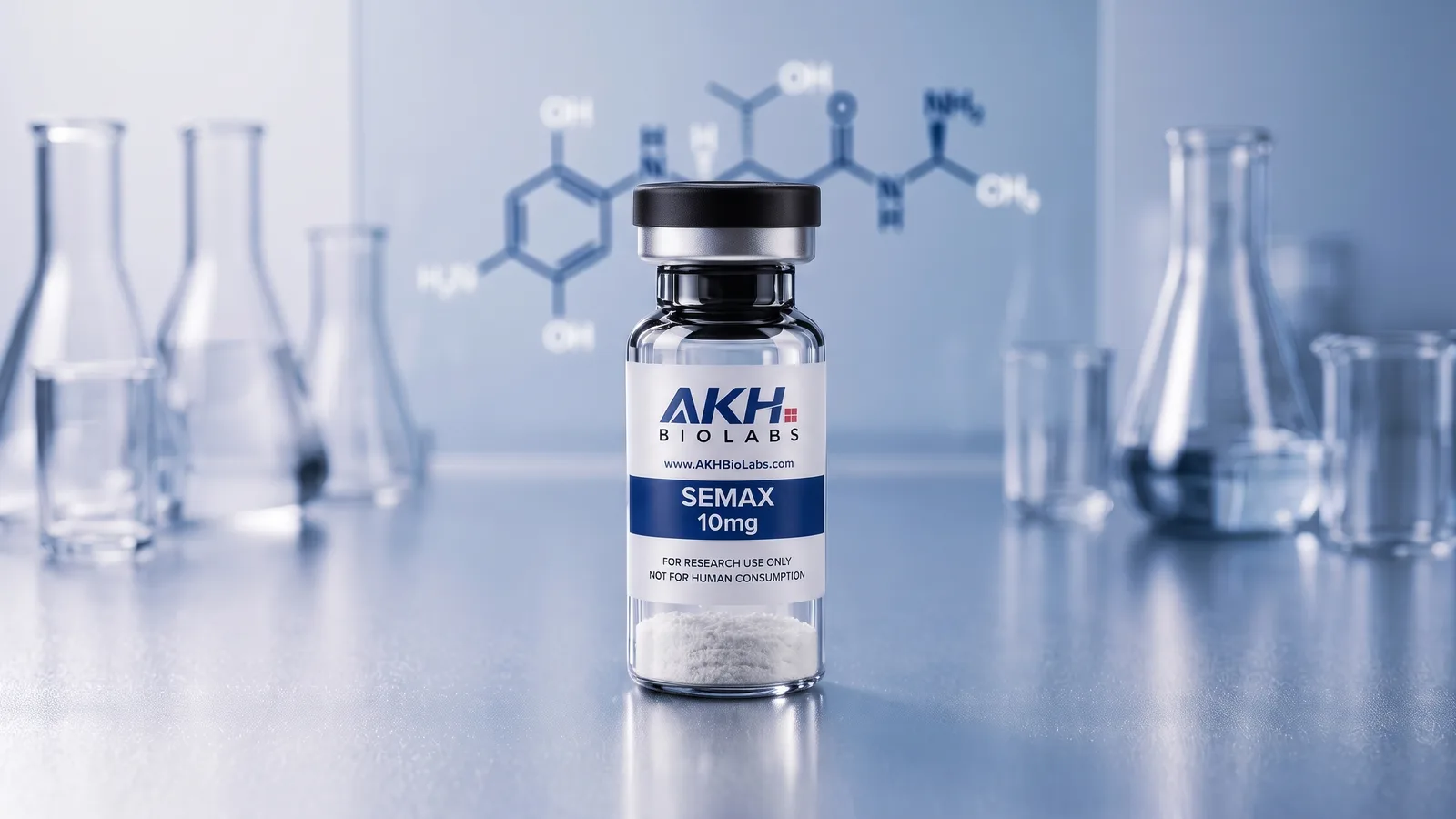
This article is written for laboratory buyers comparing public listing facts for research-use-only Semax. It uses the AKH BioLabs listing as the worked example. The Semax 10mg page states a 10mg lyophilised (freeze-dried) presentation, a 99.93% purity figure labelled HPLC verified (high-performance liquid chromatography), worldwide delivery in a 9 to 14 day window and a 4.7 Trustpilot rating from 29 reviews. The page also publishes a Certificate from a named outside laboratory and states that the material is not for human or veterinary use.
Key takeaways
- Check the exact product first: the Certificate has to belong to the vial being bought, not to the compound family.
- Read the identity fields together: name, formula, CAS number, molecular weight and stated size should not contradict each other.
- A purity figure is a chromatographic result, not a statement of how much peptide is in the vial.
- Confirm delivery to the destination country and read the review score with the number of reviews behind it.
- Stop when a field is missing. A high purity figure cannot fill in a missing batch or laboratory.
What a semax vendor listing should publish
A checkable listing puts four things in public view. First, a Certificate for the exact product, issued by a laboratory outside the seller, not a generic document for the compound family. Second, the identity and purity fields the report gives. Third, the delivery scope and window. Fourth, the public review record with the number of reviews behind it. Each is readable without contacting the seller, and each can be compared with the material on arrival.
The AKH BioLabs Semax page is built around those four. It publishes a Certificate from a named outside laboratory, states a 10mg lyophilised presentation, gives 99.93% as the purity figure, states worldwide delivery in 9 to 14 days, and displays 4.7 on Trustpilot from 29 reviews. The price is shown on the product page rather than in this article. The listing is research-use-only (RUO), and the page states that the material is not for human or veterinary use.
Reading the Semax Certificate without overreading it
One supporting section on the Certificate is enough, because the document answers one question: what did the laboratory measure for this product? A certificate of analysis is read for its product, batch, test date, laboratory and result. A report that names the product but not the batch cannot be tied to a container. A report that gives a purity figure without the laboratory cannot be checked against the laboratory's own record.
Chromatographic purity is a peak-area ratio from the chromatogram, not a statement that 99.93% of the vial mass is Semax. The product page gives 99.93% for the 10mg presentation. The research record notes that lyophilised peptide is normally supplied as a salt with residual water, so the mass of powder in a vial is not the same quantity as the peptide mass, and that chromatographic purity does not resolve the difference. The certificate is not an approval, and it is not a measure of peptide content by mass.
Identity fields: the part a purity figure cannot cover
Identity is a separate check from purity. The product page describes Semax as a synthetic seven-amino-acid analogue of the adrenocorticotropic hormone (ACTH) fragment 4-10 and gives the formula C39H54N10O10S. The research record gives CAS 80714-61-0, PubChem CID 9811102 and a molecular weight of 813.9 g/mol, and states that those figures describe the free base rather than the powder in a vial. A buyer should read those fields together and ask the seller to resolve any contradiction before ordering.
The useful question is not whether a listing has a formula line, but whether the formula, CAS number, molecular weight and stated size describe the same material. A certificate does not settle that question. It reports a measurement for a batch, while the identity fields say what the batch is supposed to be.
Delivery, reviews and the limits of each
Delivery is a commercial fact. The AKH page states worldwide delivery in a 9 to 14 day window, which is the scope to check against the destination country. It does not describe the batch. Reviews are also commercial: the page displays 4.7 on Trustpilot from 29 reviews, which is a service record with its volume attached. A review score without a count is an incomplete field, and neither delivery nor reviews answers what the Certificate answers.
Both fields belong in the decision, but neither replaces the analytical record. A delivery window can be met for a batch whose report is missing, and a review score can be high for a product that has never been checked against a certificate. The four checks are separate for that reason.
What the published Semax research covers
The research record lists 39 published studies, 13 of them since 2023, with the newest dated 2026. It states that human evidence is dominated by Russian clinical studies of stroke and optic neuropathy, with two small placebo-controlled functional magnetic resonance imaging (fMRI) studies in healthy volunteers, and that no regulatory-grade Western trial exists. A 2026 review of peptides in orthopaedics groups Semax with selank and dihexa as neuroactive peptides studied for brain-derived neurotrophic factor (BDNF) and hepatocyte growth factor (HGF) and c-Met receptor pathways. Those are statements about the literature, not about what a vial does.
Regulatory status is part of the buying picture. The research record states that the US Food and Drug Administration (FDA) Pharmacy Compounding Advisory Committee considered Semax for the 503A Bulks List on 23 and 24 July 2026 and recommended its addition on a reported vote of 8 to 5 with one abstention. It also states that the recommendation is not an approval, is not binding, that rulemaking is incomplete, and that the list governs pharmacy compounding rather than research-use-only supply.
Before ordering: where each check sits on the Semax page
The sequence is simple. Start with the exact product and stated size. Then read the Certificate for the batch, test date, laboratory and result. Compare the identity fields across the listing and the research record. Confirm delivery to the destination country. Read the review score with its count. If any of those fields is missing, the listing is only partly checkable.
The Semax 10mg page is where the AKH BioLabs listing shows the 10mg lyophilised presentation, the 99.93% HPLC verified purity figure, the Certificate from a named outside laboratory, worldwide delivery in a 9 to 14 day window and the 4.7 Trustpilot rating from 29 reviews. The price is shown there rather than here. The page also states that the material is for laboratory research and not for human or veterinary use.
Common questions.
- What should be checked on a semax vendor before ordering?
Four public facts: a Certificate from a named outside laboratory for the exact product, the identity and purity fields the report gives, delivery to the destination country, and a review record read with its review count. The AKH BioLabs Semax page publishes each of those for its 10mg presentation, and the price is shown on the product page.
- Does the AKH BioLabs Semax listing publish a Certificate from an outside laboratory?
Yes. The product page states that its Certificate from a named outside laboratory is published on the page, and it gives 99.93% as the purity figure, labelled HPLC verified. The report itself is the document to read for the product, batch, test date, laboratory and result.
- What does the 99.93% purity figure on the Semax listing measure?
It is a chromatographic purity result for that product, not a mass fraction. The research record states that lyophilised peptide is normally supplied as a salt with residual water, so the powder mass and the peptide mass are different quantities, and that chromatographic purity does not resolve the difference. The figure does not state how much peptide is in the 10mg vial.
- Is Semax approved in the United States or European Union?
No. The research record states that no regulatory-grade Western trial exists and that the July 2026 FDA advisory committee recommendation is not an approval. It also states that the recommendation is not binding and that rulemaking is incomplete. The AKH listing itself is research-use-only and not for human or veterinary use.