Popular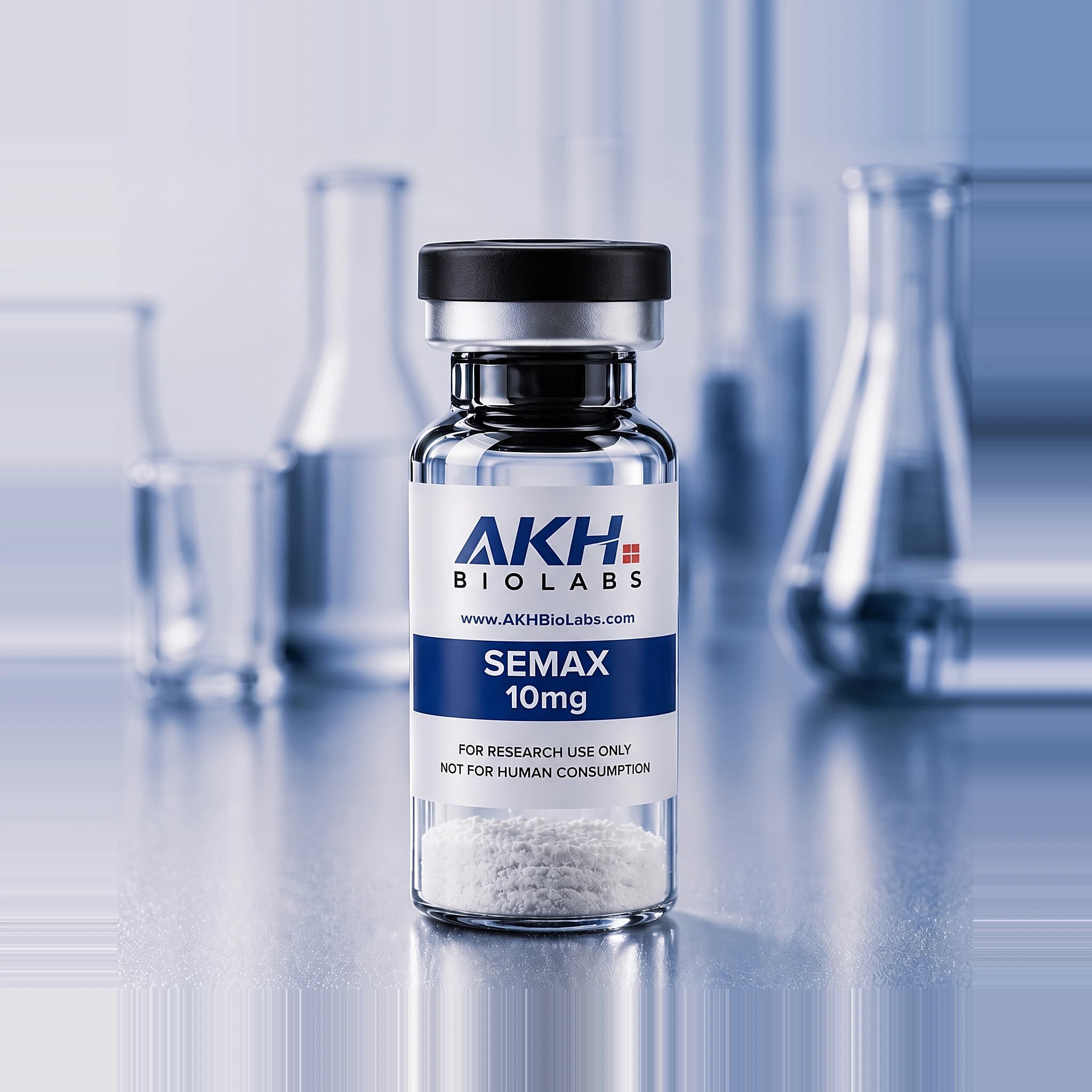
Cognitive· Popular
In stockSemax
Semax Heptapeptide
Semax is supplied as 10mg lyophilised powder for laboratory research. Price is shown in your currency, and its Certificate from a named outside laboratory is published on this page. Not for human or veterinary use.
Size10mgPurity99.93%FormulaC39H54N10O10S
Semax is a synthetic seven-amino-acid analogue of the ACTH(4-10) fragment, developed by Russia's Institute of Molecular Genetics and approved in Russia for cerebrovascular indications. It is researched as a nootropic and neuroprotective probe, with reported effects on BDNF expression, dopaminergic and serotonergic tone, and ischaemic-injury models.
€50
Quantity
HPLC verified
9–14 day shipping
Full COA
Worldwide delivery
About this compound
The research profile.
Semax is a synthetic heptapeptide consisting of the ACTH(4-7) fragment Met-Glu-His-Phe joined to a Pro-Gly-Pro tail. The parent fragment carries none of the corticotropic activity of full-length ACTH, and the Pro-Gly-Pro extension slows peptidase degradation enough for intranasal and parenteral study designs to be workable.
The best-developed line of research concerns neurotrophic signalling. Rodent studies report that Semax raises brain-derived neurotrophic factor protein in the basal forebrain, and separate work describes coordinated changes in BDNF and trkB expression in the hippocampus, with time-course comparisons against nerve growth factor across hippocampus, frontal cortex, and retina. Transcriptome-level analyses in cerebral ischaemia-reperfusion models describe broad shifts in inflammatory and neurotrophic gene programmes rather than a single defined target.
Semax is registered as a medicine in Russia, and much of the clinical record — principally in ischaemic stroke and related indications — is published in Russian-language journals. That literature has not been reproduced in large international trials, so the strength of evidence should be weighed accordingly.
Published research
18 peer-reviewed studies on Semax are summarised in our research library, including 10 published since 2023 — with study designs, reported findings and what the evidence does not establish.
Read the Semax evidence baseFor research purposes only. Not for human consumption, diagnosis, treatment, or prevention of any condition.
Categorised as Cognitive — Neuropeptides for neuroscience research.
Dosing at a glance
What the literature reports.
For research and laboratory use only. Not for human consumption.
Route
Intranasal
Frequency
2–3x daily
Reported range
200–600 mcg
Protocol duration
10–14 days
200 mcgper administration600 mcg
Subcutaneous · Once daily · 200–500 mcg per administration · 1–3 weeks
Intranasal instillation of a dilute aqueous solution is the route used across the Russian clinical literature, with divided daily portions over a ten-to-fourteen day course. Higher amounts appear in the acute-stroke protocols specifically.
Ranges reflect protocols reported in the published literature on Semax — see research citations.
Calculate a dilutionReconstitution & storage
From powder to solution.
- Step 01
Add 2 ml bacteriostatic water
Aim the stream at the vial wall rather than the powder.
- Step 02
Swirl gently — never shake
Rotate the vial until the solution runs clear. Agitation degrades the peptide.
- Step 03
Refrigerate at 2–8 °C
Reconstituted vials belong in the fridge, protected from direct light.
- Step 04
Use within 28 days
Discard any remainder once the stability window closes.
Lyophilised · −20 °CReconstituted · 2–8 °C, 28 days
A 10 mg vial in 2 ml of bacteriostatic water gives a 5 mg/ml solution; a 1 ml fill gives 10 mg/ml, which is closer to the concentrated solutions described in intranasal protocols.
Reconstitution calculator
10 mg vialmg
ml
mcg
300 mcg = 0.3 mg
Draw
6units · U-100 insulin syringe
- Concentration
- 5 mg/ml
- Draws per vial
- 33
- Cost per draw
- €1.52
For research and laboratory use only. Not for human consumption.
Laboratory arithmetic for Semax — enter the COA-verified vial content for exact figures. Not medical advice.
Effect timeline
Observed across the research window.
Milestones summarise findings reported in the cited studies. Outcomes vary across models and protocols.
Start
Early distribution and binding
Binding studies report specific interaction in rat basal forebrain tissue, with BDNF protein differences measurable in the hours following administration.
Days 1–5
Neurotrophic expression dynamics
Time-course work describes coordinated BDNF and trkB expression changes in hippocampus, with comparative NGF dynamics tracked across frontal cortex and retina over the first days of administration.
Week 2
Clinical course end points
The Russian stroke literature reports functional and neurological scale comparisons at the conclusion of a ten-to-fourteen day intranasal course.
Week 4
Transcriptome-level comparisons
Ischaemia-reperfusion studies profile gene expression at later time points, describing sustained differences in inflammatory and neurotrophic programmes relative to controls.
For research and laboratory use only. Not for human consumption.
Scientific research
The published evidence.
The dosing ranges and timeline milestones on this page summarise the peer-reviewed publications below.
References
- 01
Semax, an analogue of adrenocorticotropin (4-10), binds specifically and increases levels of brain-derived neurotrophic factor protein in rat basal forebrain. J Neurochem (2006). PubMed · 16635254
- 02
Semax, an analog of ACTH(4-10) with cognitive effects, regulates BDNF and trkB expression in the rat hippocampus. Brain Res (2006). PubMed · 16996037
- 03
Comparison of the temporary dynamics of NGF and BDNF gene expression in rat hippocampus, frontal cortex, and retina under Semax action. J Mol Neurosci (2010). PubMed · 19662538
- 04
Novel Insights into the Protective Properties of ACTH(4-7)PGP (Semax) Peptide at the Transcriptome Level Following Cerebral Ischaemia-Reperfusion in Rats. Genes (Basel) (2020). PubMed · 32580520
- 05
[The efficacy of semax in the tretament of patients at different stages of ischemic stroke]. Zh Nevrol Psikhiatr Im S S Korsakova (2018). PubMed · 29798983
Laboratory verification
One Certificate, published unaltered.
The Certificate is a test report from a named laboratory outside AKH, ordered by our manufacturer and shown here exactly as the laboratory issued it. A printed copy ships in every parcel.
- Batch
- 26104
- Test date
- 31 Jul 2026
- Task ID
- #1812400
- Purity
- 99.93%
Results
Semax: 10mg | Purity: 99.93%
Verified by Brown Institute of Biomolecular Research. Scan the full report for every measurement.
Product FAQ
Questions researchers ask.
Pairs well with
Frequently co-studied.
Compounds that appear alongside Semax in the research literature.
For research and laboratory use only. Not for human consumption.
Cognitive