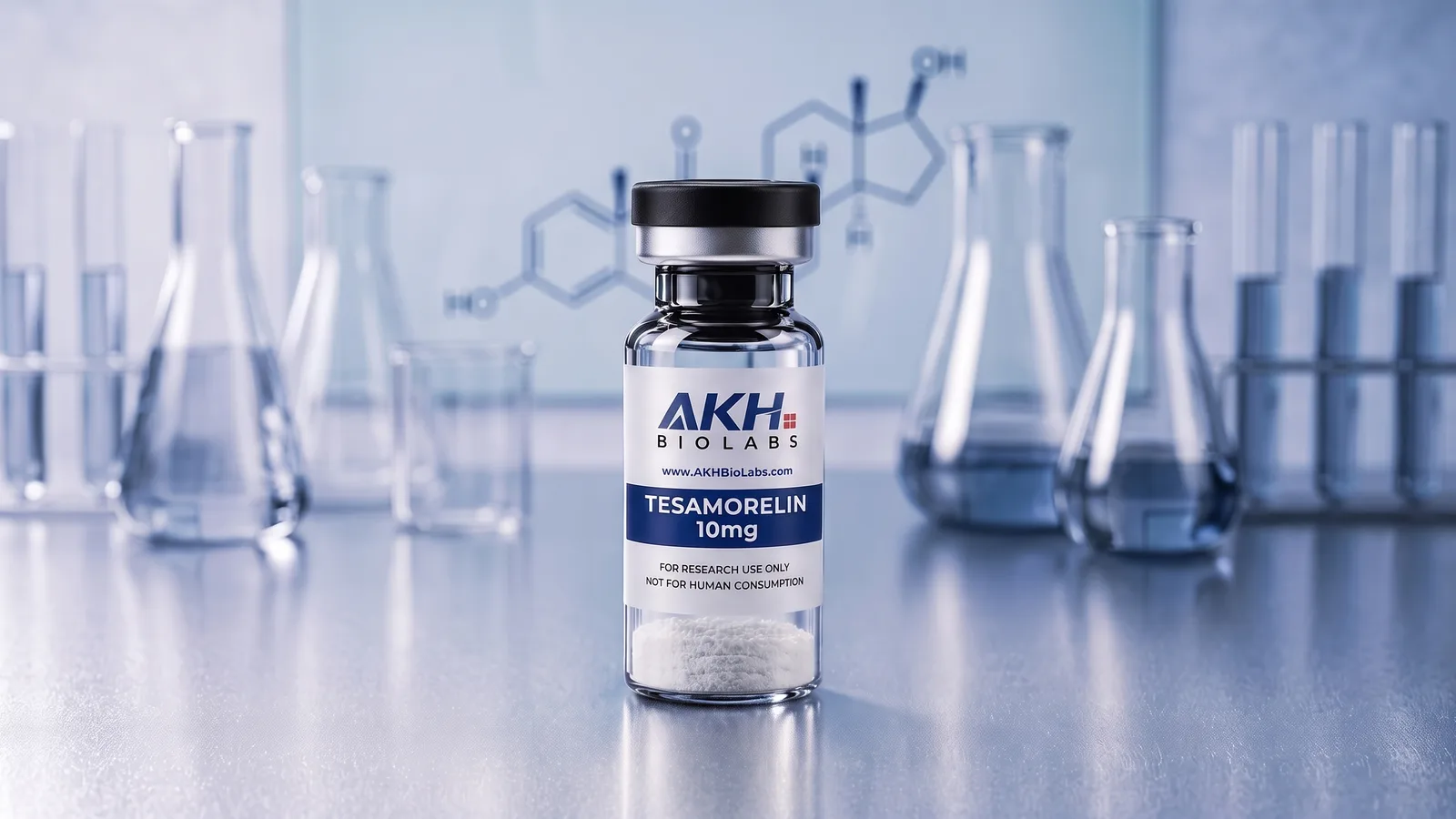
Tesamorelin with ipamorelin: what the combination is
Tesamorelin with ipamorelin is a pairing of two different growth-hormone secretagogue classes, a stabilised GHRH analogue and a selective ghrelin-receptor agonist, and the supplied literature characterises each compound separately rather than studying the pair as a fixed blend.
A tesamorelin and ipamorelin blend is a pairing of two distinct growth-hormone secretagogues, usually supplied together as a co-lyophilised vial: tesamorelin, a stabilised analogue of growth hormone-releasing hormone (GHRH), and ipamorelin, a selective agonist at the ghrelin receptor. The two act at different receptors, and the supplied literature characterises each compound on its own rather than studying the pair as a fixed blend.
This article is written for researchers and laboratory readers who want to know what tesamorelin with ipamorelin actually is, how the two components differ by mechanism class, and what the published record does and does not cover. It does not restate the compound evidence, which lives on the tesamorelin and ipamorelin research records, and it makes no claims about effects in people.
Key takeaways
- Tesamorelin and ipamorelin belong to two different secretagogue classes: a GHRH-receptor analogue and a ghrelin-receptor (GHS-R1a) agonist.
- The pairing is a co-packaged supply format, not a new molecule; each component keeps its own receptor target.
- The supplied sources characterise tesamorelin and ipamorelin separately. No supplied source studies the two together as a fixed blend.
- A certificate of analysis for a combined vial documents the components in one results line, which is how the composition is recorded.
- The full evidence record for each compound sits on its own research page, not in this post.
Two secretagogue classes, not one compound
The pairing brings together two molecules that reach growth-hormone release through different receptors. Tesamorelin is a synthetic analogue of human growth-hormone-releasing hormone (GHRH 1-44), modified at its N-terminus so it resists cleavage by dipeptidyl peptidase-IV. It binds the GHRH receptor on pituitary somatotroph cells.
Ipamorelin is a pentapeptide with the sequence Aib-His-D-2-Nal-D-Phe-Lys-NH2. The 1998 characterisation paper describes it as a growth hormone secretagogue that stimulates growth-hormone release via a GHRP-like receptor, and reports that it did not release ACTH or cortisol at levels significantly different from those seen after GHRH stimulation, even at high doses. That selectivity is the property the paper attaches to the compound.
Because the two act at different receptors, the pairing is described in the literature as a secretagogue plus a releasing-hormone analogue rather than a single agent. The ipamorelin research record notes that secretagogue and releasing-hormone pathways have been reported to act synergistically on growth-hormone release in human work, which is the rationale behind combined designs.
What a tesamorelin and ipamorelin blend actually is
A tesamorelin and ipamorelin blend is a supply format, not a chemical entity. The two peptides are co-packaged, usually lyophilised together in one vial, and each retains its own sequence and receptor target. Combining them in a vial does not create a new molecule, and it does not change what either component is.
This matters for how the material is documented. A certificate of analysis for a single-peptide vial names one component in its results line. A certificate for a combined vial names both, which is how the composition of that specific batch is recorded. The batch number and test date, not the product name, identify the material that was tested.
The distinction also matters for reading the literature. A finding reported for tesamorelin describes tesamorelin, and a finding reported for ipamorelin describes ipamorelin. Neither describes the co-packaged pair, because the supplied sources study the compounds separately.
What the published record covers, and what it does not
The supplied sources characterise the two compounds on their own. The 1998 paper describes ipamorelin's development and pharmacology, including its potency and efficacy relative to GHRP-6 in pituitary cell and whole-animal models, and its lack of effect on ACTH and cortisol. The 2026 paper examines the secondary structure, thermal stability and model-membrane interactions of eight growth-hormone-releasing peptides using electronic circular dichroism spectroscopy, and reports that the approach is a suitable analytical tool for describing their conformational preferences.
Neither supplied source studies tesamorelin together with ipamorelin. The 2026 structural work covers a set of GHRPs as a class and does not pair them with a GHRH analogue. The 1998 characterisation covers ipamorelin alone. On the supplied evidence, the combination is a supply arrangement rather than a studied entity.
That gap is the honest limit of this article. The component-level evidence for each peptide is substantial and is set out on the respective research records. The evidence for the pair, as a pair, is not present in the supplied material.
Reading a certificate for a combined vial
A certificate of analysis is the report a named laboratory issues for a specific batch. For a combined vial, the results line names both components and states the total mass, which is the document's way of declaring what is in that batch.
The checkable parts of any certificate are the same whether one peptide or two are named: the batch number, the test date, the laboratory name, the purity figure and the results string. Those fields identify the material and the measurement. A product name alone does not, because names vary between catalogue copy, laboratory reports and the literature.
The house certificate is a report from a named laboratory outside AKH, ordered by the manufacturer and published unaltered. The full reports are held in the certificate archive, and the guide to reading a certificate of analysis explains what each field measures.
Why the two are paired in research designs
The rationale for pairing a GHRH analogue with a ghrelin-receptor agonist is mechanistic rather than product-driven. The two receptors sit on the same pituitary cell type and engage different signalling inputs, so a design that studies both can examine how the two pathways interact.
The ipamorelin research record states that secretagogue and releasing-hormone pathways have been reported to act synergistically on growth-hormone release in human work, which is why many published designs pair a GHS-R agonist with a GHRH analogue rather than studying either alone. That statement describes the design convention in the literature; it is not a claim about the co-packaged pair.
Tesamorelin's own record notes that it is distinguished among GHRH analogues by its large clinical literature and its minimally modified full-length GHRH sequence. Ipamorelin's record notes that its defining property in the literature is selectivity. Those two profiles are what a combined design brings together.
Where the evidence for each component lives
This post is commentary on what the combination is. The evidence record for each compound is maintained separately, with studies ordered by strength of design and a stated limitations section.
The tesamorelin research record covers the GHRH-receptor and IGF-1 axis work, including the HIV-associated lipodystrophy trials and the later investigator-initiated studies. The ipamorelin research record covers the secretagogue work, including the 1998 characterisation, the pharmacokinetic modelling and the postoperative ileus trial that did not meet its primary endpoint.
Readers who want the citations, the study designs and the stated gaps should go to those records. This article links down to them rather than duplicating their content.
Common questions.
- What is tesamorelin with ipamorelin?
It is a pairing of two growth-hormone secretagogues supplied together, usually as one co-lyophilised vial. Tesamorelin is a stabilised GHRH analogue acting at the GHRH receptor; ipamorelin is a selective agonist at the ghrelin receptor GHS-R1a. They act at different receptors, which is the basis for studying them as a pair.
- Is a tesamorelin and ipamorelin blend a single compound?
No. It is two separate peptides co-packaged in one vial. Each retains its own sequence and receptor target, and combining them does not create a new molecule. A certificate of analysis for such a vial names both components in a single results line, which is how the composition of that batch is documented.
- Has the ipamorelin tesamorelin combination been studied together in published research?
The supplied sources characterise the two compounds separately and do not study them together. The 1998 paper covers ipamorelin alone, and the 2026 structural paper examines a set of growth-hormone-releasing peptides as a class. On the supplied evidence, the combination is a supply arrangement rather than a studied entity.
- How does the combination differ from the tesamorelin vs ipamorelin comparison?
The comparison page contrasts the two compounds against each other. This article answers what the co-packaged combination is and whether the literature covers the pair. The two questions are distinct: one is a contrast, the other is a description of a supply format and its evidence gap.
- Why are tesamorelin and ipamorelin paired in research designs?
They reach growth-hormone release through different receptors: tesamorelin at the GHRH receptor and ipamorelin at the ghrelin receptor GHS-R1a. The ipamorelin research record states that secretagogue and releasing-hormone pathways have been reported to act synergistically on growth-hormone release in human work, which is why combined designs appear in this literature.
Sources
- 01Ipamorelin, the first selective growth hormone secretagogue.
- 02Growth Hormone-Releasing Peptides: Investigation of Their Secondary Structure, Thermal Stability, and Model Membrane Interactions.
- 03Buy Ipamorelin 10mg: Batch COA · AKH BioLabs
- 04Ipamorelin research — published studies and evidence · AKH BioLabs
- 05Buy Tesamorelin 10mg: COA & Research Supply · AKH BioLabs
- 06Tesamorelin research — published studies and evidence · AKH BioLabs