Premium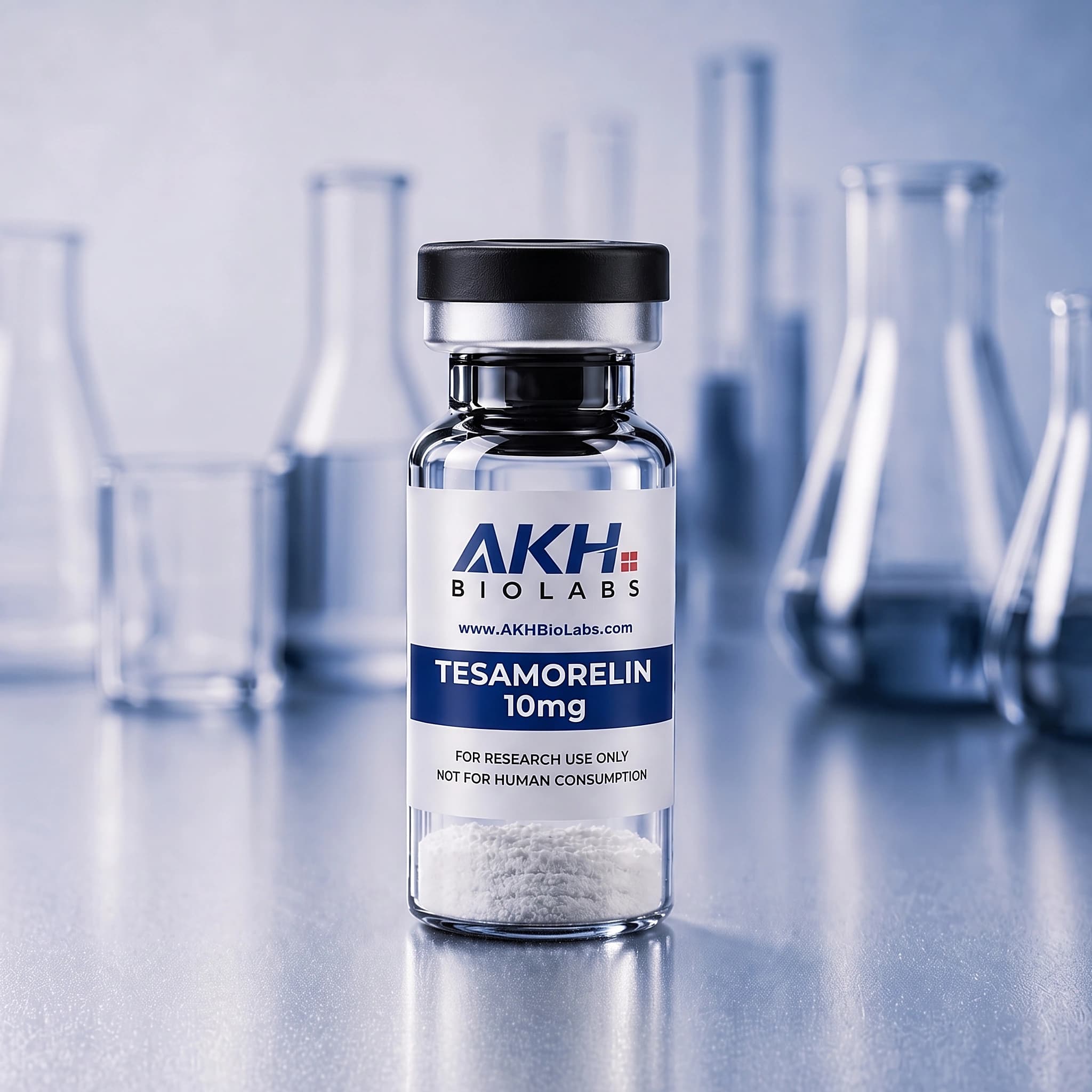
Metabolic· Premium
In stockTesamorelin
Tesamorelin Acetate
Tesamorelin acetate is supplied as 10mg lyophilised powder for laboratory research. Price is shown in your currency, and its Certificate from a named outside laboratory is published on this page. Not for human or veterinary use.
Size10mgPurity99.66%FormulaC221H366N68O67S
Tesamorelin is a stabilised 44-amino-acid analogue of growth hormone-releasing hormone (GHRH), modified at the N-terminus to resist DPP-4 enzymatic degradation. Developed by Theratechnologies and approved by the FDA in November 2010 as Egrifta, it is the only currently approved GHRH analogue and is widely studied in metabolic research around visceral adipose tissue, lipid profiles and pulsatile GH/IGF-1 signalling.
€100
Quantity
HPLC verified
9–14 day shipping
Full COA
Worldwide delivery
About this compound
The research profile.
Tesamorelin (TH9507) is a synthetic analogue of human growth-hormone-releasing hormone (GHRH 1-44) modified by the addition of a trans-3-hexenoyl moiety to the tyrosine at position 1. Preclinical characterisation reports that this modification confers resistance to cleavage by dipeptidyl peptidase-IV, extending the molecule's stability relative to native GHRH while preserving its receptor pharmacology.
The peptide binds the GHRH receptor on pituitary somatotroph cells. In a controlled study in healthy men, daily administration augmented both basal and pulsatile growth hormone secretion and raised circulating IGF-1, with the physiological pulse architecture of GH release retained — a point the literature uses to distinguish GHRH-receptor agonists from exogenous growth hormone itself, since the hypothalamic feedback loops (somatostatin tone, IGF-1 negative feedback) remain in place.
Tesamorelin has one of the larger clinical literatures among GHRH analogues, including 26-week phase 3 programmes with 26-week safety-extension data, and it has been approved in some jurisdictions for a specific clinical indication. The material supplied here is a lyophilised research compound intended solely for laboratory study of GHRH-receptor and IGF-1 axis biology.
Published research
15 peer-reviewed studies on Tesamorelin are summarised in our research library, including 11 published since 2023 — with study designs, reported findings and what the evidence does not establish.
Read the Tesamorelin evidence baseFor research purposes only. Not for human consumption, diagnosis, treatment, or prevention of any condition.
Categorised as Metabolic — GLP-1 and GIP receptor agonists for metabolic research.
Dosing at a glance
What the literature reports.
For research and laboratory use only. Not for human consumption.
Route
Subcutaneous
Frequency
Once daily
Reported range
1–2 mg
Protocol duration
26 weeks (clinical study protocols)
1 mgper administration2 mg
Published clinical studies most commonly investigate a fixed 2 mg once-daily amount; the 2-week pulsatility study in healthy volunteers used the same figure. All values describe study protocols, not guidance for use.
Ranges reflect protocols reported in the published literature on Tesamorelin — see research citations.
Calculate a dilutionReconstitution & storage
From powder to solution.
- Step 01
Add 2 ml bacteriostatic water
Aim the stream at the vial wall rather than the powder.
- Step 02
Swirl gently — never shake
Rotate the vial until the solution runs clear. Agitation degrades the peptide.
- Step 03
Refrigerate at 2–8 °C
Reconstituted vials belong in the fridge, protected from direct light.
- Step 04
Use within 28 days
Discard any remainder once the stability window closes.
Lyophilised · −20 °CReconstituted · 2–8 °C, 28 days
Reconstitution calculator
10 mg vialmg
ml
mg
1 mg = 1000 mcg
Draw
20units · U-100 insulin syringe
- Concentration
- 5 mg/ml
- Draws per vial
- 10
- Cost per draw
- €10.00
For research and laboratory use only. Not for human consumption.
Laboratory arithmetic for Tesamorelin — enter the COA-verified vial content for exact figures. Not medical advice.
Effect timeline
Observed across the research window.
Milestones summarise findings reported in the cited studies. Outcomes vary across models and protocols.
Start
GH pulse augmentation
In healthy volunteers, augmentation of basal and pulsatile growth hormone secretion is reported within the first days of daily administration, with pulse architecture preserved.
Week 2
IGF-1 axis response
Circulating IGF-1 elevations are documented at the two-week assessment point, reversing after a two-week withdrawal period in the same study.
Week 26
Primary study endpoints
The phase 3 programmes ran 26-week randomised primary phases, at which point endpoint comparisons against placebo and IGF-1 axis measures were reported.
Week 52
Safety-extension data
Pooled analyses include a further 26-week safety-extension window, providing longer-term tolerability and IGF-1 monitoring data.
For research and laboratory use only. Not for human consumption.
Scientific research
The published evidence.
The dosing ranges and timeline milestones on this page summarise the peer-reviewed publications below.
References
- 01
Metabolic effects of a growth hormone-releasing factor in patients with HIV. N Engl J Med (2007). PubMed · 18057338
- 02
Effects of tesamorelin (TH9507), a growth hormone-releasing factor analog, in human immunodeficiency virus-infected patients with excess abdominal fat: a pooled analysis of two multicenter, double-blind placebo-controlled phase 3 trials with safety extension data. J Clin Endocrinol Metab (2010). PubMed · 20554713
- 03
Non-clinical pharmacology and safety evaluation of TH9507, a human growth hormone-releasing factor analogue. Basic Clin Pharmacol Toxicol (2007). PubMed · 17214611
- 04
Effects of a growth hormone-releasing hormone analog on endogenous GH pulsatility and insulin sensitivity in healthy men. J Clin Endocrinol Metab (2011). PubMed · 20943777
Laboratory verification
One Certificate, published unaltered.
The Certificate is a test report from a named laboratory outside AKH, ordered by our manufacturer and shown here exactly as the laboratory issued it. A printed copy ships in every parcel.
- Batch
- 26094
- Test date
- 14 Aug 2026
- Task ID
- #1812390
- Purity
- 99.66%
Results
Tesamorelin: 10mg | Purity: 99.66%
Verified by Brown Institute of Biomolecular Research. Scan the full report for every measurement.
Product FAQ
Questions researchers ask.
Pairs well with
Frequently co-studied.
Compounds that appear alongside Tesamorelin in the research literature.
For research and laboratory use only. Not for human consumption.
From the blog
Further reading.
- Research notes
Tesamorelin with ipamorelin: what the combination is
Tesamorelin with ipamorelin is a pairing of two different growth-hormone secretagogue classes, a stabilised GHRH analogue and a selective ghrelin-receptor agonist, and the supplied literature characterises each compound separately rather than studying the pair as a fixed blend.
Read the post - Research notes
Tesamorelin half life and the CJC-1295 comparison
Tesamorelin's half life is not reported as a single figure in the supplied literature, while CJC-1295 with DAC carries a reported 5.8 to 8.1 day half life. What the sources do and do not establish, and what a cloudy reconstituted solution indicates about handling.
Read the post - Stability & handling
Peptide storage temperature: what the label actually says
Lyophilised powder and reconstituted solution are different storage problems with different temperature answers, and the powder answer is not even the same across compounds. Three FDA-approved lyophilised peptide labels, read side by side, show why a single storage number does not exist.
Read the post
Metabolic