What does CJC-1295 do?
CJC-1295 is a synthetic analogue of growth hormone-releasing hormone that acts at the GHRH receptor. This post covers what that means, how CJC-1295 vs sermorelin differs, and what the CJC-1295 ipa pairing is, without dosing or outcome claims.
What does CJC-1295 do? CJC-1295 is a synthetic analogue of growth hormone-releasing hormone (GHRH), the endogenous peptide that signals the pituitary to release growth hormone, and it acts at the GHRH receptor. That receptor-level description is the part the published literature supports directly; the rest of this post sets out what the evidence does and does not establish, and how CJC-1295 compares with sermorelin and with ipamorelin.
This is written for laboratory researchers and research-supply buyers who need the mechanism question answered at the level the sources actually support, plus the two comparisons that are usually asked alongside it. It is not a protocol page and contains no dosing, administration or outcome guidance. The full citation list for the compound lives on the CJC-1295 + Ipamorelin research record, and this post links there rather than restating it.
Key takeaways
- CJC-1295 is a GHRH analogue: it acts at the GHRH receptor, the same receptor the body's own releasing hormone uses.
- The principal human dataset used the DAC-modified form, which carries an albumin-binding group; the no-DAC form is a different molecule and its pharmacokinetics are not described by that trial.
- CJC-1295 vs sermorelin is a comparison of two GHRH analogues, not of two receptor classes.
- The CJC-1295 ipa pairing combines a GHRH-receptor analogue with a ghrelin-receptor (GHS-R1a) agonist, which is why the two are studied together.
- No peer-reviewed clinical trial administering CJC-1295 together with ipamorelin has been identified.
What CJC-1295 does at the receptor level
Growth hormone-releasing hormone is a peptide the hypothalamus releases to prompt the pituitary to secrete growth hormone. CJC-1295 is a synthetic analogue of that hormone, which places it in the GHRH-analogue class: it is built to engage the GHRH receptor rather than a different receptor family.
A 2026 critical review of peptide and peptide-analogue use in sport and bodybuilding lists CJC-1295 and sermorelin together as growth hormone-releasing hormone analogues, alongside growth hormone secretagogues such as ipamorelin and synthetic fragments such as Frag 176-191 and KPV. That classification is the clearest statement the supplied sources make about what CJC-1295 is: a GHRH-receptor analogue, grouped with the other releasing-hormone analogues rather than with the secretagogues.
The same review notes that the clinical evidence supporting peptide use in sport is limited, and that most published studies examine therapeutic applications under controlled regimens rather than the combined protocols common in bodybuilding. That limitation applies to this compound class as a whole and is worth holding onto before reading any mechanism claim as an outcome claim.
The DAC and no-DAC forms are different molecules
CJC-1295 appears in two forms, and the distinction matters more than the shared name suggests. The DAC version carries a drug-affinity complex that binds albumin, which extends how long the peptide persists in circulation. The no-DAC version, also written Modified GRF 1-29, is the same GHRH analogue sequence without that group.
The principal human dataset for this compound comes from a 2006 randomised placebo-controlled ascending-dose study in healthy adults, which used the analogue bearing the drug-affinity complex. That is the DAC-modified form. Reviews of this literature record the frequent substitution of unmodified CJC-1295 for the DAC-modified analogue that was actually studied, so a pharmacokinetic figure measured for one form does not describe the other.
The form is also declared on the certificate of analysis. One published AKH batch, batch 26085, tested 05 Aug 2026 by the Brown Institute of Biomolecular Research, carries the results string "CJC1295(without DAC)+IPA: 10mg | Purity: 99.58%". The parenthetical is the form declaration for that batch, and the report is published unaltered on the product page.
CJC-1295 vs sermorelin: two GHRH analogues
CJC-1295 vs sermorelin is a comparison within one class rather than across two. Both are synthetic analogues of growth hormone-releasing hormone, and the 2026 review groups them together under that heading. The practical difference the sources support is one of construct: CJC-1295 exists in a DAC-modified form carrying an albumin-binding group, while sermorelin is described in the analytical literature as one of the larger GHRH synthetic analogues studied for detection purposes.
A 2021 study on detecting GHRH synthetic analogues investigated the in vitro metabolism of four of the larger analogues, naming sermorelin, tesamorelin, CJC-1295 and CJC-1295 with drug affinity complex. Nineteen major in vitro metabolites were identified, synthesised and characterised, and used as reference materials to develop a liquid chromatography-tandem mass spectrometry method. Limits of detection were generally 1 ng/ml or less.
That study is an analytical-methods paper, not a comparative pharmacology trial, so it supports a statement about how the two analogues are distinguished in a laboratory rather than a statement about relative effect. The comparison table below keeps to what the sources establish.
| Point of comparison | CJC-1295 | Sermorelin |
|---|---|---|
| Class | GHRH analogue | GHRH analogue |
| Forms described in the sources | DAC-modified and no-DAC (Modified GRF 1-29) | Single analogue named in the analytical study |
| Principal human dataset | 2006 randomised placebo-controlled ascending-dose study in healthy adults, using the DAC-modified form | Not established by the sources consulted here |
| Analytical detection | Named in the 2021 GHRH-analogue detection study, including the drug-affinity-complex form | Named in the same study, with a metabolite used as a reference material |
What the CJC-1295 ipa pairing is
The CJC-1295 ipa combination pairs a GHRH-receptor analogue with ipamorelin, a synthetic pentapeptide that acts as a selective agonist at the growth hormone secretagogue receptor 1a (GHS-R1a), the receptor the endogenous ligand ghrelin binds. The two molecules reach growth hormone release through separate receptors, which is the stated basis for studying them as a pair.
The rationale traces to human work from 1990, in which a growth hormone-releasing peptide and GHRH given together stimulated growth hormone release synergistically, with submaximal amounts of each producing more than the sum of their separate effects. Combined designs have been standard comparators in this literature since.
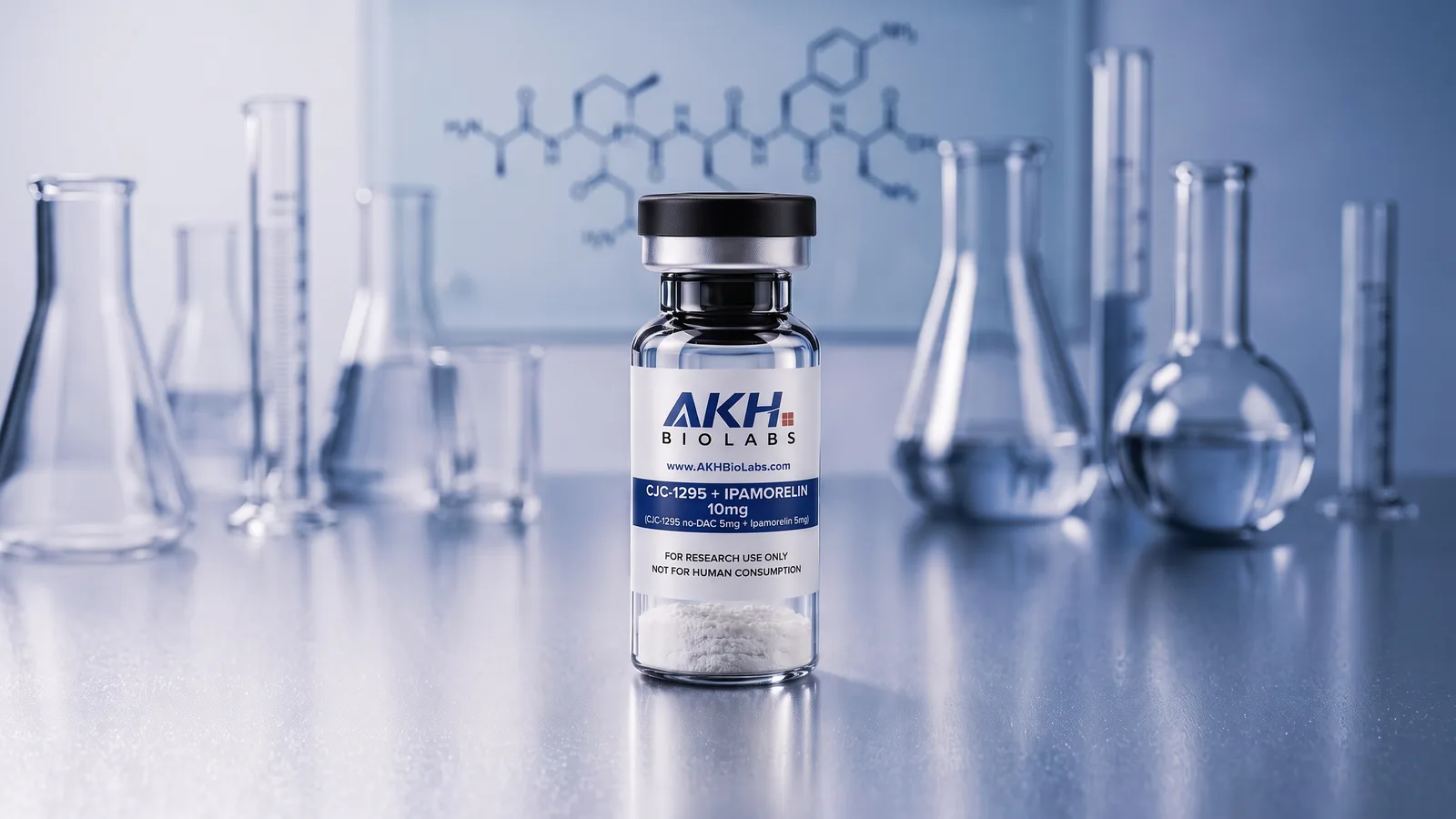
The combination is supplied as a co-lyophilised blend. The AKH BioLabs listing describes a 5mg + 5mg vial containing CJC-1295 without DAC and ipamorelin, and the certificate for batch 26085 records the blend in a single results line. The research record for the pairing states that no peer-reviewed clinical trial administering CJC-1295 together with ipamorelin was identified, and that a PubMed query intersecting both peptide names returned only narrative reviews, doping-control analytical methods and product-quality analyses.
Two receptors, one design
CJC-1295 acts at the GHRH receptor and ipamorelin at GHS-R1a. The pairing exists because the two pathways have been reported to interact more than additively.
Component-level evidence only
The available evidence comprises separate studies of each peptide plus older human work on GHRH and secretagogue co-administration. The specific combination remains untested in a controlled trial.
Documented in one results line
A certificate for a two-peptide blend names both components together. Batch 26085 carries the string "CJC1295(without DAC)+IPA: 10mg | Purity: 99.58%".
What the evidence does not establish
The 2026 review states that peptides remain experimental substances with poorly defined long-term risks, and that most published studies examine therapeutic applications under controlled regimens rather than the combined protocols common in bodybuilding. It also notes that the largely unregulated supply chain compounds the problem, because products are often mislabeled or contaminated.
For this compound specifically, the research record lists three gaps: the frequent substitution of unmodified CJC-1295 for the DAC-modified analogue actually studied, the absence of long-term IGF-I and glucose-metabolism outcome data for either component, and documented content variability in unregulated preparations. A 2018 mass-spectrometric analysis of illicitly distributed growth-promoting preparations found discrepancies between declared and actual content, including incorrect peptide identity and variable amounts.
None of this is a claim that the compound does nothing. It is a statement about what the published record can and cannot support, which is the boundary this post stays inside.
Common questions.
- What does CJC-1295 do in the body?
CJC-1295 is a synthetic analogue of growth hormone-releasing hormone and acts at the GHRH receptor, the receptor the body's own releasing hormone uses. Published reviews group it with sermorelin and tesamorelin as GHRH analogues, distinct from growth hormone secretagogues such as ipamorelin, which act at the ghrelin receptor GHS-R1a.
- Is CJC-1295 vs sermorelin a comparison of different receptor classes?
No. Both are synthetic analogues of growth hormone-releasing hormone and act within the same receptor class. The 2026 critical review lists CJC-1295 and sermorelin together as GHRH analogues. The differences the sources support concern the construct, including the DAC-modified form of CJC-1295, and how each is detected analytically.
- What is CJC-1295 ipa?
It is shorthand for a pairing of CJC-1295 with ipamorelin, usually supplied as one co-lyophilised vial. CJC-1295 is a GHRH-receptor analogue and ipamorelin is a selective GHS-R1a agonist, so the two act at different receptors. The research record states that no peer-reviewed clinical trial administering the two together has been identified.
- How is CJC-1295 documented on a certificate of analysis?
The form and the blend composition appear in the results line. One published AKH batch, batch 26085, tested 05 Aug 2026 by the Brown Institute of Biomolecular Research, carries the results string "CJC1295(without DAC)+IPA: 10mg | Purity: 99.58%". The parenthetical declares the form and the "+IPA" names the second component.
Sources
- 01Advances in the detection of growth hormone releasing hormone synthetic analogs.
- 02A new era of doping? Use of peptide and peptide-analog drugs in recreational and professional sport and bodybuilding: a critical review.
- 03COA archive — every batch we have published · AKH BioLabs
- 04Buy CJC-1295 No DAC + Ipamorelin 5mg+5mg · AKH BioLabs
- 05CJC-1295 + Ipamorelin research — published studies and evidence · AKH BioLabs
- 06Buy Ipamorelin 10mg: Batch COA · AKH BioLabs
- 07Ipamorelin research — published studies and evidence · AKH BioLabs