What does GHK-Cu do, and does GHK-Cu work?
A plain answer to what GHK-Cu does in laboratory research, why the 2025 review separates cellular activity from skin permeation, and what the phrase does GHK-Cu work can and cannot mean.
What does GHK-Cu do in published research? The short answer is that laboratory studies describe a copper-binding tripeptide that alters collagen, elastin and glycosaminoglycan synthesis in fibroblast and skin models, while the human evidence for a topical effect is thin and inconsistent.
It separates cellular observations from the formulation problem described in the 2025 review, and it points to the evidence record rather than restating the study list.
Key takeaways
- GHK-Cu is the copper(II) complex of glycyl-L-histidyl-lysine, a tripeptide found in human plasma, saliva and urine.
- Laboratory work reports effects on collagen, elastin, glycosaminoglycan synthesis, matrix metalloproteinases and fibroblast behaviour.
- The 2025 review states that published information on skin permeability, effectiveness and physicochemical properties of GHK-Cu and Pal-GHK is insufficient, and that clinical studies of them are absent.
- The evidence record lists 15 studies, including 10 published since 2023, and notes that two randomised trials found no advantage over comparator or placebo on objective endpoints.
- A purity figure on a certificate documents one batch; it does not establish biological activity or a human outcome.
What does GHK-Cu do in laboratory research?
GHK is a tripeptide with the sequence glycyl-L-histidyl-lysine. GHK-Cu is its copper(II) complex, and the 2015 review describes the peptide as present in human plasma, saliva and urine, with concentrations that decline with age. The same review proposes that GHK functions as a copper complex and describes effects on collagen and glycosaminoglycan turnover, including stimulation of collagen, dermatan sulfate, chondroitin sulfate and decorin.
The 2018 review lists stimulation of blood vessel and nerve outgrowth, increased collagen, elastin and glycosaminoglycan synthesis, and support for dermal fibroblast function. These are actions reported in laboratory and animal work, and the abstracts do not establish that a topical product reproduces them in humans.
Why the 2025 review makes formulation the checkpoint
The 2025 review examines GHK as a topical peptide and states that GHK-Cu and Pal-GHK are widely used in cosmetic products, while published information on their skin permeability, effectiveness and physicochemical properties is insufficient. It also reports a surprising absence of clinical studies using them. That is the checkpoint the query needs: cellular activity and product performance are separate questions.
The review identifies a practical reason. GHK is hydrophilic, with high aqueous solubility and a low partition coefficient, and it is unstable in formulation. Metal complexation and hydrophobic modification increase permeability, and cell-penetrating peptides and microneedle techniques are reviewed as permeation-enhancement methods. Those are formulation strategies, not evidence that a marketed product delivers the peptide to its site of action.
Three meanings of the question
Search phrasing often compresses the question to 'ghk cu what does it do', which can mean a cell-level question or a product-level question. The phrase 'does ghk cu work' has the same problem. The evidence needed differs in each case, and the supplied record answers them differently.
| Question being asked | What would answer it | What the supplied record shows |
|---|---|---|
| Cellular activity | Assays in fibroblasts or skin models | Reviews describe collagen, elastin and glycosaminoglycan effects |
| Delivery to the site | Skin permeability and stability data for the formulation | The 2025 review says published information is insufficient |
| A measured human response | Controlled human study with an objective endpoint | The evidence record notes two randomised trials with no advantage over comparator or placebo |
What the evidence record shows, and what it leaves open
The GHK-Cu evidence record at /research/ghk-cu lists 15 studies, including 10 published since 2023 and 6 human studies. It notes that most published work is in vitro or in animal models, and that the small number of controlled human trials of topical GHK-Cu have produced mixed results. Two randomised trials found no advantage over comparator or placebo on objective endpoints.
The record also notes a 2026 systematic review that identified only 20 studies of GHK-Cu as a standalone aesthetic intervention, of which 18 were preclinical and 2 were randomised controlled trials. It states that skin permeation from cosmetic vehicles is not well characterised and that no concentration-response relationship for topical effect has been established in humans. Those gaps are the reason a simple yes or no does not fit the question.
How to read a GHK-Cu claim
Claims about GHK-Cu can be sorted by evidence type before they are compared.
- 01
Name the molecule
GHK, GHK-Cu and Pal-GHK are different entries. The 2025 review describes GHK-Cu as the metal complex and Pal-GHK as the palmitoylated derivative, so a finding for one is not automatically a finding for another.
- 02
Name the evidence tier
A fibroblast culture, an animal model, an uncontrolled human observation and a randomised trial carry different weight. The evidence record orders studies by design for that reason.
- 03
Name the formulation
A single peptide in a defined vehicle is not the same as a multi-ingredient cosmetic. Several human reports in the record involve formulations with additional active ingredients, which prevents a GHK-Cu-specific conclusion.
- 04
Name the endpoint
Collagen synthesis in a culture dish, skin permeation through a membrane and a clinical score are three different measurements. The 2025 review treats cellular activity and skin permeation as separate questions.
- 05
Name the document
A certificate of analysis reports measurements for a batch, such as identity and chromatographic purity. It does not report receptor activity or a human outcome.
What the product record adds, and what it does not
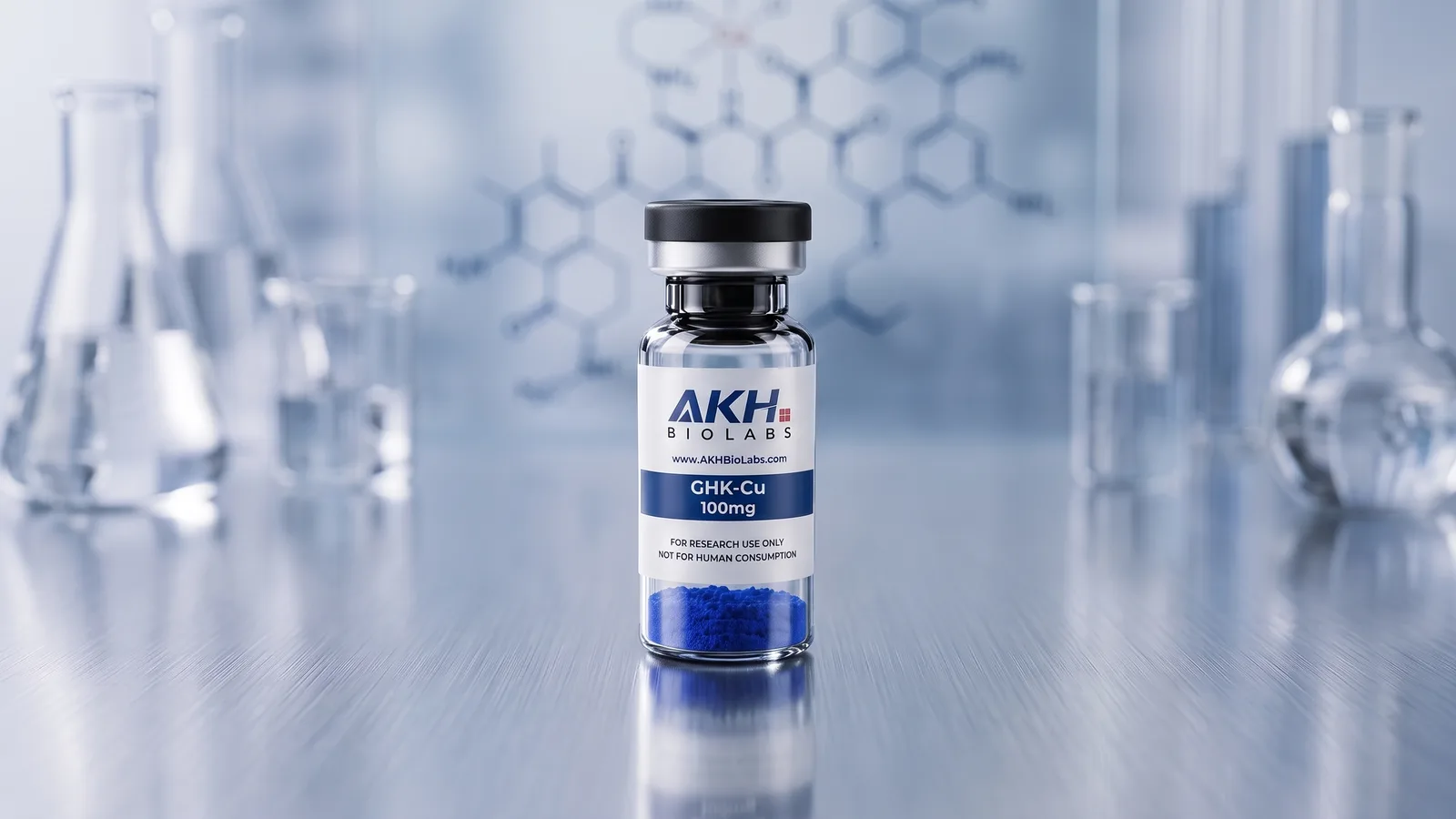
The AKH BioLabs product page describes GHK-Cu as a copper peptide supplied as 100 mg lyophilised powder for laboratory research. It lists the formula C14H24CuN6O4 and 99.64% HPLC verified purity, and it states that the material is not for human or veterinary use.
The purity figure is a batch measurement. It does not establish that the peptide penetrates skin, that a formulation is stable, or that a controlled human study has shown a benefit. Those questions belong to the literature and to formulation science, and the evidence record is the place to check them.
Common questions.
- What does GHK-Cu do to collagen and elastin in cell studies?
The 2018 review reports that GHK increases collagen, elastin and glycosaminoglycan synthesis and supports dermal fibroblast function. The 2015 review describes stimulation of collagen, dermatan sulfate, chondroitin sulfate and decorin, alongside modulation of matrix metalloproteinases and their inhibitors. These are laboratory observations, not evidence of a clinical result.
- GHK cu what does it do in a cell model compared with a topical product?
In a cell model, the reported activity is biochemical: collagen, elastin and glycosaminoglycan synthesis and matrix-enzyme modulation. In a topical product, the same peptide must first cross the skin barrier and remain stable in the vehicle. The 2025 review treats those as separate questions, and the second is the weaker one.
- Does GHK cu work in controlled human studies?
The supplied evidence record does not support a general yes. It notes that two randomised trials of topical copper tripeptide found no significant advantage over comparator or placebo on objective endpoints, and the 2025 review reports an absence of clinical studies of GHK-Cu and Pal-GHK in topical products.
- Is GHK the same molecule as GHK-Cu?
No. GHK is the tripeptide glycyl-L-histidyl-lysine, while GHK-Cu is its copper(II) complex. The 2025 review also describes Pal-GHK as a palmitoylated derivative of GHK, a third entry. A study of one form does not automatically describe another, and the evidence record keeps compound identity separate from formulation.
- Why does the 2025 review call GHK-Cu skin permeability insufficient?
The review states that published information on the skin permeability, effectiveness and physicochemical properties of GHK-Cu and Pal-GHK is insufficient despite their wide use in cosmetic products. It also notes that the peptide is hydrophilic and unstable, which creates formulation difficulty. The gap is a lack of characterisation, not a demonstration that permeation is impossible.
Sources
- 01Regenerative and Protective Actions of the GHK-Cu Peptide in the Light of the New Gene Data.
- 02GHK Peptide as a Natural Modulator of Multiple Cellular Pathways in Skin Regeneration.
- 03Topically applied GHK as an anti-wrinkle peptide: Advantages, problems and prospective.
- 04Buy GHK-Cu 100mg: Batch COA · AKH BioLabs
- 05GHK-Cu research: published studies · AKH BioLabs