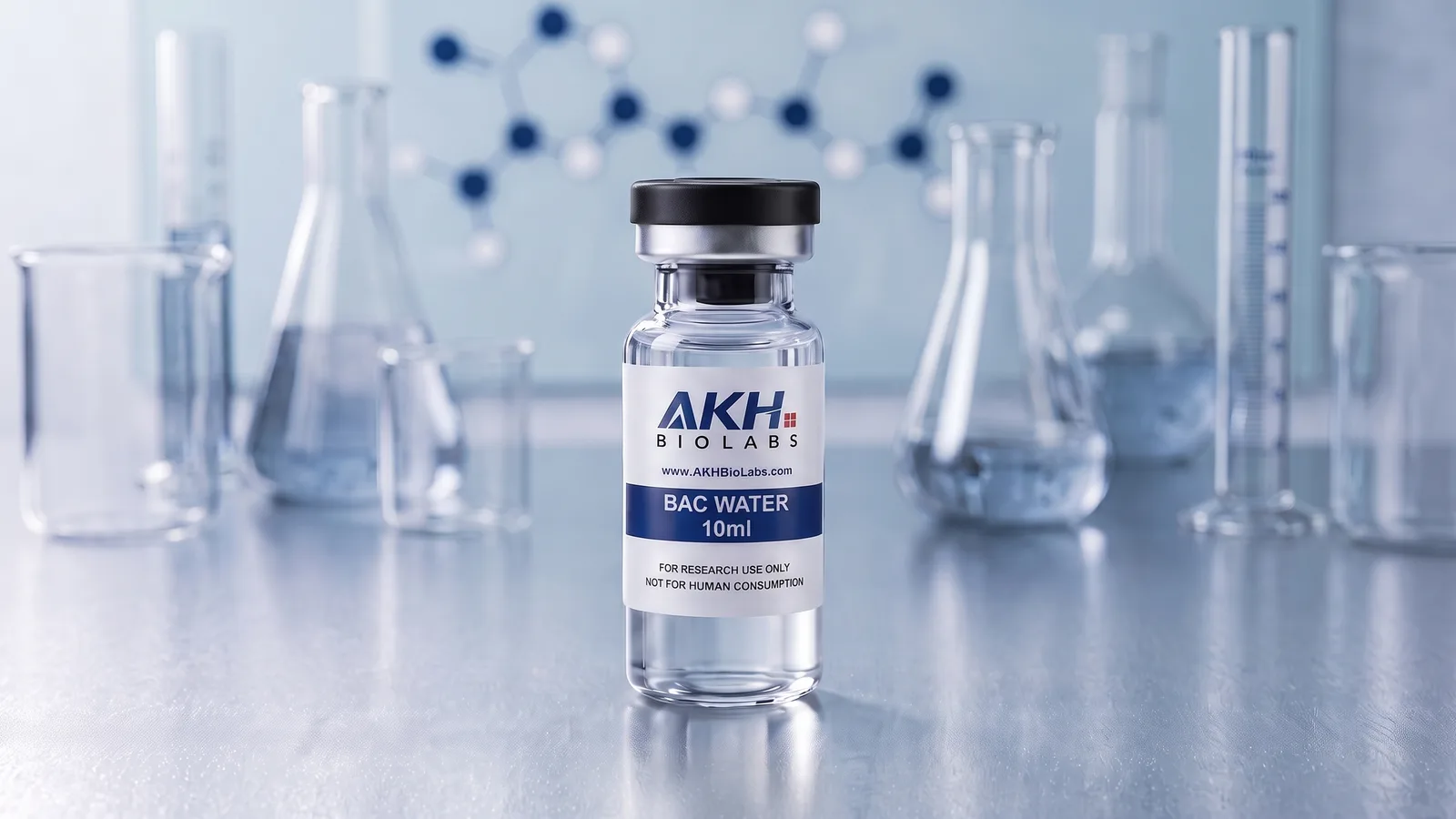
What bacteriostatic water is used for
Bacteriostatic water is used to dissolve or dilute a dried material, and the benzyl alcohol it carries is the preservative that makes repeated withdrawals from one container possible; this article sets out the labelling's stated purpose, the ba water and ebac water contractions, and what one published AKH report measures.
What bacteriostatic water is used for is dissolving and diluting: the FDA labelling describes it as a sterile, nonpyrogenic preparation of water containing benzyl alcohol added as a bacteriostatic preservative, supplied in a multiple-dose container from which repeated withdrawals may be made. The same liquid is searched under contractions such as ebac water and ba water, and none of those short forms appears in the labelling text.
This article is written for readers who need the purpose of the product rather than its lifespan. It covers what the labelling says the liquid is for, what the preservative is doing, what the shorthand names mean, and what a published AKH report for one batch of it actually measures. Shelf-life and storage questions sit with the existing handling articles rather than here.
Key takeaways
- Bacteriostatic water is a diluent or solvent, not a material under study: its whole function is to dissolve or dilute something else.
- Benzyl alcohol, at 0.9% (9 mg/mL) or 1.1% (11 mg/mL) depending on the presentation, is the preservative the labelling names, and it is what makes the container a multiple-dose one.
- Ba water, bac water and ebac water are contractions used in search and in catalogue URLs; the DailyMed labelling text names the product in full and uses no short form.
- The published AKH report for batch JP20251003, tested 04 Nov 2025 by Janoshik Analytical, reads "Benzyl Alcohol: 8.72 mg/ml".
- A certificate describes one batch, while the labelling figures are specifications for the drug presentations: the two are not interchangeable.
What bacteriostatic water is
Bacteriostatic water is water with a preservative added. The DailyMed labelling describes the preparation as a sterile, nonpyrogenic form of water containing 0.9% (9 mg/mL) or 1.1% (11 mg/mL) benzyl alcohol added as a bacteriostatic preservative, and records the water itself as chemically designated H2O. The stated pH is 5.7, with a range of 4.5 to 7.0.
Bacteriostatic means that the added benzyl alcohol suppresses microbial growth in the liquid after the container is first opened, which is the wording the AKH BioLabs product page uses for its own 10 ml solution, marketed as a 0.9% bacteriostatic solution for mixing. Sterile is a separate property, applied by the labelling to the preparation as supplied.
The labelling also lists the pack presentations behind the two benzyl alcohol figures: a tray of 25 multiple-dose 30 mL plastic vials at 9 mg/mL, and a tray of 25 multiple-dose glass vials described as a 20 mL fill in a 30 mL vial at 11 mg/mL. The concentration differs between presentations; the water in them does not.
What bacteriostatic water is used for
The labelling's stated purpose is narrow. It describes the preparation as designed to act as an aqueous vehicle once a drug requiring dilution or dissolution is added, and states that it is intended only for diluting or dissolving drugs, following the instructions of the manufacturer of the drug concerned. A vehicle, in this context, is the liquid that carries or dissolves another material.
In laboratory supply the same function is described in different words. The AKH BioLabs listing for its 10 ml solution states that it is used for mixing lyophilised research peptides and calls it the standard solvent for reconstituting them. Lyophilised means freeze-dried, and reconstitution is the step of adding liquid back to a dried powder so that it returns into solution.
The preservative is what makes the repeated-entry pattern workable. The labelling describes a multiple-dose container from which repeated withdrawals may be made, and the catalogue copy states that the benzyl alcohol suppresses microbial growth after the vial is opened. The labelling also names preservative-free sterile water as its alternative in the situations it sets out, which is the same liquid without the preservative and without the accompanying statement about microbial growth.
Ba water, bac water and ebac water: what the contractions mean
None of the contractions is a labelling term. The DailyMed text names the product in full and never shortens it; ba water, bac water and ebac water are search and catalogue shorthand for the same liquid. The composition behind each string is the one described above.
Bac water is the contraction in written use. The AKH BioLabs product page is served at /products/bac-water and its title reads Buy Bac Water 10ml: Bacteriostatic Mixing Solution, so the short form is a catalogue convention rather than a separate specification. Ba water drops the middle of the same word in the same way.
Ebac water resolves to nothing else in the source material. It appears in neither the DailyMed labelling text nor the AKH BioLabs listing as a name for the product, and it is not a brand or a chemical name. The three strings point to one product rather than to three different ones.
What a certificate for this product actually measures
AKH BioLabs publishes a certificate for its bacteriostatic water in the same form as for its research compounds. The published record gives batch JP20251003, a test date of 04 Nov 2025, task ID #86200, and a results line reading "Benzyl Alcohol: 8.72 mg/ml". The named laboratory is Janoshik Analytical.
The certificate is a test report from a named laboratory outside AKH, ordered by the manufacturer and shown as the laboratory issued it, and the product page states that a printed copy ships in every parcel. That framing matters for reading the figure: it is a measurement made on one batch rather than marketing copy restating a claim.
The measurement is a content figure for the preservative, which is the ingredient separating this product from plain sterile water, and the published record for the report lists no purity percentage alongside it. The labelling figures describe something different: 0.9% equals 9 mg/mL and 1.1% equals 11 mg/mL, and those are specification ranges for the drug presentations rather than analyses of a single container.
The two numbers are therefore not interchangeable. The labelling range applies to the prescription drug products described on DailyMed, while the 8.72 mg/ml figure applies to one batch of a research-use-only supply listed as a 10 ml solution. A certificate for one batch describes that batch.
| Item | DailyMed labelling | AKH batch JP20251003 |
|---|---|---|
| Benzyl alcohol content | Specified as 0.9% (9 mg/mL) or 1.1% (11 mg/mL) by presentation | Measured at 8.72 mg/ml |
| Container | Multiple-dose vial from which repeated withdrawals may be made | 10 ml vial listed by the supplier |
| Source document | Prescription drug labelling | Test report from Janoshik Analytical, dated 04 Nov 2025 |
Checking a bacteriostatic water listing
The product is a supply, so the document trail is short: a size, a stated preservative content, a batch number and a certificate. The order below follows the fields the published AKH report actually carries, and each step can be matched against the report published with the product listing.
- 01
Confirm the stated benzyl alcohol content
The labelling gives 0.9% (9 mg/mL) or 1.1% (11 mg/mL) depending on the presentation, and the AKH listing states 0.9% for its 10 ml solution. Preservative content is the figure that separates this product from plain sterile water, so a listing that omits it has left out the distinguishing number.
- 02
Match the batch number on the container to the certificate
The published AKH report carries batch JP20251003 and task ID #86200. A batch identifier that appears on a vial but not on a report is not covered by that report, which is the purpose the identifier serves.
- 03
Check that a laboratory is named, with a date
The AKH report names Janoshik Analytical and gives 04 Nov 2025 as the test date. A figure with no named laboratory and no date cannot be checked against anything else.
- 04
Read the results line as written
For this batch the line reads "Benzyl Alcohol: 8.72 mg/ml". It is a content measurement for one batch, not a specification for the whole product line.
- 05
Confirm the research-use statement
The listing states that the solution is supplied strictly for laboratory research use only and that it is not for human or veterinary use.
Common questions.
- Is ba water the same as bacteriostatic water?
Yes. Ba water is a contraction used in search and in catalogue URLs for the same product, and the AKH BioLabs listing is served at /products/bac-water. Neither contraction appears in the DailyMed labelling text, which names the product in full, and the composition is unchanged by the shorthand.
- What does the benzyl alcohol in bacteriostatic water do?
Benzyl alcohol is the bacteriostatic preservative named on the labelling, present at 0.9% (9 mg/mL) or 1.1% (11 mg/mL) depending on the presentation. The AKH BioLabs listing states that it suppresses microbial growth after the vial is opened, which is what allows the labelling to describe a multiple-dose container from which repeated withdrawals may be made.
- Does ebac water mean something different from bacteriostatic water?
No. Ebac water is not a brand, a chemical name or a labelling term, and it does not appear in the DailyMed labelling text or the AKH BioLabs listing. The product it points to is the water containing benzyl alcohol described in this article.
- Is bacteriostatic water a research compound?
No. It is listed as a supply and is used as the liquid that lyophilised material is reconstituted in, not as the material under study. The AKH BioLabs listing states that it is supplied strictly for laboratory research use only and that it is not for human or veterinary use.