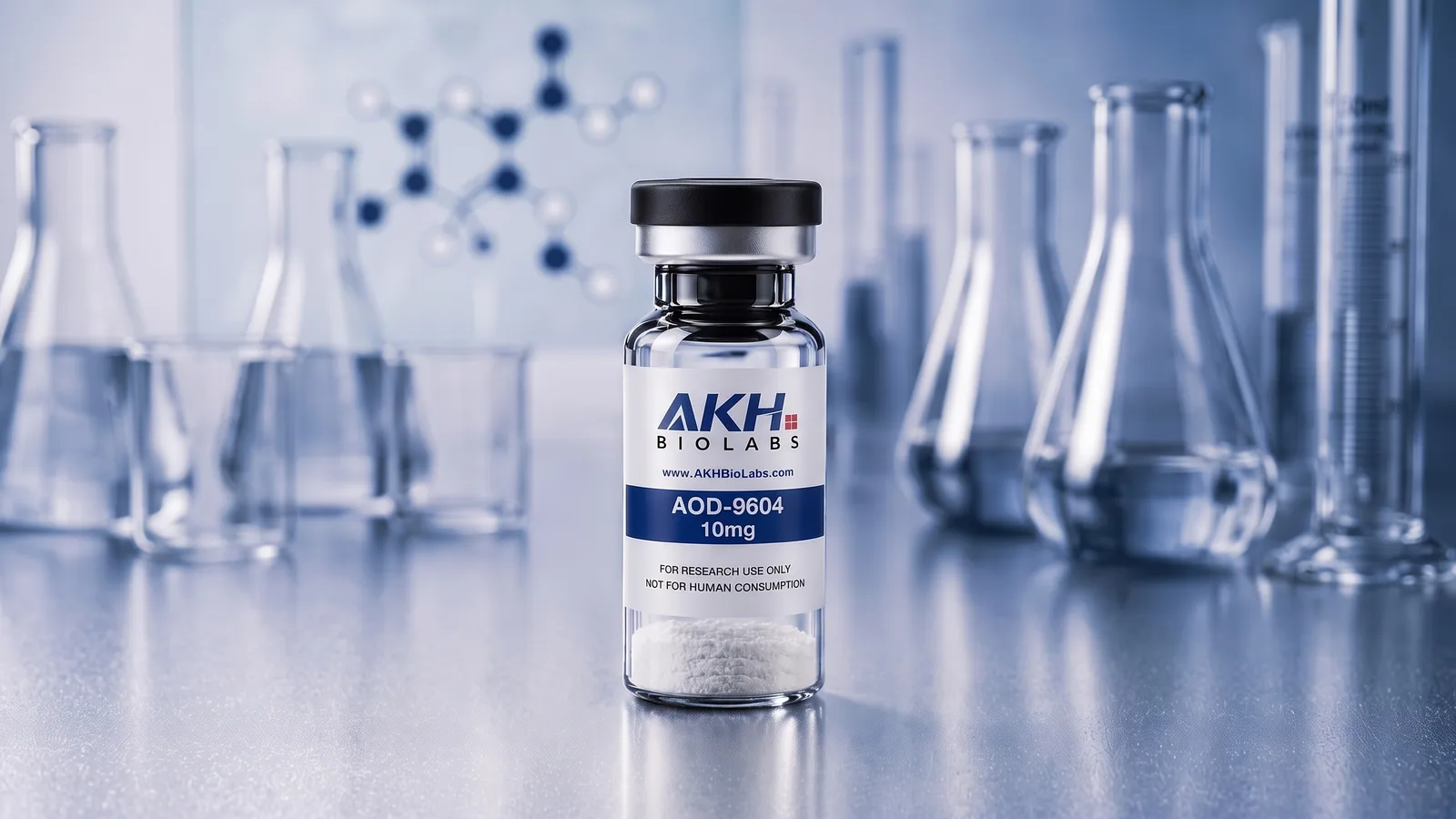
What is HGH fragment 176-191?
HGH fragment 176-191 is the C-terminal 16-amino-acid region of human growth hormone, and hgh frag 176 191 is the same sequence under a shorter name. The numbering, the added tyrosine, and the AOD-9604 identity explained.
HGH fragment 176 191 is the 16-amino-acid section at the C-terminal end of the human growth hormone sequence, spanning residues 176 to 191, and hgh frag 176 191 is the same sequence written with a shorter name. The two strings describe one peptide, not two.
The question this page answers is a naming and identity question, not an evidence question. The published findings on the fragment live on the AOD-9604 research record, which lists the studies, the study designs and the limitations of that literature. This post covers what the fragment is, how the 176-191 numbering maps onto the parent hormone, why the synthesised research analogue carries an extra tyrosine, and why the catalogue name AOD-9604 and the descriptive name hGH fragment 176-191 refer to the same molecule.
Written for researchers and laboratory buyers who have encountered the fragment under more than one label and want the naming settled before reading the literature. Research-use-only framing applies throughout: nothing here is medical advice, and no study summarised on the linked evidence record should be read as a recommendation.
Key takeaways
- HGH fragment 176 191 is the C-terminal 16-residue region of human growth hormone, residues 176 through 191 of the parent sequence.
- hgh frag 176 191 is a shorthand for the same sequence; the two names are not different compounds.
- The synthesised research analogue carries an added N-terminal tyrosine and is written in the literature as Tyr-hGH 177-191.
- AOD-9604 is the catalogue and development name for that analogue; the research record treats the names as the same sequence.
- The fragment is studied as a tool for isolating the lipolytic domain of hGH from the receptor-mediated signalling of the full hormone.
What the 176-191 numbering means
Human growth hormone is a protein, and proteins are conventionally described by the position of each amino acid in the chain, counted from the N-terminus. A fragment name such as 176-191 states which positions of that parent chain the fragment reproduces: residue 176 at one end, residue 191 at the other, sixteen residues in total.
That convention is why the fragment is a fragment rather than a compound in its own right. The sequence is not invented; it is a defined slice of a larger molecule, and the numbering is the coordinate system that says which slice. A hexadecapeptide is the general term for a peptide of sixteen amino acids, which is the length this region produces.
The research record for AOD-9604 describes the compound as a synthetic hexadecapeptide corresponding to the C-terminal lipolytic domain of human growth hormone, written there as Tyr-hGH 177-191 and commonly referred to as hGH fragment 176-191. Both forms of the name appear in the same sentence of that record, which is the clearest statement that the numbering variants are labels for one sequence.
Why the synthesised analogue carries an added tyrosine
The catalogue entry for the product describes AOD-9604 as a 16-amino-acid fragment of human growth hormone, residues 176 to 191, with an added tyrosine at the N-terminus for stability. That added residue is the difference between the descriptive name and the synthesised molecule.
The research record states the same point in sequence notation: the compound corresponds to Tyr-hGH 177-191. The 177-191 span is the parent-hormone region, and the Tyr prefix is the added N-terminal tyrosine. The published characterisation treats the two names as the same sequence, with the added N-terminal tyrosine distinguishing the synthesised analogue.
This is a common pattern in peptide research. A naturally occurring region is identified, then a synthesised version is produced with a small modification that improves handling or stability, and the literature ends up carrying both the descriptive name and the modified name. Reading either name as a different compound is the mistake this section exists to prevent.
Is hgh frag 176 191 the same thing?
Yes. hgh frag 176 191 is a search shorthand and catalogue shorthand for the same sequence, with the word fragment abbreviated and the residue numbers retained. The abbreviation carries no additional chemical meaning: it does not denote a different salt form, a different length, or a different modification.
The same shorthand appears in the peer-reviewed literature. A 2026 critical review of peptide and peptide-analogue use in sport and bodybuilding lists synthetic fragments including Frag 176-191 among the agents it covers, alongside growth hormone secretagogues and growth hormone-releasing hormone analogues. That review treats Frag 176-191 as a named entry in a list of peptide classes, which is how the shorthand functions in the field.
A second 2026 narrative review, on approved and unapproved peptide therapies for musculoskeletal injuries and athletic performance, names AOD-9604 (anti-obesity drug 9604) in its list of compounds. The two reviews therefore use the two naming conventions for the same molecule, one descriptive and one catalogue-based, which is the practical reason a reader encounters both.
How AOD-9604 relates to the fragment name
AOD-9604 is the development and catalogue name for the synthesised analogue of the fragment. The product page carries both names in its title line, describing the compound as Anti-Obesity Drug 9604 (hGH Fragment 176-191), and the research record states that AOD-9604 is a synthetic hexadecapeptide corresponding to the C-terminal lipolytic domain of human growth hormone, commonly referred to as hGH fragment 176-191.
The research record also answers the identity question directly in its own FAQ: AOD-9604 is a synthetic hexadecapeptide corresponding to the C-terminal lipolytic domain of human growth hormone, written in the literature as Tyr-hGH 177-191 and commonly referred to as hGH fragment 176-191. The published characterisation treats the two names as the same sequence.
The origin of the compound is documented in the same record. The 1993 report that first identified the C-terminal 177-191 sequence as reducing lipogenic activity in adipose tissue is described there as the origin of the compound later developed as AOD-9604. The catalogue entry adds that the compound was developed in the 1990s by Metabolic Pharmaceuticals, an Australian biotechnology company.
What the fragment is studied for
The research interest in this region comes from what it isolates. The catalogue entry states that the fragment isolates the lipolytic activity of full-length hGH whilst leaving IGF-1 and glucose regulation unaffected in preclinical models, making it a useful tool for studying fat metabolism independently of GH signalling.
The research record frames the same point as a recurring theme in the literature: separation of fat-metabolism effects from hGH-receptor-mediated and IGF-1-mediated effects. The record notes that preclinical work published between 1993 and 2001 characterised the fragment's effects on lipolysis, lipogenesis and fat oxidation in rodent models and reported that these effects occurred without measurable interaction with the hGH receptor or IGF-1 elevation.
The record also states the limits plainly. No randomised controlled efficacy trial of AOD-9604 has been published as a standalone peer-reviewed report; the human data available in the literature are a pooled safety and tolerability analysis, and body-composition outcomes have not been independently replicated in an indexed journal. Cartilage and osteoarthritis findings rest on a single small rabbit study with no human confirmation. Those findings, and the studies behind them, belong on the research record rather than being restated here.
Reading the name on a certificate
The product page for this compound states that the certificate is pending and that no matching report from an outside laboratory has been published for the product yet, so no purity figure is claimed there. The certificate, when it appears, is a test report from a named laboratory outside AKH, ordered by the manufacturer and shown as the laboratory issued it.
The practical point for a reader comparing labels is that the compound name, the batch number and the laboratory name are the checkable fields on a report. How to read a certificate of analysis covers what those fields mean and which ones a report has to carry to be verifiable.
Common questions.
- What is hgh fragment 176 191?
It is the 16-amino-acid region at the C-terminal end of human growth hormone, spanning residues 176 to 191 of the parent sequence. The synthesised research analogue of that region carries an added N-terminal tyrosine and is written in the literature as Tyr-hGH 177-191. AOD-9604 is the catalogue name for the same sequence.
- Is hgh frag 176 191 the same as AOD-9604?
Yes. The research record states that AOD-9604 is a synthetic hexadecapeptide corresponding to the C-terminal lipolytic domain of human growth hormone, written in the literature as Tyr-hGH 177-191 and commonly referred to as hGH fragment 176-191. The published characterisation treats the two names as the same sequence, with the added N-terminal tyrosine distinguishing the synthesised analogue.
- Why is the fragment called 176-191 if the analogue is written 177-191?
The two numbers describe different things. The 176-191 span is the parent-hormone region the fragment reproduces. The 177-191 form in the research record is the same region written with the added N-terminal tyrosine accounted for, which is why the record gives both forms in one sentence.
- Does the fragment act like full-length growth hormone?
The published work reports that the fragment retains activity on lipolytic-pathway enzymes in adipose-tissue preparations but lacks the growth-promoting, receptor-mediated signalling of the full hGH molecule. The research record states that the chronic rodent studies describe no adverse effect on insulin sensitivity or glucose tolerance.
- Where are the published studies on hGH fragment 176-191 listed?
On the AOD-9604 research record, which lists the studies ordered by strength of study design and sets out what the evidence does not establish. That record covers the preclinical lipolysis work, the pooled human safety analysis, the rabbit cartilage study and the anti-doping analytical literature.
Sources
- 01Safety and Efficacy of Approved and Unapproved Peptide Therapies for Musculoskeletal Injuries and Athletic Performance.
- 02A new era of doping? Use of peptide and peptide-analog drugs in recreational and professional sport and bodybuilding: a critical review.
- 03AOD-9604 — Anti-Obesity Drug 9604 (hGH Fragment 176-191) · AKH BioLabs
- 04AOD-9604 research — published studies and evidence · AKH BioLabs