AKH Signature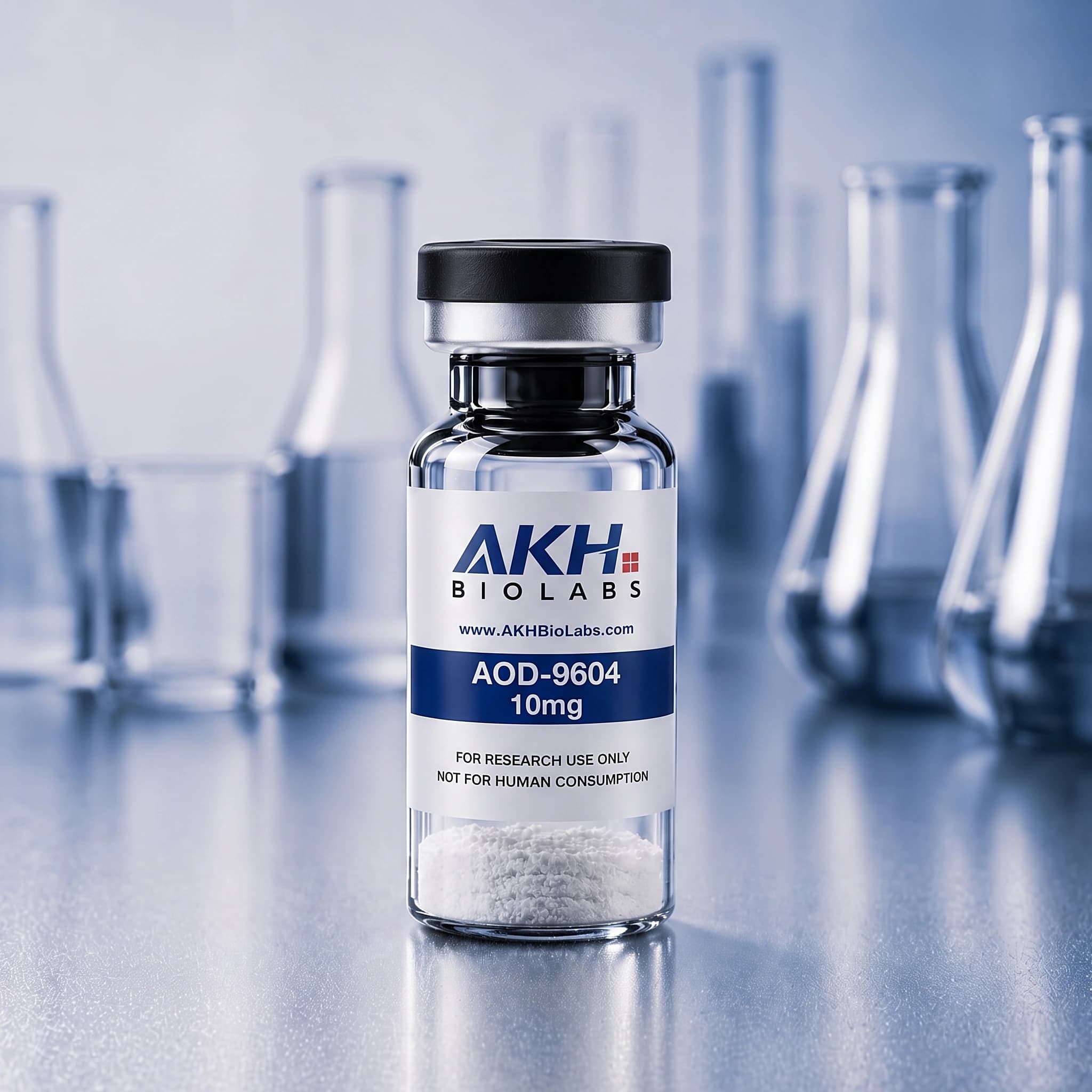
Metabolic· AKH Signature
Only 3 leftAOD-9604
Anti-Obesity Drug 9604 (hGH Fragment 176-191)
Size10mgPurityCertificate pendingFormulaC78H123N23O23S2
AOD-9604 is a 16-amino-acid fragment of human growth hormone (residues 176–191) with an added tyrosine at the N-terminus for stability. Developed in the 1990s by Metabolic Pharmaceuticals, an Australian biotechnology company, it isolates the lipolytic activity of full-length hGH whilst leaving IGF-1 and glucose regulation unaffected in preclinical models — making it a useful tool for studying fat metabolism independently of GH signalling.
€80
Quantity
9–14 day shipping
Certificate pending
Worldwide delivery
About this compound
The research profile.
AOD-9604 is a synthetic peptide corresponding to the C-terminal fragment of human growth hormone (residues 176-191) with an additional tyrosine at the N-terminus. This region of the hGH molecule was identified in the literature as a lipolytic domain: in isolated adipose-tissue preparations, the fragment is reported to stimulate hormone-sensitive lipase and inhibit acetyl-CoA carboxylase in a manner resembling the parent hormone.
A point emphasised across the published work is what the fragment does not do. Unlike full-length growth hormone, AOD-9604 is not reported to signal through the growth hormone receptor's proliferative pathways, and the chronic rodent studies describe no adverse effect on insulin sensitivity or glucose tolerance under euglycemic clamp conditions. Studies in beta-3-adrenergic-receptor knock-out mice indicate its lipolytic-pathway activity is not directly mediated by that receptor, although increased beta-3-AR expression is reported after chronic treatment.
A separate research direction has examined AOD-9604 in cartilage models: weekly intra-articular administration in a collagenase-induced rabbit osteoarthritis model was assessed alongside hyaluronic acid over a 4–7 week protocol. As with all compounds on this page, these are laboratory findings in animal and tissue models, not evidence of any effect in humans.
Published research
17 peer-reviewed studies on AOD-9604 are summarised in our research library, including 4 published since 2023 — with study designs, reported findings and what the evidence does not establish.
Read the AOD-9604 evidence baseFor research purposes only. Not for human consumption, diagnosis, treatment, or prevention of any condition.
Categorised as Metabolic — GLP-1 and GIP receptor agonists for metabolic research.
Dosing at a glance
What the literature reports.
For research and laboratory use only. Not for human consumption.
Route
Subcutaneous
Frequency
Once daily
Reported range
250–500 mcg
Protocol duration
3–12 weeks
250 mcgper administration500 mcg
The animal literature dosed orally on a per-kg basis (500 mcg per kg bodyweight daily in the chronic rodent protocols); the range shown reflects per-administration amounts commonly examined in research settings.
Ranges reflect protocols reported in the published literature on AOD-9604 — see research citations.
Calculate a dilutionReconstitution & storage
From powder to solution.
- Step 01
Add 2 ml bacteriostatic water
Aim the stream at the vial wall rather than the powder.
- Step 02
Swirl gently — never shake
Rotate the vial until the solution runs clear. Agitation degrades the peptide.
- Step 03
Refrigerate at 2–8 °C
Reconstituted vials belong in the fridge, protected from direct light.
- Step 04
Use within 28 days
Discard any remainder once the stability window closes.
Lyophilised · −20 °CReconstituted · 2–8 °C, 28 days
Reconstitution calculator
10 mg vialmg
ml
mcg
300 mcg = 0.3 mg
Draw
6units · U-100 insulin syringe
- Concentration
- 5 mg/ml
- Draws per vial
- 33
- Cost per draw
- €2.42
For research and laboratory use only. Not for human consumption.
Laboratory arithmetic for AOD-9604 — enter the COA-verified vial content for exact figures. Not medical advice.
Effect timeline
Observed across the research window.
Milestones summarise findings reported in the cited studies. Outcomes vary across models and protocols.
Start
Acute enzyme-level measures
In isolated adipose-tissue preparations, stimulation of hormone-sensitive lipase and inhibition of acetyl-CoA carboxylase are reported as acute, direct effects of the fragment.
Week 3
Chronic rodent protocol endpoints
The chronic oral rodent studies ran roughly 19-day protocols, at which point lipid-metabolism markers and glucose handling under euglycemic clamp were compared against controls.
Week 4–7
Cartilage-model endpoints
In the rabbit osteoarthritis model, weekly intra-articular administration over 4–7 weeks preceded the gross morphological and histopathological scoring used as study endpoints.
For research and laboratory use only. Not for human consumption.
Scientific research
The published evidence.
The dosing ranges and timeline milestones on this page summarise the peer-reviewed publications below.
References
- 01
Metabolic studies of a synthetic lipolytic domain (AOD9604) of human growth hormone. Horm Res (2000). PubMed · 11146367
- 02
The effects of human GH and its lipolytic fragment (AOD9604) on lipid metabolism following chronic treatment in obese mice and beta(3)-AR knock-out mice. Endocrinology (2001). PubMed · 11713213
- 03
Effect of Intra-articular Injection of AOD9604 with or without Hyaluronic Acid in Rabbit Osteoarthritis Model. Ann Clin Lab Sci (2015). PubMed · 26275694
Laboratory verification
Certificate pending.
The Certificate is a test report from a named laboratory outside AKH, ordered by our manufacturer and shown here exactly as the laboratory issued it. A printed copy ships in every parcel.
No matching report from an outside laboratory has been published for this product yet, so no purity figure is claimed. The Certificate will appear here unaltered once it is.
Product FAQ
Questions researchers ask.
Pairs well with
Frequently co-studied.
Compounds that appear alongside AOD-9604 in the research literature.
For research and laboratory use only. Not for human consumption.
From the blog
Further reading.
- Research notes
What is TB4 frag? TB4 vs HGH frag explained
TB4 frag is a fragment of thymosin beta-4, the 43-amino-acid actin-sequestering peptide, while HGH frag is a fragment of human growth hormone. The two names describe molecules from different parent proteins, and the resemblance between them is a naming collision rather than shared chemistry.
Read the post - Research notes
What is HGH fragment 176-191?
HGH fragment 176-191 is the C-terminal 16-amino-acid region of human growth hormone, and hgh frag 176 191 is the same sequence under a shorter name. The numbering, the added tyrosine, and the AOD-9604 identity explained.
Read the post
Metabolic