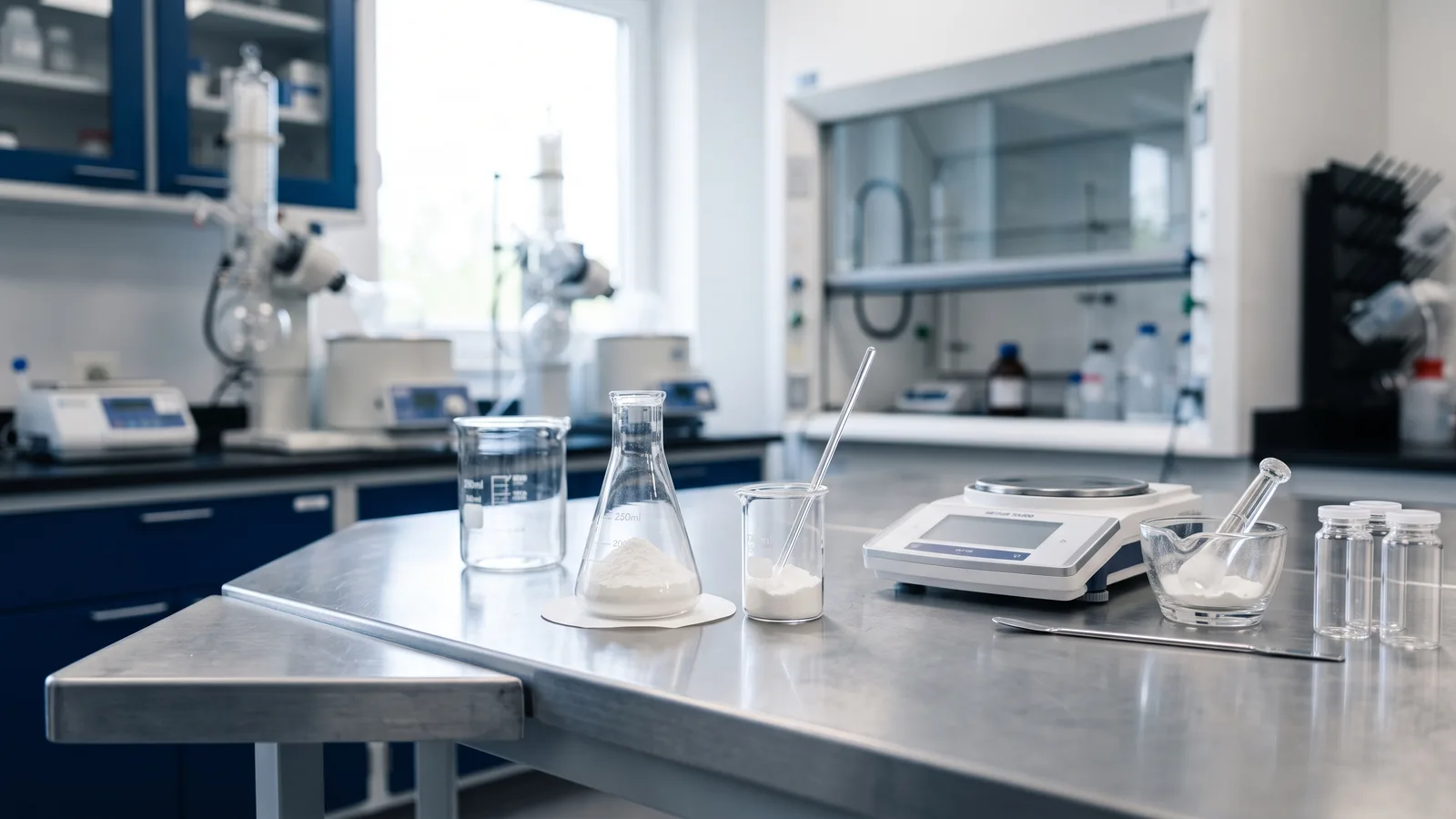
What is lyophilized powder?
Lyophilized means freeze-dried: a solution is frozen and its ice is removed under vacuum, leaving a dry solid. Research peptides ship as lyophilized powder because they are unstable in solution, and the powder is a formulated solid with some residual water, not pure peptide.
Lyophilized powder is the dry solid left after a solution is frozen and the ice is removed under vacuum. The process is called lyophilization, or freeze-drying, and lyophilized simply means freeze-dried. It is the form most research peptides ship in.
The reason is stability. An FDA inspection guide on the process puts it in one line: products are manufactured in the lyophilized form due to their instability when in solution. Removing the water slows the chemistry that breaks a peptide down.
This note explains what the word means, how the process works, what is actually in a vial of lyophilized powder, and what the dry form means for handling before any liquid is added.
Key takeaways
- Lyophilized means freeze-dried. The spelling lyophilised is the same word.
- The process has three stages: freezing, primary drying by sublimation, and secondary drying.
- Peptides ship as lyophilized powder because they are less stable in solution than as a dry solid.
- A vial of lyophilized powder holds the peptide plus counterions, any excipients and a small amount of residual water, so powder mass and peptide mass differ.
- Residual moisture is a measured quality attribute, not a target of zero.
What does lyophilized mean?
Lyophilized means freeze-dried. A lyophilized product was made by freezing a solution and then removing the frozen water without letting it melt. American usage writes lyophilized; British usage, and the rest of this site, writes lyophilised. Both describe the same process and the same product.
The result looks like a white or off-white solid at the bottom of a vial, often called a cake. A well-made cake keeps its shape. If it has shrunk or partly melted, a defect the FDA guide calls meltback, the product may be less stable.
How lyophilization works
The FDA guide describes three stages, which together turn a liquid into a dry solid without passing through a warm liquid state.
- 01
Freezing
The filled vials are cooled until the solution is completely frozen, typically well below the temperature at which any liquid could remain.
- 02
Primary drying (sublimation)
A vacuum is applied and the shelves are gently heated. The ice turns straight from solid to vapour, a change called sublimation, and is collected on a condenser. Most of the water leaves here.
- 03
Secondary drying (desorption)
The temperature is raised further to remove water that is bound to the solid rather than frozen as ice. The vials are then stoppered inside the chamber.
What is in a vial of lyophilized powder
Lyophilized peptide powder is not pure peptide. It contains the peptide, the counterions left from synthesis and purification, any excipients added before freezing, and a small amount of residual water.
That is why the mass on a label and the amount of peptide in the vial are different numbers. A purity figure on a certificate of analysis is a chromatographic peak-area ratio, which says how much of what the method detected is the target peptide. It is not a statement of how much of the powder's weight is peptide. That second figure is net peptide content, which is measured separately.
Why lyophilized powder is not completely dry
Some water always remains after freeze-drying, and the amount is controlled rather than driven to zero. The FDA guide treats moisture in the vial as a central quality concern and expects stability data at the moisture specification.
A 1992 study of lyophilized protein products, methionyl human growth hormone and tissue plasminogen activator, found that drier is not always better. Samples dried below a calculated monolayer of water became cloudy when redissolved, while wetter samples lost more stability under heat. The authors concluded that an optimum residual moisture balances the two. That work concerns proteins, but the principle carries over: moisture is a managed attribute.
Measuring it is routine. The standard method is Karl Fischer titration, and a 2020 study in the Journal of Pharmaceutical Sciences describes near-infrared spectroscopy as a non-destructive alternative for freeze-dried products, calling moisture content a critical quality attribute.
What the powder form means for handling
Before any liquid is added, handling is about protecting a dry solid. Lyophilized powder takes up water from humid air, so the vial stays sealed until it is needed. Temperature is the second variable: the dry form tolerates storage far better than a solution, but the stated storage range on each label still applies.
Once the powder is reconstituted, it becomes a solution again and the stability advantage is gone. Powder and solution are separate storage questions, which is why storage temperature and the shelf life of reconstituted peptides are covered in their own posts.
Common questions.
- What does lyophilized mean?
Lyophilized means freeze-dried. A solution is frozen, then the ice is removed under vacuum so it turns straight to vapour, leaving a dry solid. Lyophilised is the British spelling of the same word.
- Why are research peptides sold as lyophilized powder?
Because peptides are less stable in solution than as a dry solid. An FDA inspection guide states that products are manufactured in the lyophilized form due to their instability in solution, and lists better stability in the dry state as the main advantage.
- Is lyophilized powder 100% peptide?
No. The powder contains the peptide plus counterions from synthesis, any excipients added before freezing, and a little residual water. Chromatographic purity and net peptide content are different measurements for that reason.
- What is the cake in a lyophilized vial?
The cake is the dry solid left after freeze-drying. A good cake keeps its shape. Shrinkage or partial melting, called meltback, is a defect that the FDA inspection guide links to lower stability.