What is TB4 frag? TB4 vs HGH frag explained
TB4 frag is a fragment of thymosin beta-4, the 43-amino-acid actin-sequestering peptide, while HGH frag is a fragment of human growth hormone. The two names describe molecules from different parent proteins, and the resemblance between them is a naming collision rather than shared chemistry.
TB4 frag is a fragment of thymosin beta-4, the 43-amino-acid actin-sequestering peptide, while HGH frag is a fragment of human growth hormone. The two names describe molecules from different parent proteins, so they are not interchangeable, and the resemblance between them is a naming collision rather than shared chemistry.
This explainer is written for researchers, writers and readers who have met the strings TB4, TB4 frag and HGH frag in catalogue copy, forum threads or paper titles and want to know which parent protein each one derives from. It separates the three names, states where the published literature is thin, and links down to the evidence records instead of restating their citation lists. Both catalogue compounds discussed here are supplied for laboratory research use only, not for human or veterinary use.
Key takeaways
- TB4 is shorthand for thymosin beta-4, a 43-amino-acid endogenous actin-sequestering peptide.
- TB4 frag is a shorter piece of that same parent peptide, usually the central actin-binding motif rather than the full 43-residue chain.
- HGH frag is a piece of human growth hormone, a different parent protein, conventionally written as residues 176 to 191.
- The word fragment describes a position inside a parent sequence, so the same word appears on two unrelated molecules with unrelated literatures.
- Almost all published thymosin beta-4 biology concerns the full-length peptide rather than a short fragment.
Three names, two parent proteins
The three strings that get mixed up are TB4, TB4 frag and HGH frag. TB4 is shorthand for thymosin beta-4, which the TB-500 research record describes as a 43-amino-acid endogenous actin-sequestering peptide with a large preclinical literature on tissue repair, angiogenesis, anti-fibrotic activity and inflammation resolution. TB4 frag is a shorter piece of that same parent peptide.
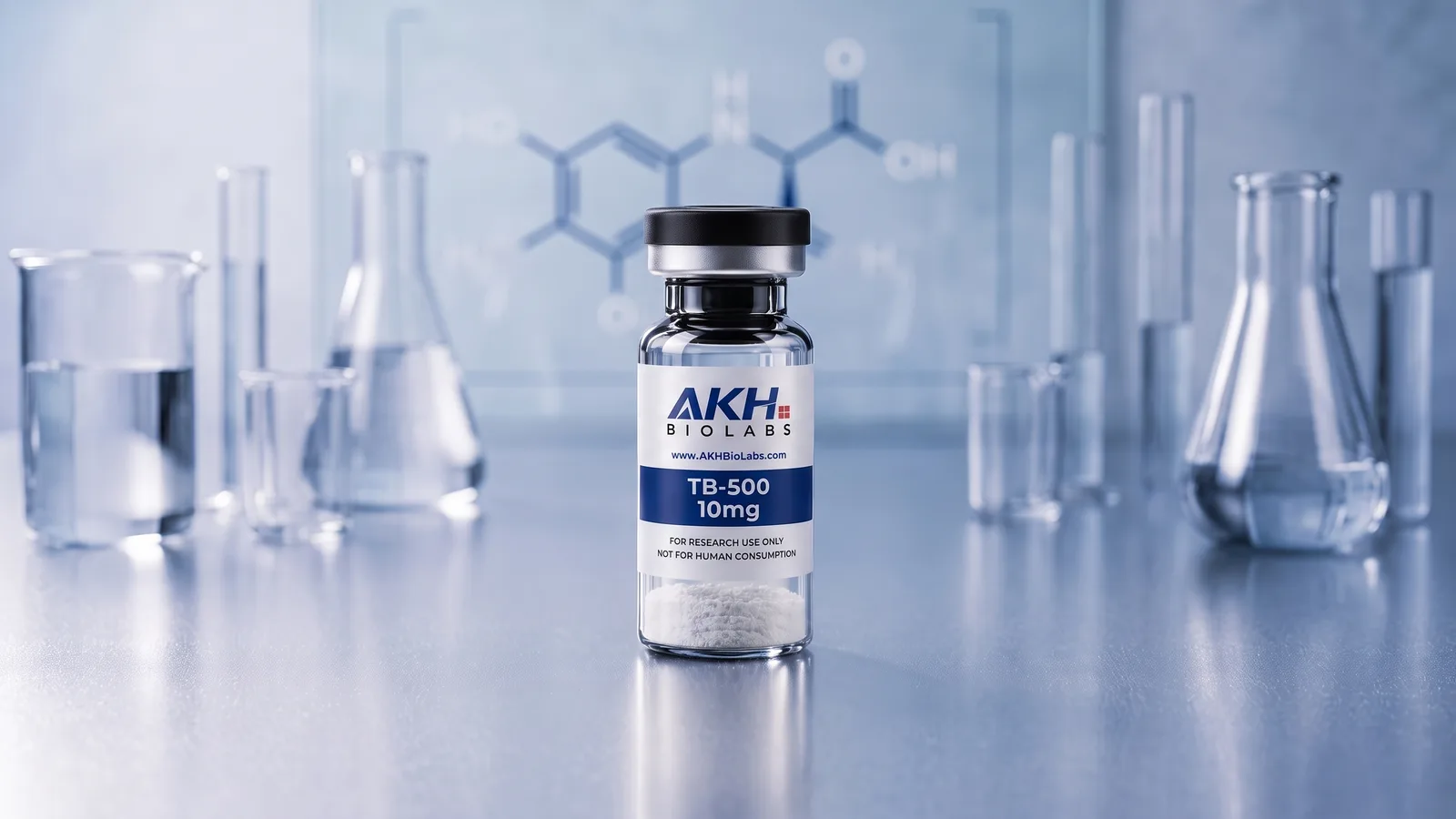
The same record states what the catalogue compound is: TB-500, the synthetic Ac-LKKTETQ fragment marketed as a Tb4 analogue. It then adds the qualification that matters most when reading the literature, namely that almost all published biology concerns full-length Tb4 rather than the fragment, and that the two are frequently conflated.
HGH frag comes from a different parent protein altogether. The AOD-9604 product page describes that compound as a 16-amino-acid fragment of human growth hormone spanning residues 176 to 191, with an added tyrosine at the N-terminus for stability. Different parent protein, different chain length, different research literature. Nothing about the shared word fragment implies shared behaviour or shared study models.
What TB4 is, and what TB4 frag means
Thymosin beta-4 is described on the TB-500 product page as a naturally occurring actin-binding protein found in almost every human cell. That page notes the short actin-binding motif at its centre (LKKTETQ) accounts for much of the activity described in published laboratory models, and that because the parent molecule is a 43-amino-acid peptide, the literature distinguishes between full-length preparations and shorter actin-binding fragments.
The research record is blunt about the fragment's own evidence base, stating that the specific TB-500 fragment has almost no independent pharmacology of its own and that its equivalence to full-length Tb4 is assumed rather than demonstrated. TB4 frag therefore names a real sequence, but the biology usually cited alongside it belongs to the parent peptide.
Two examples of that parent-level literature are cited with this article. A 2025 organoid study reported that expression of TMSB4X, the gene encoding thymosin beta-4, was significantly decreased in familial Alzheimer disease organoid neurons, and that Tβ4 rescued the neurodevelopmental deficits and amyloid formation in those organoids; the same paper reports effects in 5xfAD model mice. A 2016 review reports that thymosin beta-4 reduces infarct volume and preserves cardiac function in preclinical models of cardiac ischaemic injury, with antifibrotic effects also described in vitro and in animal models of fibrosis. Neither finding concerns a short fragment.
What is HGH frag? A fragment of a different parent protein
The AOD-9604 research record describes the compound as a synthetic hexadecapeptide corresponding to the C-terminal lipolytic domain of human growth hormone, written in the literature as Tyr-hGH 177-191 and commonly referred to as hGH fragment 176-191. The record treats the two names as the same sequence, with the added N-terminal tyrosine distinguishing the synthesised analogue.
Preclinical work published between 1993 and 2001 characterised the fragment's reported effects on lipolysis, lipogenesis and fat oxidation in rodent models, and reported that those effects occurred without measurable interaction with the hGH receptor or IGF-1 elevation. The 1993 report that first identified the C-terminal 177-191 sequence as reducing lipogenic activity in adipose tissue is the origin of the compound later developed as AOD-9604.
The human evidence is narrower than the preclinical literature. The same record states that no randomised controlled efficacy trial has been published as a standalone peer-reviewed report, that the human data available are a pooled safety and tolerability analysis, and that body-composition outcomes have not been independently replicated in an indexed journal.
TB4 frag and HGH frag side by side
The table below sets out the naming split in the form most useful for reading a catalogue page or a paper title. Every row is drawn from the research or product records linked at the end of this article.
| Attribute | TB4 and TB4 frag | HGH frag (hGH 176-191) |
|---|---|---|
| Parent protein | Thymosin beta-4, a 43-amino-acid endogenous actin-sequestering peptide | Human growth hormone |
| What the fragment is | A shorter piece of thymosin beta-4, typically the central actin-binding motif rather than the full chain | The C-terminal lipolytic domain, commonly written as hGH fragment 176-191, with an added N-terminal tyrosine in the synthesised analogue |
| Catalogue name | TB-500, described as the synthetic Ac-LKKTETQ fragment marketed as a Tb4 analogue | AOD-9604, described as a synthetic hexadecapeptide corresponding to the C-terminal lipolytic domain |
| Research focus in the literature | Tissue repair, angiogenesis, anti-fibrotic activity and inflammation resolution | Lipolysis, lipogenesis and fat oxidation in adipose-tissue and rodent models |
| State of the evidence for the fragment | Almost all published biology concerns full-length Tb4 rather than the fragment | No randomised controlled efficacy trial published as a standalone peer-reviewed report |
Reading the names without overreading them
The first rule is to check the parent protein before comparing two fragments. Two molecules that both carry the word fragment are not thereby related, and a finding reported for one parent does not transfer to the other.
The second rule is to check whether a paper is about the fragment or about the parent. The AOD-9604 record makes that distinction explicitly, stating that the fragment retains activity on lipolytic-pathway enzymes in adipose-tissue preparations but lacks the growth-promoting, receptor-mediated signalling of the full hGH molecule. The TB-500 product page makes the same structural point, noting that the literature distinguishes full-length preparations from shorter actin-binding fragments, which is why comparing results across papers requires checking which preparation each study used.
The third rule is to treat a catalogue name as a label rather than a definition. TB-500, TB4 frag, AOD-9604 and hGH fragment 176-191 are all shorthand; the sequence and the parent protein are what identify the material under study.
Where the evidence for each name lives
The canonical evidence record for thymosin beta-4 and its fragment sits at the TB-500 research page, which lists 15 published studies ordered by strength of study design and sets out what the evidence does not establish. That record notes that no human trial has tested Tb4 or TB-500 for tendon, ligament or muscle injury, and that the completed human trials cover dry eye, venous ulcers, cardiac ischaemia and healthy-volunteer safety.
The equivalent record for the human growth hormone fragment sits at the AOD-9604 research page, which lists 17 published studies. Its limitations section states that the cartilage and osteoarthritis findings rest on a single small rabbit study with no human confirmation, and that long-term outcomes are not addressed in the peer-reviewed data.
Both pages carry the full citation lists and their own limitation statements. This article is a naming explainer and deliberately does not duplicate either record.
Common questions.
- What does TB4 frag mean in practice?
It names a shorter piece of thymosin beta-4, the 43-amino-acid actin-sequestering peptide. The TB-500 research record states that the catalogue compound is the synthetic Ac-LKKTETQ fragment marketed as a Tb4 analogue, and that almost all published biology concerns the full-length peptide rather than the fragment.
- Are TB4 frag and HGH frag the same thing?
No. TB4 frag derives from thymosin beta-4, a 43-amino-acid actin-binding peptide. HGH frag derives from human growth hormone, and the AOD-9604 product page describes that compound as a 16-amino-acid fragment of human growth hormone spanning residues 176 to 191. The two share the word fragment but come from different parent proteins.
- Which parent protein does HGH frag come from?
Human growth hormone. The AOD-9604 research record describes the compound as a synthetic hexadecapeptide corresponding to the C-terminal lipolytic domain of human growth hormone, written as Tyr-hGH 177-191 and commonly referred to as hGH fragment 176-191.
- Is most thymosin beta-4 research done on the full-length peptide?
Yes, according to the TB-500 research record, which states that almost all published biology concerns full-length Tb4 rather than the fragment, and that the specific TB-500 fragment has almost no independent pharmacology of its own. Both PubMed records cited with this article name thymosin beta-4 itself rather than a short fragment.
Sources
- 01Thymosin beta 4 as an Alzheimer disease intervention target identified using human brain organoids.
- 02Cardioprotection by Thymosin Beta 4.
- 03Buy TB-500 10mg (Thymosin Beta-4): COA · AKH BioLabs
- 04TB-500 research — published studies and evidence · AKH BioLabs
- 05AOD-9604 — Anti-Obesity Drug 9604 (hGH Fragment 176-191) · AKH BioLabs
- 06AOD-9604 research — published studies and evidence · AKH BioLabs