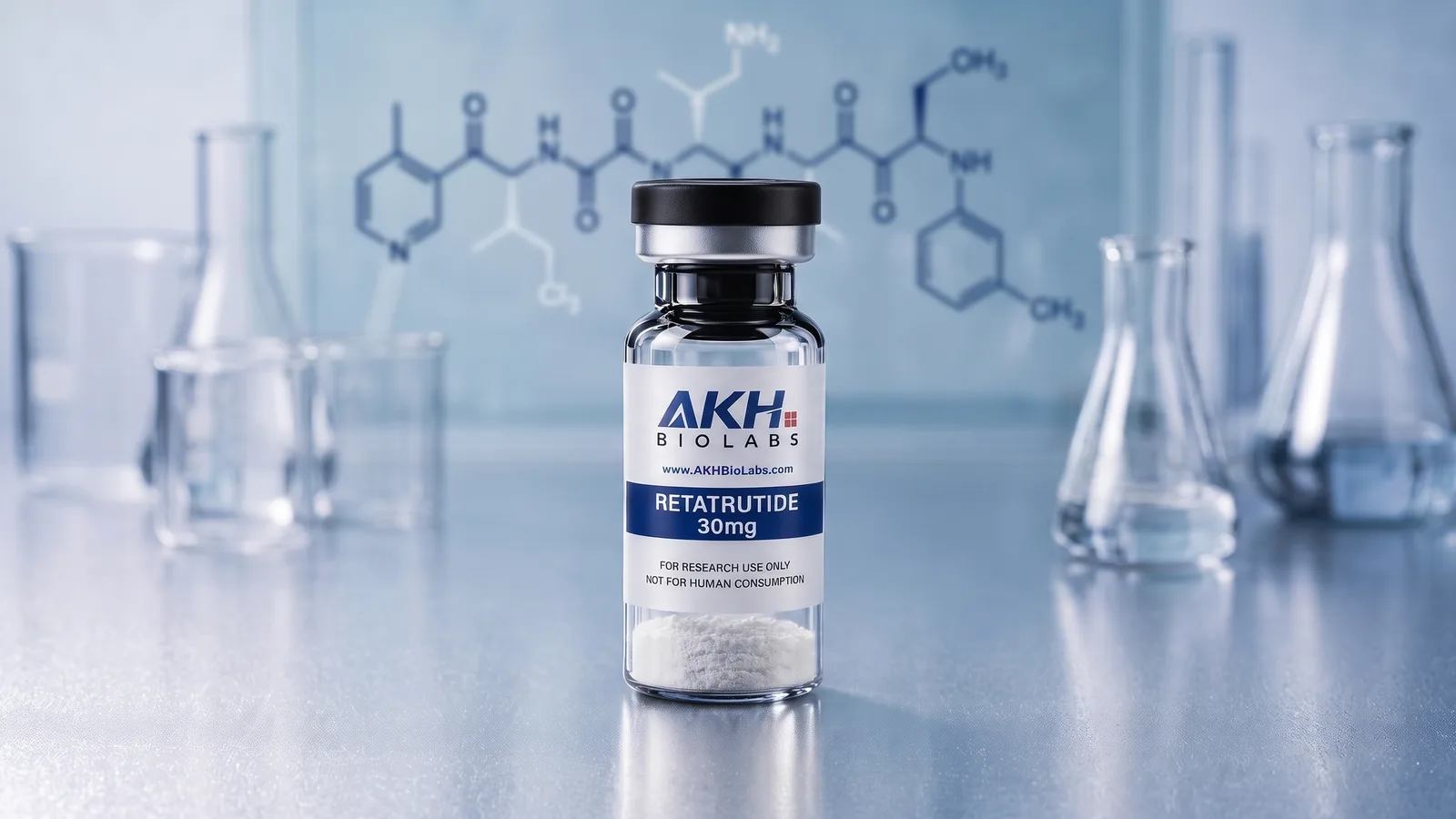
Where to get retatrutide: what to check before ordering
A buyer's guide to where to get retatrutide for laboratory research: the four public checks that settle a seller, the batch record published for the 30mg presentation, and the approval boundary the research record sets.
The short answer to where to get retatrutide for laboratory research is a seller whose claims can be read and checked from public pages before payment: a published certificate from a named outside laboratory covering that exact product, the identity and purity that report states, shipping to the destination country, and a public review record read with its count. The AKH BioLabs Retatrutide page publishes those fields for its 30mg lyophilised presentation, and the page itself is Retatrutide 30mg.
The public Retatrutide product page reviewed here publishes a product name, size, purity, formula and a statement that a certificate from a named outside laboratory is on the page. This article is written for laboratory buyers comparing those public pages before an order, and it describes the material as research-use-only stock throughout. It does not cover human use, and the retatrutide research record states that the compound was not an approved medicine in any jurisdiction as of October 2026.
Key takeaways
- The buying question has a documentary answer: what a seller publishes, not what a listing promises.
- Four public fields cover most of it: an exact-product certificate from a named outside laboratory, the identity and purity it reports, a stated delivery scope, and a review record with its count.
- Fill size and purity are separate fields, and a net peptide content figure is the field to look for if the quantity matters.
- The research record marks the boundary of what is known about the compound, and a product page does not move that boundary.
The four checks that settle a buying decision
The supplied product page uses the compound name in its title, product information and description. What varies is the set of documents and terms a buyer can read before payment, and that set is what makes one page checkable and another not.
The first check is a certificate that covers the exact product and names the laboratory outside the seller that issued the measurement. A report written for a related product, or one with no laboratory named, cannot be tied to the material on offer.
The second is what the report states about identity and purity, read as two separate fields. The third is a delivery scope, expressed as destinations and a window rather than a promise. The fourth is the public review record, read together with the number of reviews behind the score.
- 01
Certificate for the exact product
The report must name the product offered and the outside laboratory that produced the measurement.
- 02
Identity and purity fields
Two statements, not one: what the material is, and what the laboratory measured for the batch.
- 03
Delivery scope
Destinations plus a window. The AKH BioLabs page states worldwide delivery in 9 to 14 days.
- 04
Review record with its count
The page displays 4.7 on Trustpilot from 30 reviews, which is a service record across past orders rather than a measurement.
The batch record behind the 30mg presentation
A certificate of analysis (COA) is a report from a laboratory recording measurements for one batch of material. On the AKH BioLabs page it is published beside the listing, and the identity block gives the formula C112H164N26O31 with a purity of 99.86% marked HPLC verified.
The supplied product page gives the product name and size and states that a Certificate (COA) from a named outside laboratory is on the page, with purity given as 99.86% HPLC verified.
The 30mg is the stated fill and the 99.86% is the laboratory's purity result for that batch, published as two fields. The page states no net peptide content figure, so the two numbers are not one quantity, and the glossary entries on HPLC purity and on purity versus quantity set out what each field measures.
What the research record adds to the buying decision
The retatrutide research record is a separate page from the catalogue entry. It lists 23 published studies, 21 of them since 2023, with the newest dated 2026, and records a last review of October 2026.
It describes the compound as an investigational single-peptide triple agonist of the GIP, GLP-1 and glucagon receptors, first described in preclinical pharmacology and phase 1 work in 2022, and states that as of October 2026 retatrutide was not an approved medicine in any jurisdiction.
The same page states what the evidence does not establish: long-term safety, cardiovascular outcome data and durability of effect after discontinuation had not been established in peer-reviewed reports.
For a laboratory buyer that record has one specific job. It marks the line between what is documented about the material supplied and what is documented about the compound, and it stops the second from being read as approval of the first.
Where to get reta: the shorter search, the same checks
The supplied Retatrutide product page publishes a statement that a certificate from a named outside laboratory is on the page, along with the product name, size, purity, formula, a delivery scope and a review count.
The shorthand creates no second compound and no separate specification, so both spellings should lead to the same documents. A page that uses reta in its title and publishes nothing for the product has added no information; a page that publishes a batch-level report has added the one thing that can be checked again after delivery.
Before ordering: the sequence that settles the decision
Start with the certificate, then the identity block, then the delivery window, then the review count. Form and fill are read last, because a page can be clear on one field and silent on another, and the silent field is the one that decides whether the listing can be checked at all.
For this presentation the fields sit on Retatrutide 30mg, which states that a certificate from a named outside laboratory is on the page.
That comparison is the reason for reading a batch-level document rather than a headline percentage.
Common questions.
- Is a purity figure enough to choose where to get reta?
No. A percentage on its own carries no laboratory name, no batch number and no test date, so it cannot be matched to a container. The supplied Retatrutide page states that a Certificate (COA) from a named outside laboratory is on the page and gives the purity as 99.86% HPLC verified.
- What delivery window does the Retatrutide page state for an order?
The page states worldwide delivery in 9 to 14 days. That is a commercial term about reach and timing rather than a quality claim, and it belongs beside the certificate fields rather than in place of them.
- Is the retatrutide supplied for laboratory work a lyophilised powder?
Yes. The page describes 30mg lyophilised powder for laboratory research and states that the material is not for human or veterinary use. The fill and the purity result are published as separate fields, and the page states no net peptide content figure.
- How should a public review score be read next to a batch certificate?
As two different records. The review score, 4.7 on Trustpilot from 30 reviews on the Retatrutide page, describes service across past orders. The certificate describes measurements for one batch. Neither substitutes for the other, and a review count says nothing about identity or purity.