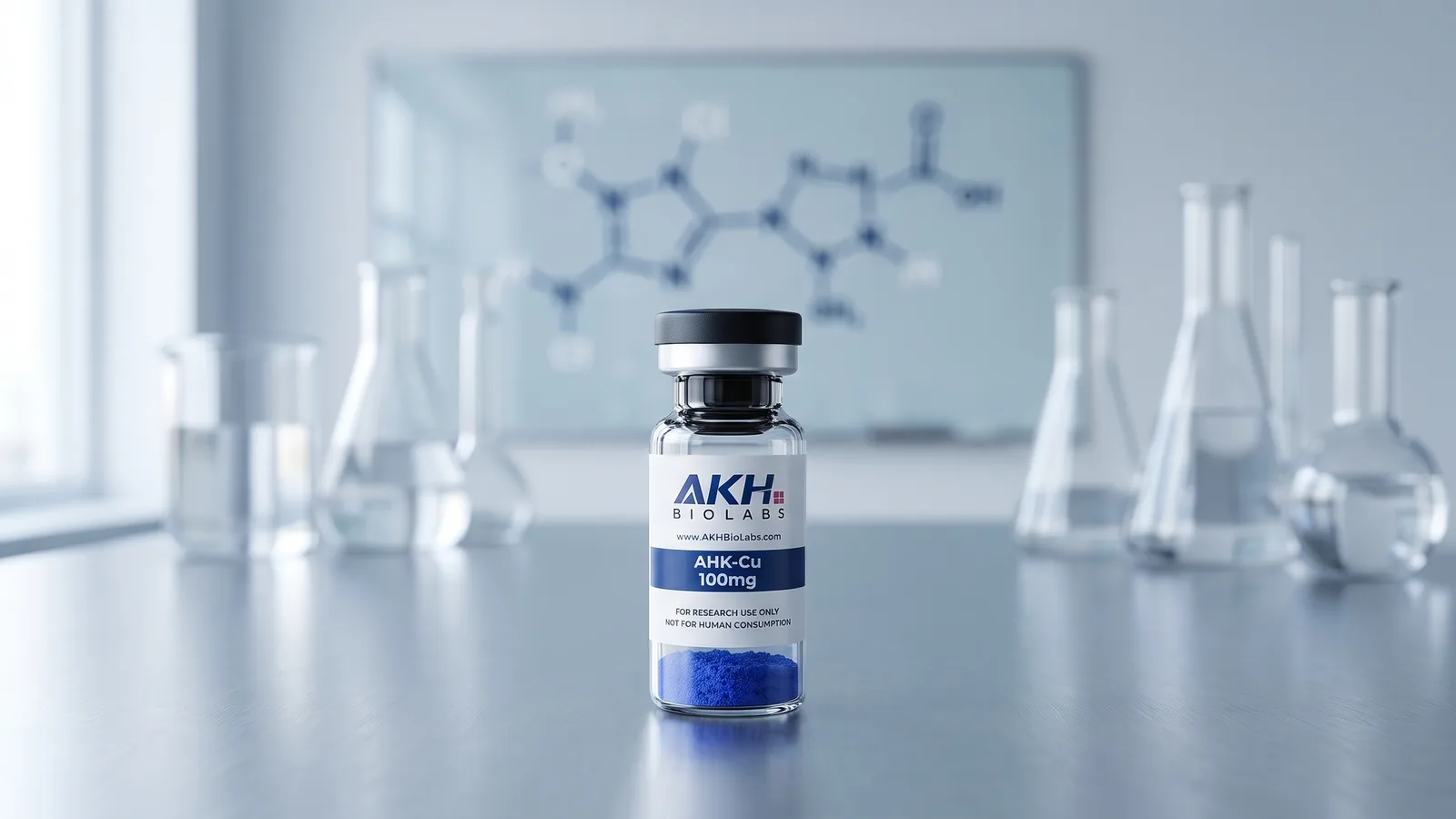
AHK cu supplier: what to check before ordering
The question behind an ahk cu supplier search is where AHK-cu can be bought for research with something checkable attached, and the answer is a seller that publishes a Certificate from a named outside laboratory for that exact product, states the identity and purity the report gives, delivers to the destination country and shows a public review record with its count.
The question behind an ahk cu supplier search is where AHK-cu can be bought for research with something checkable attached, and the answer is a seller that publishes a Certificate from a named outside laboratory for that exact product, states the identity and purity the report gives, delivers to the destination country and shows a public review record with its count. The AKH BioLabs page for AHK-Cu 100mg lyophilised powder publishes each of those fields, and the sections below set out how to read them there or on any other seller's listing.
This article is for laboratory buyers comparing research-use-only listings, and it covers only what can be read from public pages: the batch record, the identity fields behind the catalogue name, the delivery term and the published evidence record. It makes no claim that AKH BioLabs is the best or the cheapest seller, and it quotes no price, because the price is a commercial figure shown on the product page.
Key takeaways
- The published AHK-cu record names batch 26202, tested 02 Aug 2026 by the Brown Institute of Biomolecular Research, at a stated purity of 99.6%.
- A Certificate tied to a batch number, a test date and a named laboratory outside the seller is the document that makes a listing checkable.
- The CAS number, the PubChem identifier and the molecular formula describe the compound; they do not state the mass of powder in a vial.
- The research record cites 10 published studies and states that no human clinical trial of AHK-Cu and no controlled comparison with GHK-Cu exist.
- Delivery is the only one of the four checks that a destination country changes, and the stated window is worldwide, 9 to 14 days.
How to judge an ahk cu supplier: four public checks
A certificate of analysis (COA) is a report issued for one batch of material. On a research-use-only listing, the checkable version of that document is narrow: one product, one batch number, one test date, one named laboratory outside the seller, and a results line that gives the identified material and its measured purity. A generic purity claim with no batch attached cannot be tied to the vial that arrives.
The AKH BioLabs archive describes its own table in those terms, stating that each row is one Certificate covering one batch, tested once, by a named laboratory outside AKH, on a report ordered by the manufacturer. That sentence is the standard worth applying to any other seller: who issued the measurement, for which batch, and on whose instruction.
The four checks below are the ones a buyer can complete without contacting the seller.
A product-specific Certificate
The report should name the exact product and carry a batch number, a test date and the laboratory that issued it. A report that names no batch describes material in general rather than the container in hand.
The identity and purity it reports
Purity is a chromatographic result for the detected material. Identity fields such as the CAS number, the molecular formula and the PubChem identifier state which compound the record describes. Both belong on the same listing.
Delivery to the destination country
A stated scope and window, such as worldwide delivery in 9 to 14 days, can be checked against the destination before payment. It is a commercial term rather than a quality measurement.
A public review record, read with its count
A rating without the number of reviews behind it says very little. The AHK-cu page shows 4.7 on Trustpilot from 28 reviews, which is a service record across past orders and not a batch measurement.
What the published AHK-cu Certificate reports
The published AHK-cu record exists in two places: one row in the COA archive and one report linked from the product page. It names batch 26202, a test date of 02 Aug 2026 and the Brown Institute of Biomolecular Research, with a stated purity of 99.6%. The archive row lists the product, batch, purity, test date and laboratory, while the product page lists size and purity separately.
The product page presents the figure as 99.6% HPLC verified and lists the size as 100mg of lyophilised powder. The product page describes the material as a lyophilised powder.
Two fields on that record do different work. The 100mg is a fill for the presentation. The 99.6% is a chromatographic purity result, and such a result does not resolve the difference between the mass of powder in a vial and the molecular weight. Neither figure states the net peptide content of the vial, and the archive points readers to the certificate guide and the lab glossary for what the numbers cannot establish.
The batch number is what ties the two together. A report carrying 99.6% but a different batch describes different material, so the number printed on the vial is the one to compare against the published row.
ahk cu uk: what the destination changes, and what it does not
An ahk cu uk search adds one variable to the same four checks: whether the seller's stated delivery covers the United Kingdom. On the AKH BioLabs listing the answer is a worldwide window of 9 to 14 days, which describes scope and timing rather than a country-by-country commitment, and it is read before payment rather than after.
The destination changes nothing else. A report for batch 26202 issued by the Brown Institute of Biomolecular Research is the same document wherever the parcel is sent, and a 100mg fill is the same fill. Delivery is the one field a buyer can settle from a listing without laboratory knowledge.
One further field applies to every destination. The listing states that the material is for laboratory research and not for human or veterinary use. That is an intended-use statement attached to the product, and it does not vary with the shipping address.
Identity fields that a purity figure cannot cover
A purity figure and an identity record answer different questions, and AHK-cu shows the gap clearly. The research record gives CAS 682809-81-0, PubChem CID 168431292, the molecular formula C15H24ClCuN6O4- and a molecular weight of 451.39 g/mol, and states that those figures describe the free base as recorded in PubChem. Lyophilised peptide is normally supplied as an acetate or trifluoroacetate salt and carries residual water, so the mass of powder in a vial is not the quantity the formula implies.
That is why a listing can be complete on identity and still silent on quantity. The identity fields confirm which compound is offered. The fill states what the presentation contains. Net peptide content would be a third measurement, and the AHK-cu record does not report one.
| Field on the AHK-cu record | What it states | What it does not settle |
|---|---|---|
| Batch 26202 | Which batch the report covers | Whether the material delivered carries the same batch |
| 99.6% purity | A chromatographic result for the detected material | The share of vial mass that is peptide |
| 100mg size | The stated fill for the presentation | Net peptide content after salt and residual water |
| CAS 682809-81-0 | Which compound the record describes | The quantity or purity of a specific batch |
What the ahk cu vendor record supports about the research
The evidence for the compound sits on its own research record rather than inside a buying article, and an ahk cu vendor that paraphrases studies adds a layer between the reader and the source. The AHK-Cu record lists 10 published studies, 6 of them published since 2023, and describes the compound as a copper-tripeptide analogue of GHK-Cu in which alanine replaces glycine.
The direct dermatological evidence is thin, and the record says so. A single 2007 ex vivo and cell-culture study of human hair follicles and cultured dermal papilla cells is the principal source. There are no published human clinical trials of AHK-Cu for hair growth or skin appearance, no controlled comparison of AHK-Cu against GHK-Cu has been published in any model, and most claims made for the compound are extrapolations from the wider copper-tripeptide literature.
That shapes what a listing can honestly assert. A page that reports batch measurements and points to the study record is checkable. A page that turns one ex vivo experiment into a product claim is not, because a single cell and organ-culture study does not carry that weight.
Where to buy AHK-cu for research, and the order of checks
The AHK-cu listing at AHK-Cu 100mg lyophilised powder carries the Certificate, the 100mg fill, the 99.6% HPLC figure and the stated worldwide window, and the same batch appears as a row in the COA archive.
The sequence below is the order that keeps the paperwork ahead of the order.
- 01
Read the report before payment
Open the Certificate for the exact product and confirm that the batch number, the test date and the issuing laboratory are all present. A report missing any of the three cannot be tied to a container.
- 02
Match the product page to the archive row
A disagreement between the two is the point to stop.
- 03
Read the identity fields against the catalogue name
CAS 682809-81-0, PubChem CID 168431292 and the formula C15H24ClCuN6O4- confirm which compound the record describes. The fill and the delivery term are separate fields with separate meanings.
- 04
Confirm the stated window covers the destination
The published worldwide window of 9 to 14 days is the field to read, and it is the only one of the four checks that a destination country alters.
- 05
Compare the batch on arrival
The number printed on the material is compared with the published row. A different number describes different material, even when the compound name and the purity figure are identical.
Common questions.
- What should an ahk cu supplier publish before an order is placed?
Four fields: a Certificate for the exact product naming the laboratory, batch number and test date; the identity and purity that report gives; a stated delivery scope and window; and a public review record with its count.
- Which batch and laboratory appear on the published AHK-cu certificate?
Batch 26202, tested 02 Aug 2026 by the Brown Institute of Biomolecular Research, with a stated purity of 99.6%. The same row appears in the COA archive, which holds one row per Certificate. Matching that batch number to the number printed on the material is what ties the published measurement to the container.
- Does the AHK-cu Certificate state how much peptide is in the 100mg vial?
No. The 100mg is the stated size and the 99.6% is a chromatographic purity result. Lyophilised peptide is normally supplied as a salt carrying residual water, so powder mass and peptide mass differ, and net peptide content would be a separate measurement that the record does not report.
- Is AHK-cu an approved medicine for human use?
No. The research record states that there are no published human clinical trials of AHK-Cu for hair growth or skin appearance, and the listing states that the material is for laboratory research and not for human or veterinary use. A batch Certificate reports measurements for one batch and does not confer a regulatory status.