AKH Signature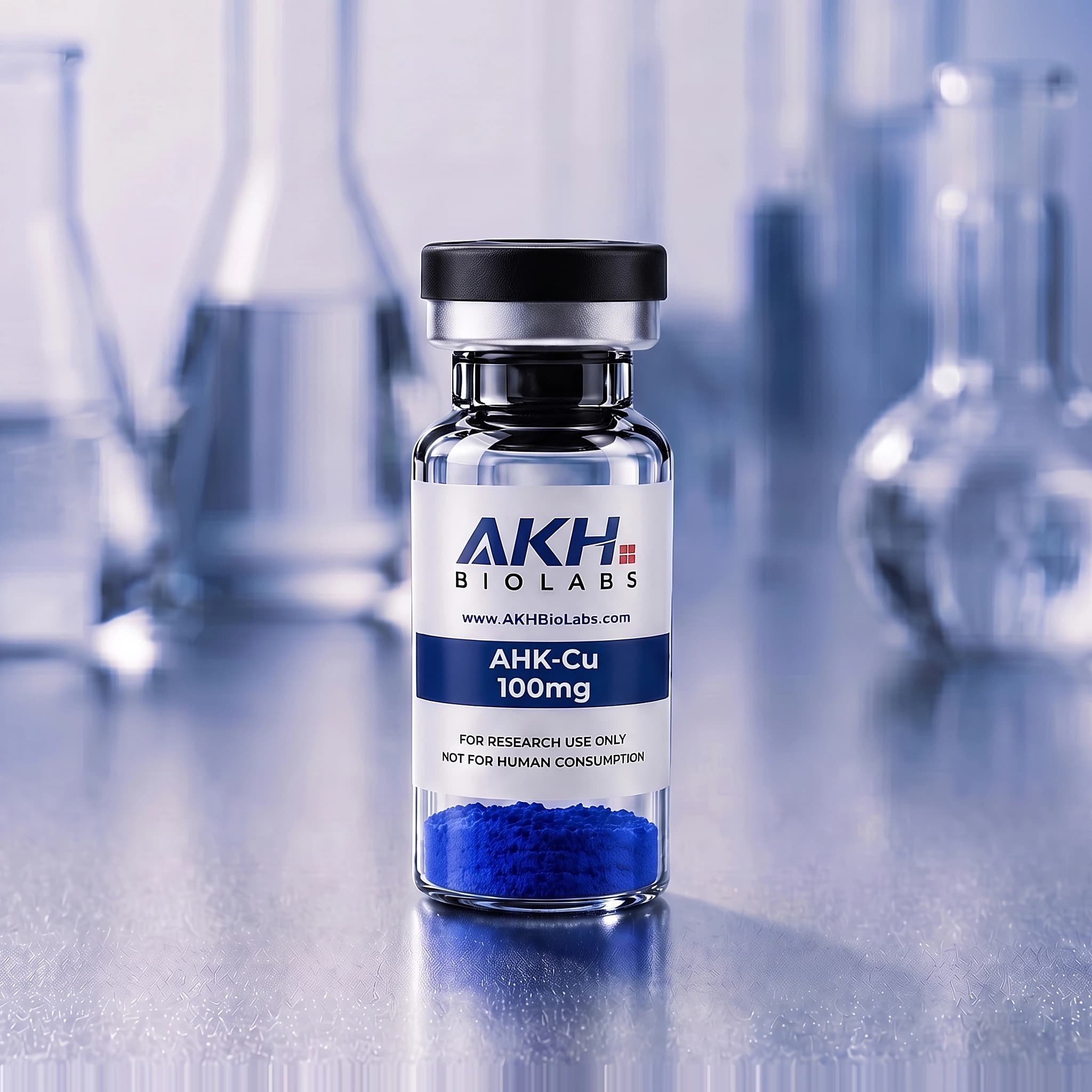
Skin· AKH Signature
In stockAHK-cu
Copper Peptide AHK-cu
Size100mgPurity99.6%
AHK-cu is a copper-binding tripeptide (alanine-histidine-lysine) studied alongside GHK-cu in cosmetic research. It is investigated for stimulating dermal fibroblast proliferation, supporting hair follicle growth through dermal papilla cell activity, and promoting microcirculation in skin models.
€60
Quantity
HPLC verified
9–14 day shipping
Full COA
Worldwide delivery
About this compound
The research profile.
AHK-Cu is the copper(II) complex of the tripeptide L-alanyl-L-histidyl-L-lysine. Like its better-known relative GHK-Cu, it binds copper through the histidine imidazole and delivers it in a bioavailable, peptide-chelated form — but its research footprint is different: AHK-Cu appears chiefly in hair-follicle and dermal-papilla-cell models rather than the wound and matrix literature that GHK-Cu dominates.
The principal published study examined isolated human hair follicles ex vivo and cultured dermal papilla cells. AHK-Cu at nanomolar concentrations stimulated follicle elongation and dermal-papilla-cell proliferation, with the authors reporting an elevated Bcl-2/Bax ratio and reduced cleaved caspase-3 — an anti-apoptotic signature in the cells that regulate the follicle growth cycle. These are in vitro observations; controlled in vivo data for AHK-Cu specifically remain sparse.
The broader copper-peptide literature provides the mechanistic backdrop: peptide-copper complexes influence fibroblast growth-factor secretion and remodelling gene expression, and copper itself is a cofactor for lysyl oxidase and other enzymes relevant to dermal structure. Where AHK-Cu claims outrun this thin but consistent evidence base, they outrun the science — the compound is best described as an early-stage research peptide with a focused in vitro literature.
Published research
10 peer-reviewed studies on AHK-Cu are summarised in our research library, including 6 published since 2023 — with study designs, reported findings and what the evidence does not establish.
Read the AHK-Cu evidence baseFor research purposes only. Not for human consumption, diagnosis, treatment, or prevention of any condition.
Categorised as Skin — Copper peptides and compounds for dermal research.
Dosing at a glance
What the literature reports.
For research and laboratory use only. Not for human consumption.
Route
Topical
Frequency
1–2x daily (formulation studies)
Reported range
0.5–2 mg
Protocol duration
8–12 weeks
0.5 mgper application (formulation conventions)2 mg
Subcutaneous · Once daily · 1–5 mg per administration · 4–8 weeks
AHK-Cu research is predominantly in vitro; laboratory formulation work applies it topically at low concentrations, and the range shown approximates those per-application amounts rather than figures from a controlled trial.
Ranges reflect protocols reported in the published literature on AHK-Cu — see research citations.
Calculate a dilutionReconstitution & storage
From powder to solution.
- Step 01
Add 3 ml bacteriostatic water
Aim the stream at the vial wall rather than the powder.
- Step 02
Swirl gently — never shake
Rotate the vial until the solution runs clear. Agitation degrades the peptide.
- Step 03
Refrigerate at 2–8 °C
Reconstituted vials belong in the fridge, protected from direct light.
- Step 04
Use within 30 days
Discard any remainder once the stability window closes.
Lyophilised · −20 °CReconstituted · 2–8 °C, 30 days
Like other copper peptides, reconstituted AHK-Cu shows a blue tint from the copper complex — this is expected.
Reconstitution calculator
100 mg vialmg
ml
mg
2 mg = 2000 mcg
Draw
6units · U-100 insulin syringe
- Concentration
- 33.33 mg/ml
- Draws per vial
- 50
- Cost per draw
- €1.20
For research and laboratory use only. Not for human consumption.
Laboratory arithmetic for AHK-cu — enter the COA-verified vial content for exact figures. Not medical advice.
Effect timeline
Observed across the research window.
Milestones summarise findings reported in the cited studies. Outcomes vary across models and protocols.
Start
Dermal-papilla-cell response
In culture, dermal papilla cells exposed to nanomolar AHK-Cu showed increased proliferation within the first days of the assay window.
Week 1
Ex vivo follicle elongation
Isolated human hair follicles cultured with AHK-Cu elongated measurably more than controls over the roughly week-long ex vivo culture period used in the published protocol.
Week 4+
Class-level remodelling window
Beyond the ex vivo timescale, expectations rest on the broader copper-peptide literature, where growth-factor and remodelling effects are described over multi-week protocols — an extrapolation, not an AHK-Cu-specific finding.
For research and laboratory use only. Not for human consumption.
Scientific research
The published evidence.
The dosing ranges and timeline milestones on this page summarise the peer-reviewed publications below.
References
- 01
The effect of tripeptide-copper complex on human hair growth in vitro. Arch Pharm Res (2007). PubMed · 17703734
- 02
Regenerative and Protective Actions of the GHK-Cu Peptide in the Light of the New Gene Data. Int J Mol Sci (2018). PubMed · 29986520
- 03
Effects of copper tripeptide on the growth and expression of growth factors by normal and irradiated fibroblasts. Arch Facial Plast Surg (2005). PubMed · 15655171
Laboratory verification
One Certificate, published unaltered.
The Certificate is a test report from a named laboratory outside AKH, ordered by our manufacturer and shown here exactly as the laboratory issued it. A printed copy ships in every parcel.
- Batch
- 26202
- Test date
- 02 Aug 2026
- Task ID
- #1812498
- Purity
- 99.6%
Results
AHK-CU: 100mg | Purity: 99.60%
Verified by Brown Institute of Biomolecular Research. Scan the full report for every measurement.
Product FAQ
Questions researchers ask.
Pairs well with
Frequently co-studied.
Compounds that appear alongside AHK-cu in the research literature.
For research and laboratory use only. Not for human consumption.
Skin