Best HMG: what to check before choosing for research
A buyer's guide to choosing HMG for laboratory research: what the material is, what the 75 IU presentation states, and where the AKH BioLabs product page shows each one.
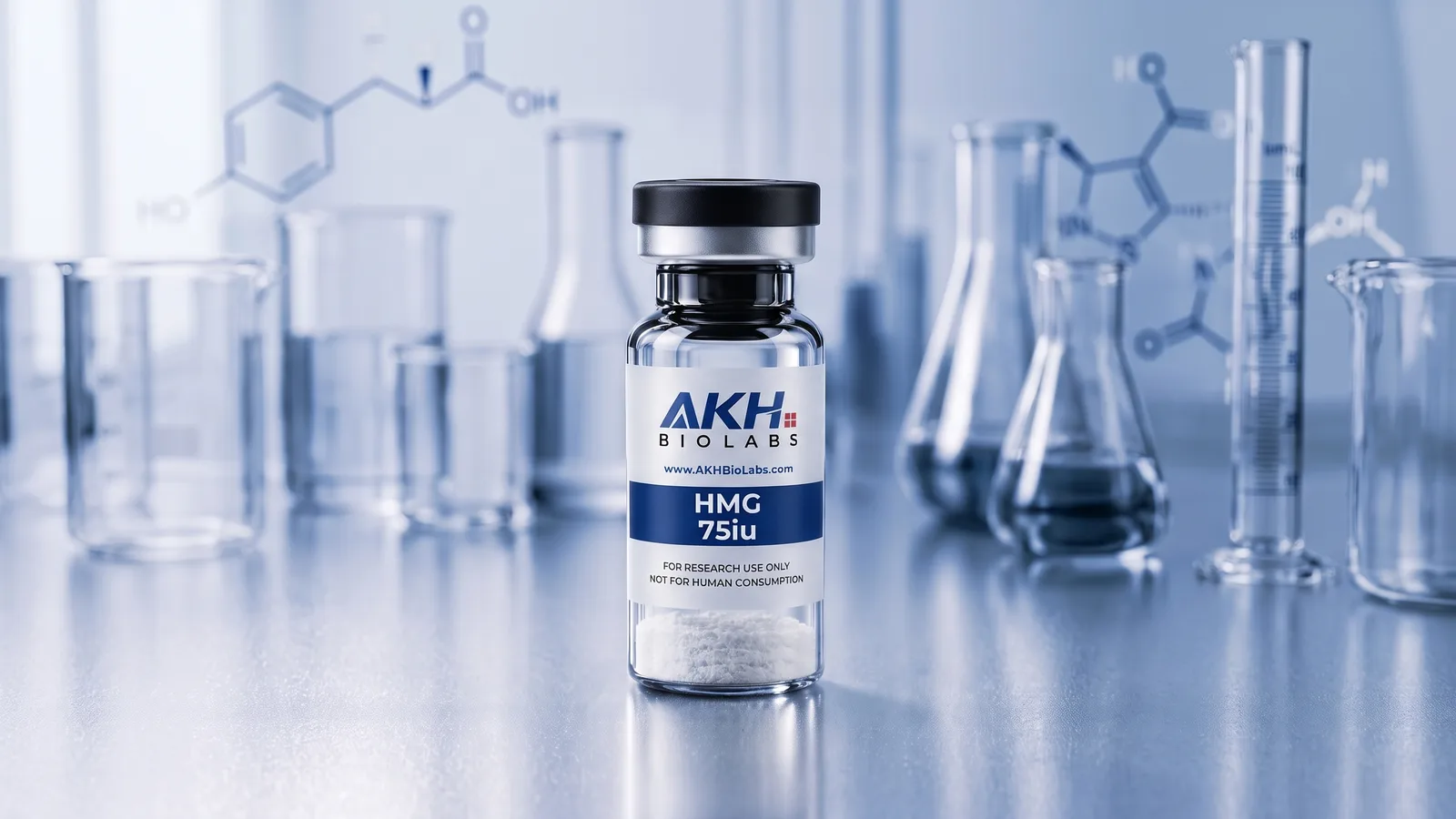
For a laboratory buyer, the best hmg is not a superlative but a set of checkable facts: a stated identity, a stated fill, a stated purity and delivery terms that cover the destination. The HMG 75 IU page publishes those fields for one presentation, from the identity line and the 75 IU fill to the 99.69% purity figure and a Full COA link.
This guide is written for laboratory buyers comparing research-use-only gonadotropin listings, and for readers checking a published Certificate against a catalogue page. It covers what HMG is, why the fill is written in international units rather than milligrams, which fields on the Certificate tie the report to a batch, what the listing states about storage and delivery, and where the compound's published literature sits. The evidence record at /research/hmg is linked rather than restated here.
Key takeaways
- HMG is a urine-derived gonadotropin preparation carrying FSH and LH activity in roughly a 1:1 ratio by international unit, described on the listing as a biological preparation rather than a synthetic peptide.
- The 75 IU fill and the 99.69% purity figure are separate fields: the first states the presentation, the second is marked HPLC verified on the page.
- The page links a Full COA alongside the 75 IU size and the 99.69% purity figure marked HPLC verified.
- The listing states worldwide delivery in 9 to 14 days and supplies the material strictly for laboratory research use only.
- Storage is not printed in the page text used for this article, so it is a field to confirm on the page before an order.
What HMG is, and why the formula line reads Biological Preparation
Human menopausal gonadotropin, also written menotropin, is a purified preparation extracted from urine that contains both follicle-stimulating hormone and luteinising hormone activity, in an approximately 1:1 ratio by international unit. The product page states that the material is not a synthetic peptide but a biologic.
The gonadotropins in the preparation are glycoprotein heterodimers sharing a common alpha subunit with a hormone-specific beta subunit, and the preparation carries a small contribution of chorionic gonadotropin that accounts for part of the labelled LH activity. That is why the formula line reads Biological Preparation rather than a molecular formula.
The page describes FSH and LH as signalling through their own receptors, so a single preparation supplies two activities where recombinant FSH supplies FSH activity alone. For a buyer, the practical consequence is that identity is described in words and units rather than in a residue sequence. A listing that offers only a trade name has not supplied an identity record.
Grade and size: reading 75 IU beside 99.69%
Grade, on a research listing, is the intended-use statement rather than a purity band. This listing states that the material is supplied strictly for laboratory research use only and is not for human consumption, diagnosis, treatment, or prevention of any condition.
The size field reads 75 IU. International units are the unit this urine-derived preparation is measured in, so the figure describes the presentation offered rather than a milligram mass. The purity field reads 99.69% and is marked HPLC verified, which names the analytical method behind the result.
The two fields answer different questions. The 75 IU states what is offered; the 99.69% is the purity figure stated beside it and marked HPLC verified. Neither converts into the other, and no net content figure appears beside them on the page.
| Field on the listing | What it states | What it leaves open |
|---|---|---|
| Size: 75 IU | The presentation, written in international units | A milligram mass for the vial contents |
| Purity: 99.69%, marked HPLC verified | A stated purity figure, with HPLC named as the method | How much material the vial holds by mass |
| Formula: Biological Preparation | That the material is a biologic rather than a synthetic peptide | A residue sequence or a molecular formula |
| A linked Full COA | The identity line, the stated fill and the purity figure on the listing | Intended human use, which the listing excludes in its research-use-only statement |
| Delivery: worldwide, 9 to 14 days | A shipping scope and a window | Identity, purity or holding conditions |
The Certificate for batch 26196: what the fields establish
The product page links a Full COA, and it states a 75 IU fill and a 99.69% purity figure marked HPLC verified.
The listing states several fields that can be checked before purchase. The identity line names the compound, the fill is stated as 75 IU, the purity figure is given as 99.69% and marked HPLC verified, and worldwide delivery is stated with a 9 to 14 day window. The page also links a Full COA, and the material is described as supplied strictly for laboratory research use only.
A buyer can check the identity line, the 75 IU fill and the 99.69% purity figure on the listing itself. The listing carries a research-use-only statement and no printed storage condition. The linked Full COA is a separate document from the listing.
Storage and delivery: what the listing states and what it leaves open
Delivery is stated: worldwide in 9 to 14 days. That gives a destination scope and a timeline to plan around. It is a commercial term rather than a quality claim, so it belongs beside the Certificate check and not in place of it.
Storage is the field the page text used for this article does not print. A stability question appears in the product FAQ, but the text does not include its answer, so no holding condition can be quoted from the page as read here. That field is worth confirming on the page before an order rather than inferred from the form of the material.
The page also displays a 4.7 Trustpilot rating from 28 reviews. Read with the number of reviews behind it, that is a service record across past orders. It says nothing about the identity or purity of a batch.
Where the HMG literature sits, and why it is not a batch record
The compound's published literature is collected at /research/hmg, which lists 18 published studies, 13 of them since 2023, ordered by strength of study design and then by recency. The record also states its own limits, including that head-to-head randomised data remain insufficient to settle the comparative questions it covers. Those are statements about a literature, not about a vial.
The two PubMed records supplied with this article sit in clinical reproductive medicine rather than in analytical chemistry. One is a single case report; the other is a prospective study that evaluated 30 subjects. Neither reports identity, purity or a batch measurement of supplied material, so neither can stand in for a Certificate.
A literature record and a batch Certificate answer different questions. The literature describes what has been published about a compound; the listing states the identity, the fill and the purity figure for one presentation. Reading one as the other leaves the identity and quantity questions unresolved.
Before ordering HMG: where each check sits
A short set of checks narrows the choice. Most are stated on the listing, including the identity line, the 75 IU fill, the 99.69% purity figure and worldwide delivery, while no storage condition is printed there.
The HMG 75 IU page shows the identity line, the 75 IU fill, the 99.69% figure marked HPLC verified, a Full COA link and the delivery window, so the checks above can be run against one public page before an order is placed.
- 01
Confirm the identity line
The listing should describe a urine-derived gonadotropin preparation carrying FSH and LH activity, and should not present the material as a synthetic peptide.
- 02
Read the fill and the purity as separate fields
The presentation is 75 IU; the purity result is 99.69%, marked HPLC verified. One is a stated quantity and the other is a laboratory result.
- 03
Match the Certificate to the batch
The identity line, the 75 IU fill, the 99.69% purity figure and the delivery terms belong together on the one listing page.
- 04
Check the delivery window against the destination
The listing states worldwide delivery in 9 to 14 days, which gives a scope and a timeline to plan around.
- 05
Confirm the intended-use line
The material is supplied strictly for laboratory research use only and is not for human consumption, diagnosis, treatment, or prevention of any condition.
- 06
Confirm storage on the page
The page text used for this article does not print a holding temperature, so that field is read on the page rather than assumed.
Common questions.
- Which public fields should be read before buying HMG for laboratory work?
Four fields do most of the work: the identity line, the stated fill in international units, the stated purity figure, and the delivery terms. The HMG 75 IU page publishes those for one presentation, with the purity stated as 99.69% and marked HPLC verified.
- What is human menopausal gonadotropin derived from?
It is a purified preparation extracted from urine, and the product page describes it as a biologic rather than a synthetic peptide. The preparation carries both follicle-stimulating hormone and luteinising hormone activity in an approximately 1:1 ratio by international unit, with a small chorionic gonadotropin contribution that accounts for part of the labelled LH activity.
- Why is the HMG fill written in international units instead of milligrams?
International units are the unit this urine-derived preparation is measured in, so 75 IU describes the presentation offered rather than a milligram mass. The page prints no milligram figure beside it. The purity result, 99.69%, is a separate laboratory measurement marked HPLC verified and does not convert into a mass.
- What does the Certificate for batch 26196 report, and what does it not establish?
The page states the product identity, the 75 IU fill and the 99.69% purity figure, and links a Full COA. The listing carries a research-use-only statement, and no net content figure appears beside the 75 IU fill.
- How does the published HMG literature relate to a batch Certificate?
The literature record at /research/hmg lists 18 published studies, 13 since 2023, ordered by strength of study design then recency, and states its own limits. The two PubMed records supplied with this article are clinical reports, one a single case report and one a prospective study of 30 subjects, and neither reports identity or purity testing of supplied material.