New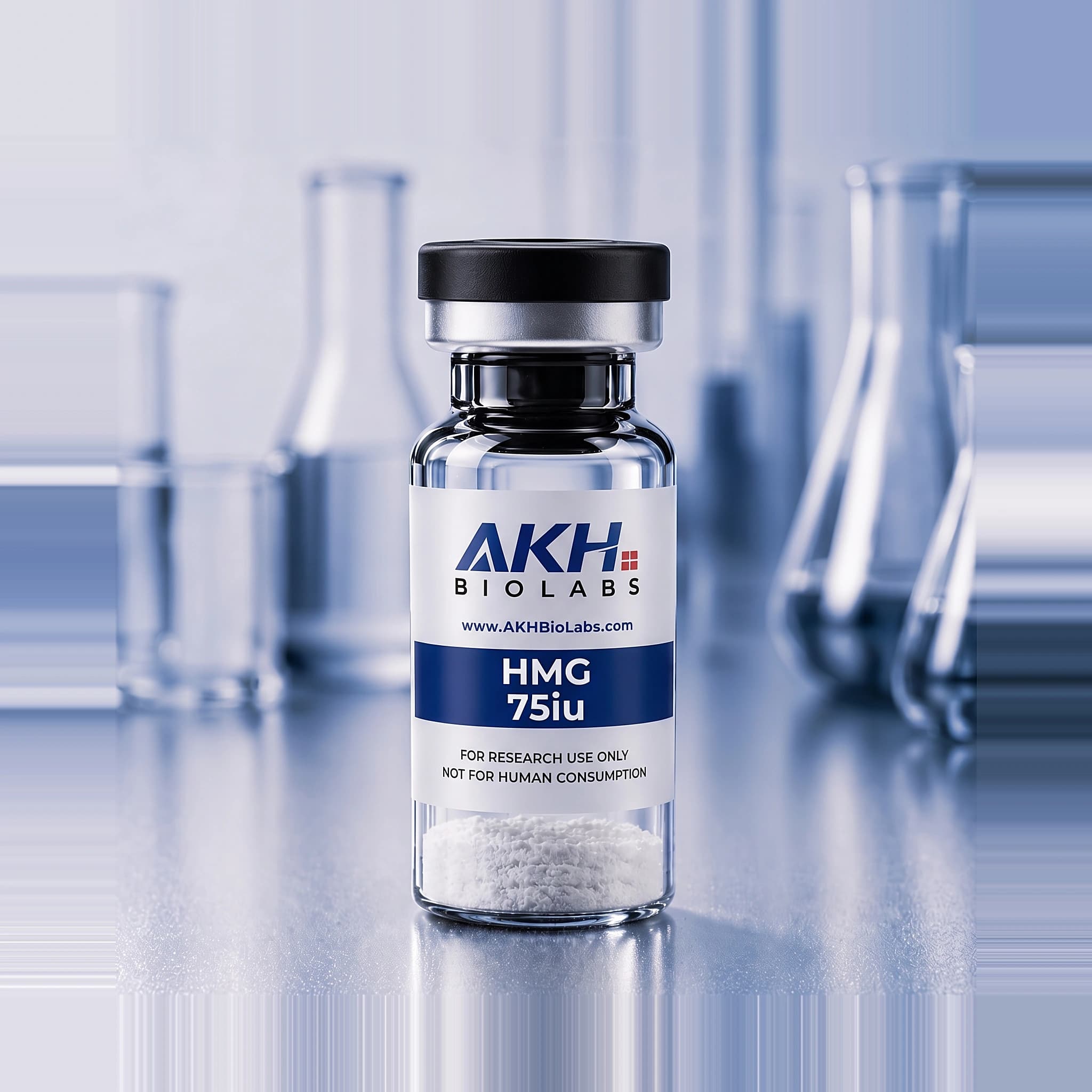
Hormones· New
In stockHMG
Human Menopausal Gonadotropin
Size75 IUPurity99.69%FormulaBiological Preparation
HMG (menotropin) is a purified gonadotropin preparation containing balanced FSH and LH activity, studied as a reference reagent for gonadotropin receptor (FSHR, LHCGR) signalling and reproductive endocrinology research. Supplied strictly for laboratory research use only.
€50
Quantity
HPLC verified
9–14 day shipping
Full COA
Worldwide delivery
About this compound
The research profile.
Human menopausal gonadotropin is a purified preparation extracted from urine, containing both follicle-stimulating hormone and luteinising hormone activity in an approximately 1:1 ratio by international unit. It is not a synthetic peptide but a biologic — the gonadotropins in it are glycoprotein heterodimers sharing a common alpha subunit with a hormone-specific beta subunit, and the preparation carries a small contribution of chorionic gonadotropin that accounts for part of the labelled LH activity.
Its two activities act at different gonadal targets. FSH signals through the FSH receptor on granulosa cells in the ovary and Sertoli cells in the testis; LH acts at the LH/hCG receptor on theca and Leydig cells, driving steroidogenesis. Because a single preparation supplies both, hMG occupies a distinct position in the gonadotropin literature from recombinant FSH, which supplies FSH activity alone.
The history of these preparations is well documented: gonadotropin therapy developed from urinary extraction methods in the mid-twentieth century through successive purification generations, and comparative reviews have since evaluated urinary against recombinant preparations across large pooled study populations. Those comparative datasets, not manufacturer material, are the reference points cited on this page.
Published research
15 peer-reviewed studies on HMG are summarised in our research library, including 11 published since 2023 — with study designs, reported findings and what the evidence does not establish.
Read the HMG evidence baseFor research purposes only. Not for human consumption, diagnosis, treatment, or prevention of any condition.
Categorised as Hormones — GH secretagogues, recombinant GH and gonadotropins.
Dosing at a glance
What the literature reports.
For research and laboratory use only. Not for human consumption.
Route
Intramuscular
Frequency
Once daily to 3x weekly, depending on protocol
Reported range
75–150 IU
Protocol duration
5–12 days in stimulation cycles; 12–24 months in male gonadotropin protocols
75 IUper administration150 IU
Published protocols are built around the 75 IU ampoule as the unit of measure, with commonly reported amounts of 75 IU or 150 IU per administration. The comparative literature covers pooled populations across dozens of trials rather than prescribing a single schedule, and male gonadotropin studies pair hMG with chorionic gonadotropin over far longer periods than stimulation cycles. All figures describe research protocols.
Ranges reflect protocols reported in the published literature on HMG — see research citations.
Calculate a dilutionReconstitution & storage
From powder to solution.
- Step 01
Add 2 ml bacteriostatic water
Aim the stream at the vial wall rather than the powder.
- Step 02
Swirl gently — never shake
Rotate the vial until the solution runs clear. Agitation degrades the peptide.
- Step 03
Refrigerate at 2–8 °C
Reconstituted vials belong in the fridge, protected from direct light.
- Step 04
Use within 28 days
Discard any remainder once the stability window closes.
Lyophilised · −20 °CReconstituted · 2–8 °C, 28 days
A 75 IU vial in 2 ml gives 37.5 IU/ml; each vial is a single labelled unit, drawn in full with a 3 ml syringe. Reconstituted solution is held at 2–8 °C and protected from light; sealed lyophilised vials are stored refrigerated.
Reconstitution calculator
75 IU vialIU
ml
IU
Draw
200units · U-100 insulin syringe
This draw exceeds a 100-unit U-100 syringe. Use a 3 ml syringe, or less water for a shorter draw.
- Concentration
- 37.5 IU/ml
- Draws per vial
- 1
- Cost per draw
- €50.00
For research and laboratory use only. Not for human consumption.
Laboratory arithmetic for HMG — enter the COA-verified vial content for exact figures. Not medical advice.
Effect timeline
Observed across the research window.
Milestones summarise findings reported in the cited studies. Outcomes vary across models and protocols.
Hours 0–24
Dual receptor engagement
FSH activity engages FSH receptors on granulosa and Sertoli cells while LH activity acts at the LH/hCG receptor on theca and Leydig cells — the two-signal profile that distinguishes hMG from recombinant FSH preparations.
Days 5–12
Stimulation-cycle window
In assisted reproduction protocols, the gonadotropin phase is typically monitored across this window before the cycle end point. The Cochrane comparison pooled 42 trials and roughly 9,600 couples to compare urinary and recombinant preparations across such cycles.
Months 6–12
Long-run male protocols
Male hypogonadotropic protocols combining chorionic gonadotropin with hMG run on a far longer timescale, with review data reporting median times to first observed spermatogenesis measured in many months rather than weeks.
Protocol end points
Comparative outcomes
The pooled Cochrane analysis reported no statistically significant difference in live birth rate between recombinant FSH and the other gonadotropins studied, and concluded that choice depends on availability, convenience, and cost.
For research and laboratory use only. Not for human consumption.
Scientific research
The published evidence.
The dosing ranges and timeline milestones on this page summarise the peer-reviewed publications below.
References
- 01
Historical perspectives in gonadotrophin therapy. Hum Reprod Update (2004). PubMed · 15388674
- 02
Recombinant versus urinary gonadotrophin for ovarian stimulation in assisted reproductive technology cycles. Cochrane Database Syst Rev (2011). PubMed · 21328276
- 03
Pulsatile GnRH or human chorionic gonadotropin/human menopausal gonadotropin as effective treatment for men with hypogonadotropic hypogonadism: a review of 42 cases. Eur J Endocrinol (1998). PubMed · 9758439
Laboratory verification
One Certificate, published unaltered.
The Certificate is a test report from a named laboratory outside AKH, ordered by our manufacturer and shown here exactly as the laboratory issued it. A printed copy ships in every parcel.
- Batch
- 26196
- Test date
- 27 Jul 2026
- Task ID
- #1812492
- Purity
- 99.69%
Results
HMG: 75iu | Purity: 99.69%
Verified by Brown Institute of Biomolecular Research. Scan the full report for every measurement.
Product FAQ
Questions researchers ask.
Pairs well with
Frequently co-studied.
Compounds that appear alongside HMG in the research literature.
For research and laboratory use only. Not for human consumption.
Hormones