HMG price: what to check before ordering
HMG price is shown on the product page, not in this article. What a buyer can check before ordering is the certificate, the laboratory named on it, the batch number, the shipping terms and the public review record.
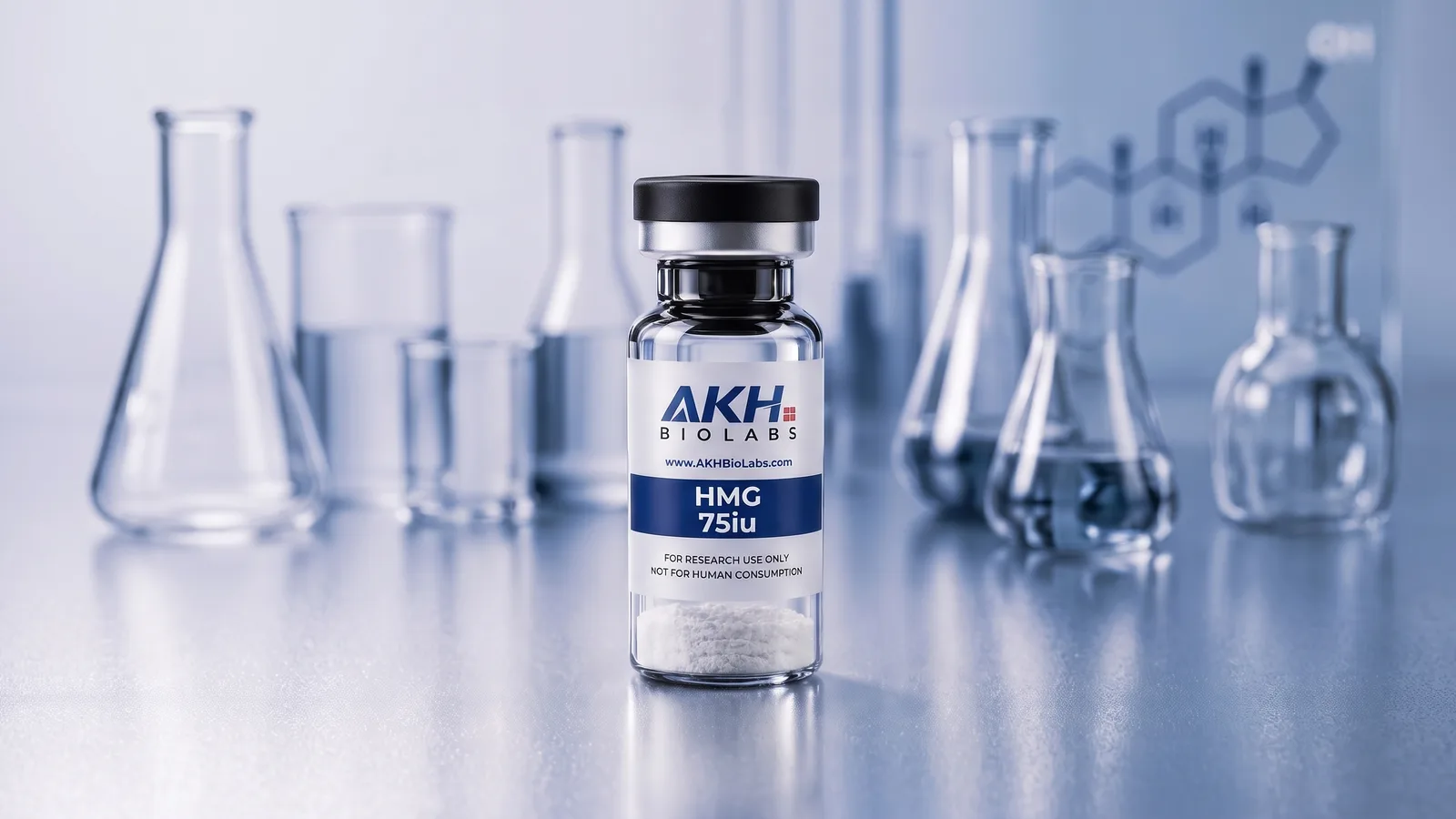
HMG price is not the field that separates one listing from another, because the price sits on the product page and changes with size and promotions. The checkable part of any HMG vendor listing is the documentation: a certificate published for that exact product, the laboratory named on it, the batch number and test date, the shipping terms, and a public review record read with its volume. The AKH BioLabs HMG page is at HMG 75 IU (Menotropins), and it shows each of those fields.
This article is written for laboratory buyers comparing HMG listings before ordering. It covers what HMG is as a supplied material, which fields on a certificate can be checked, how a batch number ties a document to a vial, what a purity figure does and does not measure, and where the published evidence record lives. It does not give prices, and it does not describe any human use.
Key takeaways
- HMG (human menopausal gonadotropin, also called menotropin) is a urine-derived biologic preparation carrying both follicle-stimulating hormone and luteinising hormone activity, conventionally in an approximately 1:1 ratio by international unit.
- The AKH BioLabs listing states a 75 IU size and a 99.69% purity figure, with the certificate covering batch 26196, tested 27 Jul 2026 by the Brown Institute of Biomolecular Research.
- A chromatographic purity figure is a peak-area ratio from the chromatogram, not a statement of how much of the vial mass is the compound.
- The batch number is the field that ties a certificate to a physical vial; a report whose batch does not match the material supplied describes different material.
- The published HMG literature is summarised on the HMG research record, which lists 18 studies and sets out what the evidence does not establish.
What HMG is as a supplied material
HMG is a purified gonadotropin preparation extracted from urine, containing both follicle-stimulating hormone and luteinising hormone activity in an approximately 1:1 ratio by international unit. It is not a synthetic peptide but a biologic: the gonadotropins in it are glycoprotein heterodimers sharing a common alpha subunit with a hormone-specific beta subunit, and the preparation carries a small contribution of chorionic gonadotropin that accounts for part of the labelled LH activity.
The two activities act at different gonadal targets. FSH signals through the FSH receptor on granulosa cells in the ovary and Sertoli cells in the testis; LH acts at the LH/hCG receptor on theca and Leydig cells. Because a single preparation supplies both, HMG occupies a position in the gonadotropin literature distinct from recombinant FSH, which supplies FSH activity alone.
The AKH BioLabs listing describes the material as a purified gonadotropin preparation studied as a reference reagent for gonadotropin receptor signalling and reproductive endocrinology research, supplied strictly for laboratory research use only. The listing states a 75 IU size and a formula line reading Biological Preparation.
What to check on any HMG vendor listing
A listing can be read on four public fields before an order is placed, and each can be checked again after delivery. The first is whether a certificate is published for that exact product rather than for the product line as a whole. The second is whether the certificate names the laboratory that produced the measurement, the batch number and the test date. The third is whether the seller states the destinations it ships to and a delivery window. The fourth is the public review record, read with its review count rather than as a star rating alone.
The AKH BioLabs HMG page carries a certificate for batch 26196, tested 27 Jul 2026 by the Brown Institute of Biomolecular Research, with a purity figure of 99.69%. The listing states worldwide delivery in a 9 to 14 day window and shows a public review record with its review count. Each published certificate is a report from a named laboratory outside AKH, ordered by the manufacturer.
None of those four fields is a price. The price is a commercial fact shown on the product page, and it is not comparable across listings without the documentation that sits beside it.
- 01
Certificate published for the exact product
A product-specific report, not a generic document reused across a catalogue. The HMG page links a Full COA for the listing.
- 02
Laboratory, batch and test date named
The report for this product names the Brown Institute of Biomolecular Research, batch 26196 and a test date of 27 Jul 2026.
- 03
Shipping destination and window stated
The listing states worldwide delivery in a 9 to 14 day window rather than a vague promise.
- 04
Public review record read with its volume
A rating is more informative when the number of reviews behind it is visible.
Reading the HMG certificate: batch, laboratory and results line
The certificate published with the HMG listing carries the results string "HMG: 75iu | Purity: 99.69%". The 75 IU is the stated fill, expressed in international units rather than milligrams because the material is a biologic preparation rather than a single synthetic peptide. The 99.69% is a chromatographic purity result for that batch.
The batch number is the field that connects the document to the container. A report with a high purity figure but a batch that does not match the material being supplied describes a different batch, so the number printed on the vial is the one to compare against the published record. The laboratory name and the test date complete the identification: they state who produced the measurement and when.
The archive at /lab/coa collects the published reports so a batch can be looked up rather than taken on trust. The glossary entry on the batch number explains why that field carries more weight than the purity figure beside it.
What a purity figure does not measure
A chromatographic purity figure is a peak-area ratio taken from the chromatogram. It states what share of the detected material is the target peak, not what share of the vial mass is the compound. Salt form and residual water both sit between the two, which is why net peptide content is measured separately.
For HMG the distinction is sharper than for a synthetic peptide, because the quantity is expressed in international units. An international unit is a defined biological activity measure rather than a mass, so the fill figure and the purity figure answer different questions and neither substitutes for the other.
The glossary entries on HPLC purity and net peptide content set out the difference in more detail, and the guide on reading a certificate of analysis walks through the fields a report needs to carry to be checkable.
Where the HMG evidence record lives
The published literature on HMG is summarised on the HMG research record rather than restated here. That record lists 18 published studies ordered by strength of study design, 13 of them published since 2023, with the newest dated 2026. It covers ovarian stimulation for IVF/ICSI, ovulation induction in polycystic ovary syndrome, combined gonadotropin therapy for spermatogenesis induction in male hypogonadotropic hypogonadism, and the comparative literature against recombinant FSH.
The record also states what the evidence does not establish. Head-to-head randomised data remain insufficient to establish whether HMG or highly purified HMG changes cumulative live birth rate across fresh and subsequent frozen transfers, and the magnitude of any live birth advantage over recombinant FSH varies by protocol, responder phenotype and trial era. No consensus exists on the optimal amount of LH activity.
A batch certificate does not speak to any of that. It documents measurements for one batch of one material, and the evidence record documents what published studies report. Keeping the two documents separate is what makes each of them readable.
Before ordering HMG for research
The order of checks matters less than doing all of them. A listing that is clear on the certificate but silent on shipping, or clear on shipping but vague about which batch the report covers, is only partly checkable. The four fields together are what make a listing verifiable before an order and again on arrival.
The AKH BioLabs HMG page is at HMG 75 IU (Menotropins), where the certificate, the stated size, the shipping terms and the review record sit together. The price is shown there rather than here, and the material is supplied for laboratory research use only.
For buyers comparing several HMG vendors, the practical test is whether the same four fields can be read from each listing without contacting the seller. Where they can, the listings can be compared on documentation rather than on presentation.
Common questions.
- Where is the HMG price shown?
On the product page, not in this article. The AKH BioLabs HMG listing shows the price alongside the stated 75 IU size, the shipping terms and the certificate for batch 26196. Price is a commercial fact that changes with size and promotions, so it is read from the listing rather than from a comparison article.
- What should be checked on an HMG vendor listing before ordering?
Four public fields: a certificate published for that exact product, the laboratory name, batch number and test date on it, the seller's stated shipping destination and window, and the public review record read with its volume. Each is readable from a public page before ordering, and each can be checked again after delivery against the batch printed on the vial.
- Does the HMG certificate state how much compound is in the vial?
No. The report for batch 26196 carries the results string "HMG: 75iu | Purity: 99.69%". The 75 IU is the stated fill, expressed in international units because the material is a biologic preparation, and the 99.69% is a chromatographic purity result, which is a peak-area ratio rather than a mass fraction.
- Why does the batch number matter more than the purity figure on an HMG report?
The batch number is the field that ties the document to the physical vial. A report with a high purity figure but a batch that does not match the material being supplied describes a different batch. The purity figure states what was measured; the batch number states which material the measurement applies to.
- Where is the published HMG research recorded?
On the HMG research record, which lists 18 published studies ordered by strength of study design and sets out what the evidence does not establish. That record covers the comparative work against recombinant FSH, the ovulation induction literature and the male hypogonadotropic hypogonadism studies, with the limitations of each strand stated.