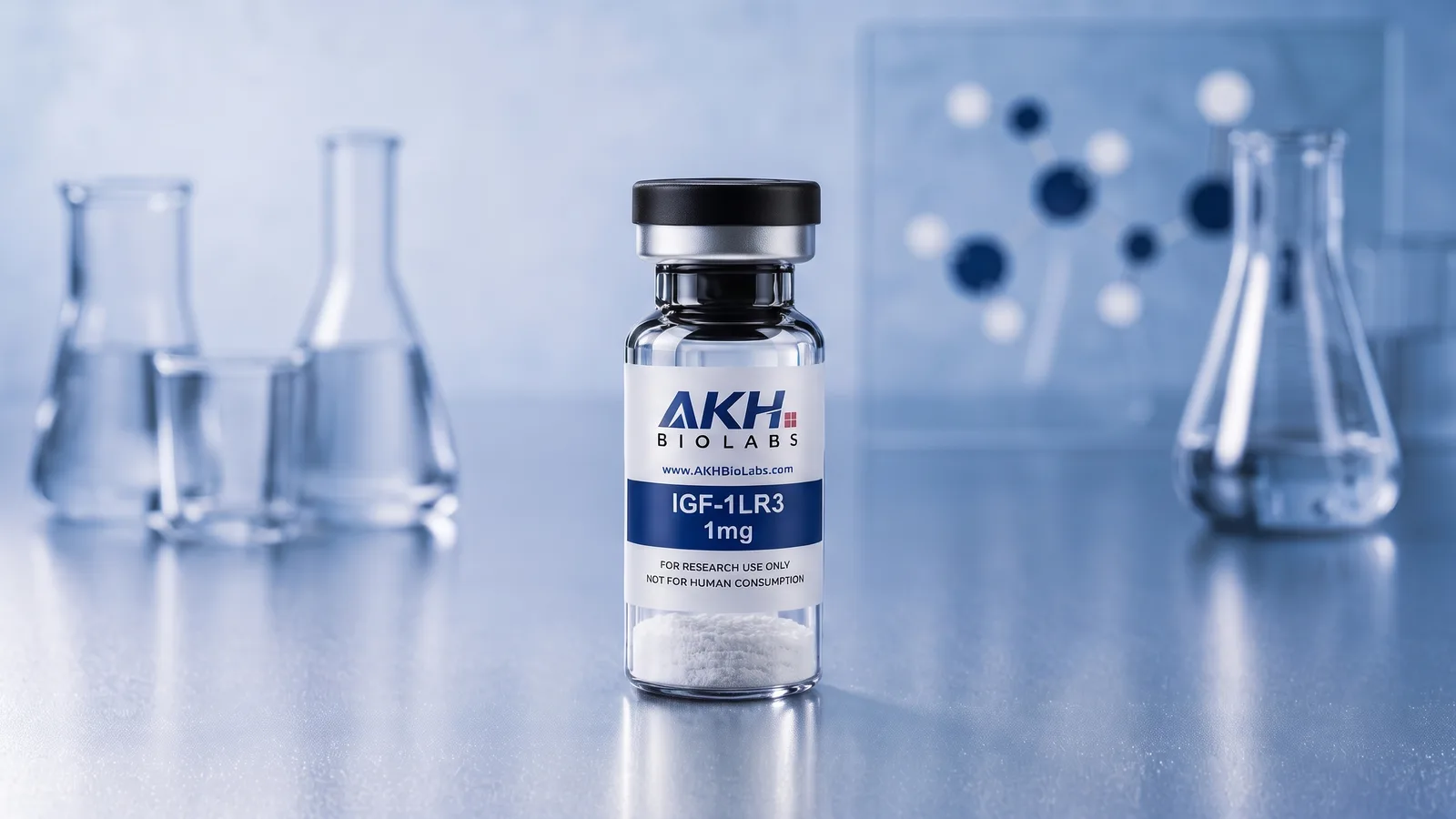
Best IGF-1 LR3: how to choose for research
A practical choice for laboratory research is the listing whose identity, size, purity and Certificate link can all be read and checked before ordering, and the AKH BioLabs page shows each of those fields for a 1mg presentation.
The best IGF-1 LR3 for laboratory research is the listing whose identity, size, Certificate and storage terms can all be read and checked before ordering, rather than the one with the loudest claim. IGF-1 LR3 (Long R3 IGF-1) is an 83-amino-acid analogue of human insulin-like growth factor 1, and the AKH BioLabs page for IGF-1 LR3 1mg states the size, the formula and the purity figure alongside a published Certificate.
This article is written for laboratory buyers and research groups comparing listings before an order. It sets out what IGF-1 LR3 is, which fields on a listing can be checked against a document, and what the published Certificate for one AKH batch records. It does not cover human use, and the material is supplied for research purposes only.
Key takeaways
- IGF-1 LR3 is an 83-amino-acid analogue of human IGF-1 carrying an Arg3 substitution and a 13-residue N-terminal extension, which together cut its binding to the six IGF-binding proteins roughly a hundredfold.
- The AKH BioLabs listing states a 1mg size, a purity of 99.85% and the formula C400H625N111O115S9.
- The AKH BioLabs page links to a Full COA for the product.
- A chromatographic purity figure is a peak-area ratio from the chromatogram, not a statement of how much of the vial mass is peptide.
- No human studies of LR3-IGF-I have been published, and the compound has never been approved for human use.
What IGF-1 LR3 is, and why the analogue exists
IGF-1 LR3 is a recombinant analogue of human insulin-like growth factor 1. The AKH BioLabs product page describes it as an 83-amino-acid analogue carrying an Arg3 substitution and a 13-residue N-terminal extension, and states that these changes together cut its binding to the six IGF-binding proteins roughly a hundredfold. The research record adds that the analogue was developed in Adelaide in the early 1990s and that the reduced binding-protein affinity is the property most of the literature turns on.
That property is why the analogue appears in the literature at all. The research record states that in cell and rodent studies the analogue was several-fold more potent than native IGF-I for anabolic and gut-growth effects despite being cleared from plasma more rapidly. The same record notes that the effects were species-dependent: growth was stimulated in rats but inhibited in pigs, and recent disease-model studies were negative on their main functional outcomes.
Two of those outcomes are worth naming because they set the boundary of what a listing can claim. A 2020 study in fetal sheep reported that coronary conductance was preserved on a per-gram basis following IGF-1 treatment and concluded that IGF-1-stimulated fetal myocardial growth was accompanied by appropriate expansion and function of the coronary vasculature. A 2025 study in growth-restricted fetal sheep reported that a one-week IGF-1 LR3 treatment did not improve growth, with body weights, insulin, glucose, oxygen and glucose-stimulated insulin secretion not different between groups. Neither paper describes a human study, and neither supports a claim about a vial.
Which fields on an IGF-1 LR3 listing can be checked
A buying decision rests on fields that can be read from a public page and checked again after delivery. Three carry most of the weight: the compound identity and stated size, the Certificate published for that exact product, and the purity figure stated on the listing. A listing that is clear on one and vague on the others is only partly checkable.
The identity field matters because the name covers a specific construct. The AKH BioLabs page states the full name as Long R3 Insulin-like growth factor-1, the size as 1mg, the purity as 99.85% and the formula as C400H625N111O115S9. Those four strings are what a buyer can compare against a Certificate and against the vial label.
The Certificate field matters because it is the document that ties a measurement to a container. The AKH BioLabs page links to a Full COA and states a purity of 99.85% for the 1mg presentation. The batch number is the field that connects that document to the physical vial, so a report whose batch does not match the material being supplied describes a different batch regardless of the figures it carries.
Identity and size
The compound name, the full chemical name, the stated fill and the formula. The AKH BioLabs listing gives Long R3 Insulin-like growth factor-1, 1mg and C400H625N111O115S9.
Certificate for the exact product
A report published on the product page rather than a generic document. A report linked from the product page rather than a generic document.
Laboratory, batch and test date
The three fields that make a report checkable. The fields that make a report checkable include the laboratory, the batch and the test date.
Storage terms
The form supplied is a lyophilised powder. A lyophilised powder and a solution are different storage problems with different answers.
Reading the Certificate for one published IGF-1 LR3 batch
The AKH BioLabs IGF-1 LR3 page links to a Full COA. The page states a purity figure of 99.85% for the 1mg presentation. The page lists the size as 1mg and the purity as 99.85%.
Two things about that string are worth separating. The 1mg is the stated fill, and the 99.85% is a chromatographic purity result. Purity in this context is a peak-area ratio taken from the chromatogram: it states what share of the detected material is the target peak, not what share of the vial mass is the peptide. Lyophilised material is normally supplied as a salt and carries residual water, so the powder mass differs from the peptide mass, and net peptide content is a separate measurement.
The report is a document linked from the listing, and it applies to the batch it names. It is not a statement about the product line as a whole, and it does not describe a human use. The research record for the compound states plainly that no clinical trial, pharmacokinetic study or safety study of LR3-IGF-I in humans has been published and that the compound has never been approved for human use.
Storage terms and the form supplied
Storage is a field on the listing, and it splits by form. A lyophilised powder tolerates months or years of storage under suitable conditions, while the same peptide in solution has a much shorter working window. The AKH BioLabs listing supplies the material as a lyophilised powder.
The research record adds a handling point that bears on the choice of listing. It notes that anti-doping laboratories have identified research-grade and degraded forms of the analogue in black-market products, and that a 2010 case report found a vial containing Long-R3-IGF-I carrying a C-terminal His6-tag, a form normally produced for biochemical research rather than for use in a person. A Certificate that names the compound and the batch is the document that lets a buyer check what was supplied against what was ordered.
The practical sequence is short. Read the identity and size, read the Certificate and confirm the batch number matches the vial on arrival, and read the storage terms for the form supplied. Each of those steps uses a document rather than a claim, and each can be repeated later.
- 01
Confirm the compound name and stated size
The AKH BioLabs listing gives Long R3 Insulin-like growth factor-1 at 1mg, with the formula C400H625N111O115S9.
- 02
Open the Certificate for that exact product
The listing states a purity of 99.85% for the 1mg presentation.
- 03
Match the batch number to the vial
The batch number is the field that ties the document to the container. A report for a different batch describes different material.
- 04
Read the storage terms for the form supplied
The listing supplies a lyophilised powder.
What a listing and a Certificate do not settle
A Certificate documents measurements for one batch. It does not establish a therapeutic effect, a human use, or a regulatory status, and it does not describe what the compound does in a living system. The research record for IGF-1 LR3 states that no human studies have been published and that the compound is not approved for human use, and a batch report does not change either fact.
The evidence base also carries limits that a buying decision should not paper over. The record notes that animal results are species-dependent, that recent disease-model studies were negative on their main functional outcomes, and that long-term effects of sustained IGF-1 receptor stimulation have not been characterised for this analogue. Human safety data exist only for native IGF-I, not for the analogue.
What remains checkable is narrower and more useful: the identity on the page, the Certificate for the batch, the laboratory that issued it, and the storage terms. Those are the fields a buyer can verify before ordering and again on arrival, and they are the fields that distinguish one listing from another.
Where the AKH BioLabs IGF-1 LR3 page shows these fields
The AKH BioLabs page for IGF-1 LR3 1mg shows the identity, the size, the formula and the purity figure, and it links to a Full COA. The same page states worldwide delivery in a 9 to 14 day window and carries the research-use-only statement: for research purposes only, not for human consumption, diagnosis, treatment, or prevention of any condition.
The published evidence record for the compound sits at /research/igf-1-lr3, which lists the studies ordered by strength of study design and sets out what the evidence does not establish. That record is the place to check what the literature covers before treating any listing claim as settled, and it is the page the product page links down to.
A buyer comparing listings can apply the same four checks to any of them: identity and size, a Certificate for the exact product, the laboratory, batch and test date on that Certificate, and the storage terms. The AKH BioLabs IGF-1 LR3 page is one listing where the identity, size, formula, purity figure and Certificate link can be read before an order is placed.
Common questions.
- What makes the best IGF-1 LR3 for laboratory research?
The listing whose identity, size, Certificate and storage terms can all be read and checked before ordering. IGF-1 LR3 is an 83-amino-acid analogue of human IGF-1, and the AKH BioLabs page states a 1mg size, a purity of 99.85% and the formula C400H625N111O115S9, alongside a link to a Full COA. A listing that is clear on one field and vague on the others is only partly checkable.
- Does an IGF-1 LR3 Certificate state how much peptide is in the vial?
No. The page lists the size as 1mg and the purity as 99.85%. The 1mg is the stated fill and the 99.85% is a chromatographic purity result, which is a peak-area ratio rather than a mass fraction. Lyophilised material is normally supplied as a salt with residual water, so net peptide content is measured separately.
- Why does the batch number matter more than the purity figure on an IGF-1 LR3 report?
The batch number is the field that ties the document to the physical vial. A report with a high purity figure but a batch that does not match the material being supplied describes a different batch. The purity figure states what was measured; the batch number states which material the measurement applies to.
- How should lyophilised IGF-1 LR3 be stored before use?
The listing supplies the material as a lyophilised powder. The listing supplies the material as a lyophilised powder.