Best thymosin alpha 1: choosing for a laboratory study
The best thymosin alpha 1 choice for a laboratory is the listing whose identity, stated size, batch certificate and delivery terms can all be read in public, and this guide explains each check and where the AKH BioLabs Thymosin Alpha-1 page shows it.
The best thymosin alpha 1 for laboratory work is the listing that publishes four checkable facts: what the material is, which size is supplied, what a named laboratory outside the seller reported for the batch, and how the material is held and delivered. None of those four is a slogan, and each can be read from a public page before an order is placed.
AKH BioLabs publishes those fields on its Thymosin Alpha-1 page, and this guide sets out what each one settles, what it leaves open, and how the same checks apply to any other seller's listing.
It is written for laboratory buyers and research procurement staff comparing research-use-only material. It does not cover human use, which the supplied material is not intended for.
Key takeaways
- The phrase best thymosin alpha 1 resolves to checkable fields rather than to a superlative printed on a shop page.
- A stated size and a purity figure describe different quantities and are read separately.
- The certificate behind the AKH BioLabs presentation covers batch 26172, tested 27 Jul 2026 by the Brown Institute of Biomolecular Research, with a purity result of 99.79%.
- The published literature is collected at /research/thymosin-alpha-1 rather than restated in this buying guide.
What the material is, before any certificate is read
The starting point is the identity line. Thymosin Alpha-1 is a 28-amino-acid, N-terminally acetylated peptide originally isolated from thymosin fraction 5, a thymic tissue extract, and its synthetic counterpart carries the international non-proprietary name thymalfasin. The AKH BioLabs listing writes the name as Thymosin Alpha-1 (Thymalfasin).
The research record supplies the identifiers that make the name checkable: molecular formula C129H215N33O55, CAS number 62304-98-7 and PubChem CID 16130571. It also records a free-base molecular weight of 3108.3 g/mol, and notes that lyophilised peptide is normally supplied as an acetate or trifluoroacetate salt carrying residual water, so the mass of powder in a vial is not the quantity that molecular weight describes.
The name also collides with a different peptide family. Thymosin beta-4, and its fragment TB-500, is a 43-amino-acid actin-sequestering peptide, and the research record describes the alpha and beta thymosins as unrelated molecules from the same original tissue fractionation. A listing or a search result that swaps the two is not describing the same material.
Size and purity are two fields, not one
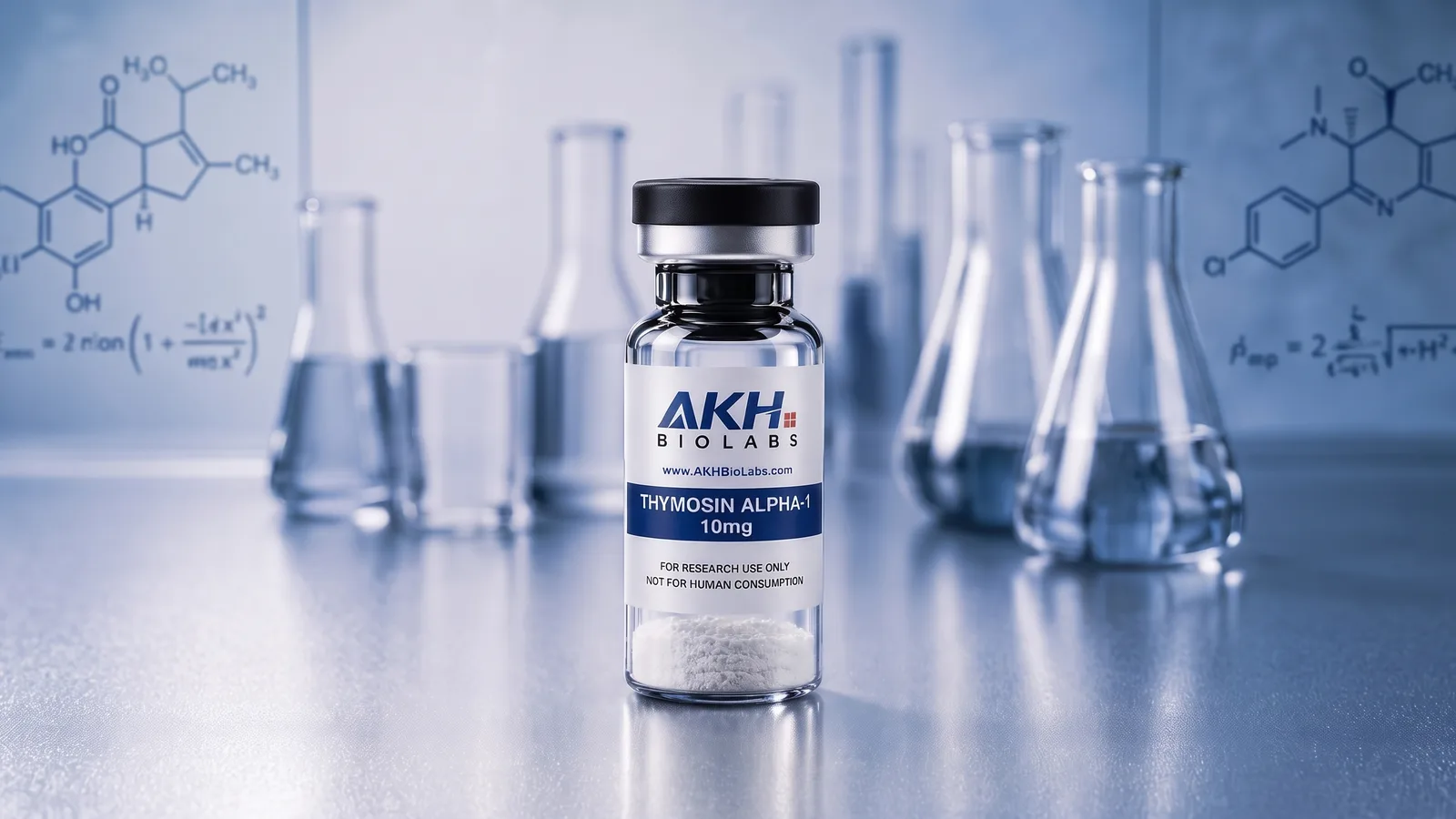
The product listing presents size and purity as two separate fields, and the archive row records purity alongside the batch, test date and laboratory. The 10mg is the stated size of the presentation. The 99.79% is the purity result recorded for that batch, marked HPLC verified on the product page and repeated in the archive row.
Chromatographic purity is a peak-area ratio taken from the chromatogram. It states what share of the detected material sits in the target peak, not what share of the vial mass is peptide. Salt form and residual water sit between those two quantities, which is why net peptide content is measured separately, and the page reports no net peptide content figure.
A buyer comparing listings gains more from confirming that the two fields are separate than from comparing the percentages alone, because a percentage cannot answer a question about mass.
Reading the certificate behind batch 26172
Batch 26172 is the record behind the AKH BioLabs presentation. The archive row reads: Thymosin Alpha-1, batch 26172, purity 99.79%, test date 27 Jul 2026, laboratory Brown Institute of Biomolecular Research. The product page lists size and purity as separate fields rather than as a single combined string.
The archive describes its own structure plainly: each row is one Certificate, one batch, tested once, by a named laboratory outside AKH, on a report ordered by the manufacturer. That sentence carries the qualifier that matters. The measurement comes from a laboratory that is not the seller, and the report is not issued by AKH.
Four fields tie a document to a container: the product name, the batch number, the test date and the issuing laboratory. A report missing the batch or the laboratory cannot be matched to the material in hand, however high the percentage printed beside it.
| Field | What it establishes | What it does not establish |
|---|---|---|
| Product name and stated fill | Which presentation the report describes | That the material in a particular parcel matches it |
| Batch number and test date | Which batch was measured, and when | That other batches of the same product were measured |
| Purity percentage | A chromatographic ratio for the measured sample | How much of the vial mass is peptide |
| Laboratory name | Who produced the measurement | That the material is approved for any human use |
Storage, delivery and the parts a report cannot cover
Holding conditions are a listing question rather than a certificate question. The published record is presented as product, batch, purity, test date and laboratory, and no holding condition appears among those fields. A buyer should read the condition printed on the listing rather than infer one from the powder form.
Two commercial terms sit alongside that and are worth reading as what they are. AKH states worldwide delivery in 9 to 14 days, which describes reach and timing rather than identity or purity. A public review record describes service across past orders and is read together with its review count, which the listing displays beside the score.
Nor does a batch report establish a manufacturing standard or sterility. It records what a named laboratory measured for one batch, while the research-use-only statement that accompanies a catalogue entry describes what the material is supplied for, not what a laboratory found.
Where the published evidence lives
The evidence record for this compound sits at /research/thymosin-alpha-1, which is where the published studies, their designs and their limits are collected. The record cites 19 published studies, 12 of them from 2023 onward, with the newest dated 2026, and it states that Thymosin Alpha-1 is not approved by the FDA or EMA.
Regulatory approval elsewhere attaches to licensed pharmaceutical product in those jurisdictions. It says nothing about the research material supplied for laboratory work, and that distinction is the one to hold onto when a seller sets approval headlines next to a catalogue entry.
The wider category is unevenly documented. A 2026 narrative review indexed on PubMed describes a parallel gray market of unapproved compounds operating largely outside regulatory oversight, and notes that many unapproved peptides show favourable findings in animal models while rigorous human safety data are scarce. Its list of named compounds includes thymosin beta-4 and TB-500, and does not include Thymosin Alpha-1. It is cited here for the market framing it states, not as a finding about this compound.
Matching the four checks to a product page
Each check maps to a visible field. The identity line names the compound and the alternative writing. The size line reads 10mg and the purity line reads 99.79%, marked HPLC verified. A full COA link sits on the page, and the certificate itself names the Brown Institute of Biomolecular Research and batch 26172. Delivery is stated as worldwide in 9 to 14 days.
All of that appears on the Thymosin Alpha-1 product page, and the same batch appears as one row in the COA archive. The final check happens after delivery: the batch number on the material should match batch 26172, and the laboratory name on the accompanying report should be the same one.
Where a listing cannot show those fields, the shortage is information rather than price, and no percentage printed on its own closes the gap.
Common questions.
- What is the best thymosin alpha 1 to buy for a laboratory study?
There is no single superlative answer, because the right presentation depends on the study. What can be compared is checkable: a listing that names the compound and its alternative writing, states the size, publishes a report from a named laboratory outside the seller with a batch number and test date, and states a delivery scope. The AKH BioLabs page shows a 10mg presentation, a 99.79% figure, a certificate for batch 26172 and worldwide delivery in 9 to 14 days.
- Which laboratory issued the certificate for Thymosin Alpha-1 batch 26172?
The Brown Institute of Biomolecular Research, on a report tested 27 Jul 2026 and recorded in the COA archive with a purity result of 99.79%. The archive states that each row is one Certificate, one batch, tested once, by a named laboratory outside AKH, on a report ordered by the manufacturer. Reading the laboratory name and the test date together is what shows who produced the measurement and when.
- Does the 10mg figure on a Thymosin Alpha-1 vial measure peptide content?
No. The 10mg is the stated size of the presentation, and the 99.79% beside it is a chromatographic purity result for the batch. Lyophilised peptide is normally supplied as a salt carrying residual water, so powder mass and peptide mass differ, and net peptide content would be a separate measurement that the page does not report.
- Does a Thymosin Alpha-1 certificate of analysis state a storage temperature?
The published record is presented as product, batch, purity, test date and laboratory, and no holding condition appears among those fields. Storage guidance belongs to the listing, where the condition is stated for the presentation offered. A delivery window such as the 9 to 14 days quoted for worldwide shipping is a commercial term rather than a holding condition.