AKH Signature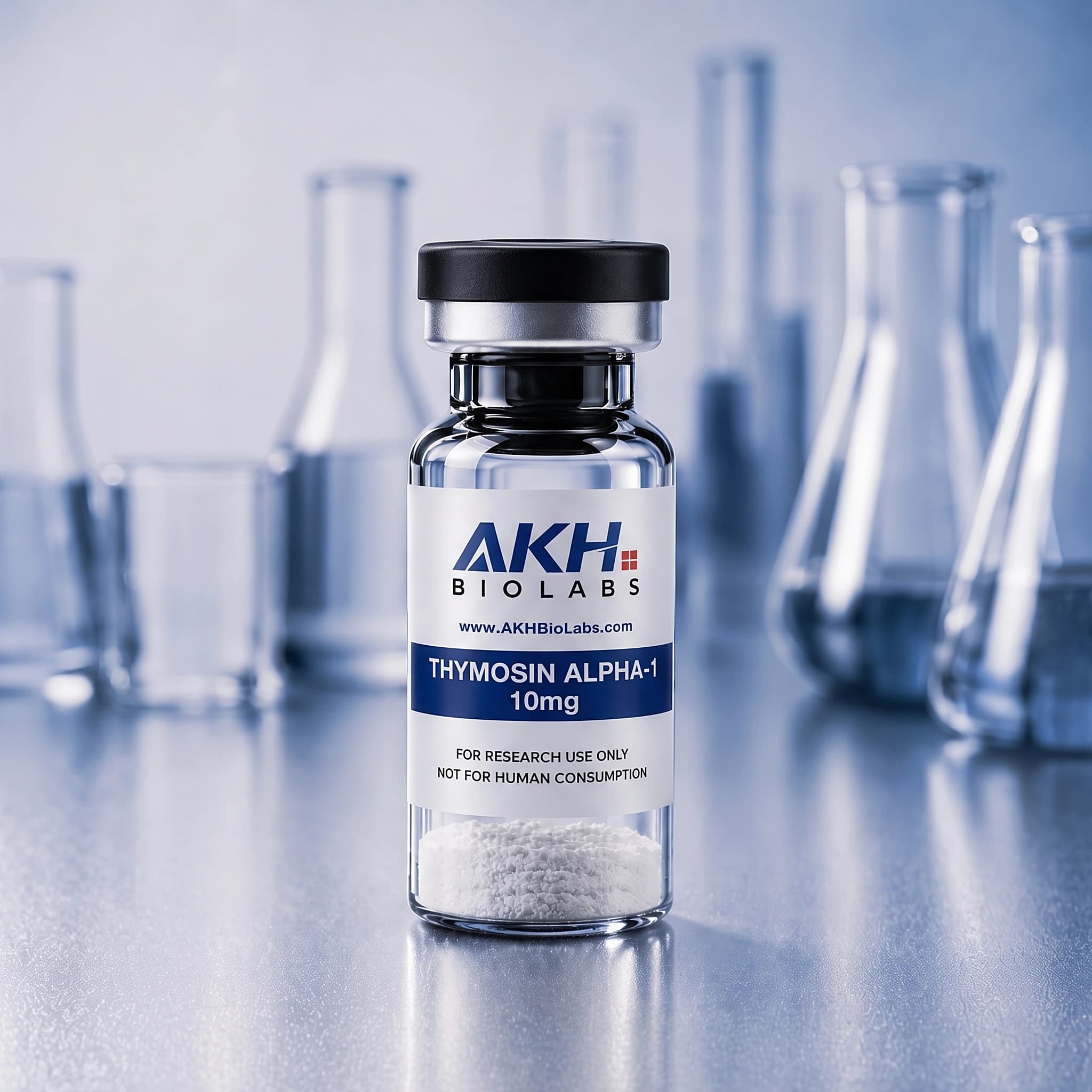
Longevity· AKH Signature
In stockThymosin Alpha-1
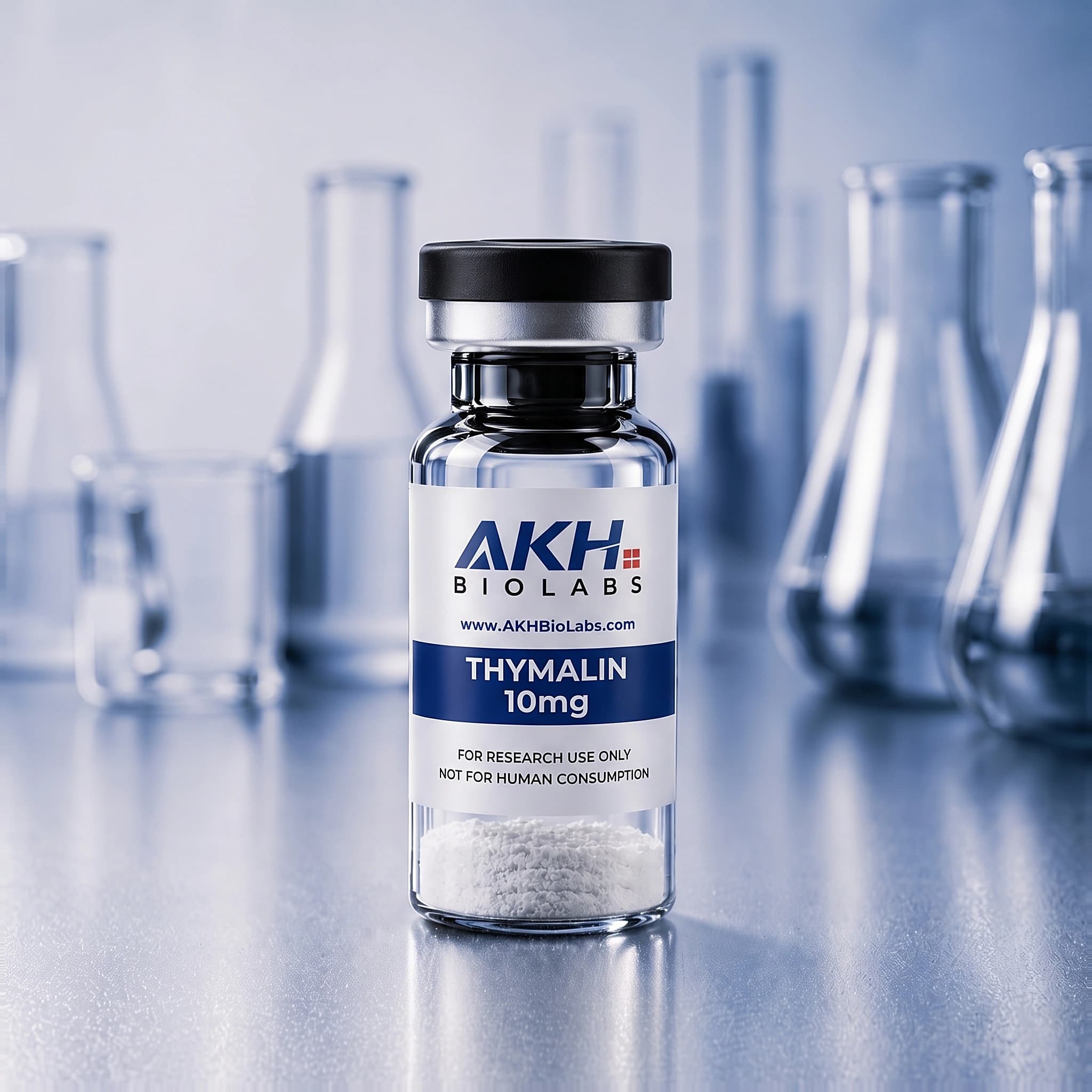
Thymosin Alpha-1 (Thymalfasin)
Size10mgPurity99.79%FormulaC129H215N33O55
Thymosin Alpha-1 (thymalfasin) is a 28-amino-acid peptide originally isolated from the thymus gland and now produced synthetically. It is one of the most clinically studied immunomodulatory peptides, researched for its role in T-cell maturation, Toll-like receptor signalling and innate–adaptive immune crosstalk. Marketed in over 35 countries as Zadaxin for hepatitis research.
€80
Quantity
HPLC verified
9–14 day shipping
Full COA
Worldwide delivery
About this compound
The research profile.
Thymosin Alpha-1 is a 28-amino-acid, N-terminally acetylated peptide originally isolated from thymosin fraction 5, a thymic tissue extract characterised by Goldstein and colleagues. Its synthetic counterpart is designated thymalfasin. NMR work describes the free peptide as largely unstructured in water, adopting helical character in membrane-mimetic environments — a conformational flexibility the structural literature links to its interaction with cell-surface receptors.
Mechanistic reviews place its activity upstream in innate immune signalling rather than at a single target. Thymosin Alpha-1 is described as acting through Toll-like receptors on both myeloid and plasmacytoid dendritic cells, with downstream effects on dendritic-cell maturation, T-cell differentiation, and the balance of pro- and anti-inflammatory signalling. The reviews characterise it as a modulator that can shift immune signalling in either direction depending on baseline state, rather than a uniform stimulant.
Regulatory history, noted here as neutral background only: review articles record that the synthetic peptide is approved in more than 35 countries — marketed as Zadaxin in several of them — for hepatitis B and hepatitis C, and that it has been examined in trials across oncology, vaccine adjuvancy, and sepsis. That regulatory record attaches to licensed pharmaceutical product in those jurisdictions and says nothing about the research material supplied on this page.
Published research
16 peer-reviewed studies on Thymosin Alpha-1 are summarised in our research library, including 11 published since 2023 — with study designs, reported findings and what the evidence does not establish.
Read the Thymosin Alpha-1 evidence baseFor research purposes only. Not for human consumption, diagnosis, treatment, or prevention of any condition.
Categorised as Longevity — Compounds for cellular-ageing and immune research.
Dosing at a glance
What the literature reports.
For research and laboratory use only. Not for human consumption.
Route
Subcutaneous
Frequency
Twice weekly (study protocols)
Reported range
1.6–1.6 mg
Protocol duration
26–52 weeks in the hepatitis trial literature
1.6 mgper administration1.6 mg
1.6 mg subcutaneously twice weekly is the regimen most consistently reported across the clinical trial literature, including combination hepatitis B protocols run over 26 weeks. Shorter daily courses at the same 1.6 mg amount appear in the sepsis literature. These figures describe published trial designs.
Ranges reflect protocols reported in the published literature on Thymosin Alpha-1 — see research citations.
Calculate a dilutionReconstitution & storage
From powder to solution.
- Step 01
Add 2 ml bacteriostatic water
Aim the stream at the vial wall rather than the powder.
- Step 02
Swirl gently — never shake
Rotate the vial until the solution runs clear. Agitation degrades the peptide.
- Step 03
Refrigerate at 2–8 °C
Reconstituted vials belong in the fridge, protected from direct light.
- Step 04
Use within 28 days
Discard any remainder once the stability window closes.
Lyophilised · −20 °CReconstituted · 2–8 °C, 28 days
A 10 mg vial in 2 ml of bacteriostatic water gives a 5 mg/ml solution, so the 1.6 mg literature amount corresponds to 0.32 ml. Lyophilised vials keep best at -20 °C.
Reconstitution calculator
10 mg vialmg
ml
mg
1.6 mg = 1600 mcg
Draw
32units · U-100 insulin syringe
- Concentration
- 5 mg/ml
- Draws per vial
- 6
- Cost per draw
- €13.33
For research and laboratory use only. Not for human consumption.
Laboratory arithmetic for Thymosin Alpha-1 — enter the COA-verified vial content for exact figures. Not medical advice.
Effect timeline
Observed across the research window.
Milestones summarise findings reported in the cited studies. Outcomes vary across models and protocols.
First doses
Innate signalling engagement
Mechanistic reviews describe engagement of Toll-like receptors on myeloid and plasmacytoid dendritic cells as the earliest measurable event, preceding any change in adaptive immune readouts.
Weeks 2–8
Cellular immune markers
Trial and review literature reports changes in T-cell subsets and dendritic-cell maturation markers over the early weeks of treatment, well before the clinical end points of those studies were assessed.
Week 26
Primary trial end point
The combination hepatitis B protocol ran 26 weeks of twice-weekly peptide alongside interferon before switching to interferon alone, with virological response assessed at that switch point.
Follow-up
Sustained-response assessment
Review summaries of the hepatitis programmes describe post-treatment follow-up periods as the window in which sustained versus transient responses were separated.
For research and laboratory use only. Not for human consumption.
Scientific research
The published evidence.
The dosing ranges and timeline milestones on this page summarise the peer-reviewed publications below.
References
- 01
From lab to bedside: emerging clinical applications of thymosin alpha 1. Expert Opin Biol Ther (2009). PubMed · 19392576
- 02
Immune Modulation with Thymosin Alpha 1 Treatment. Vitam Horm (2016). PubMed · 27450734
- 03
Thymosin alpha 1: past clinical experience and future promise. Ann N Y Acad Sci (2010). PubMed · 20536460
- 04
NMR structure of human thymosin alpha-1. Biochem Biophys Res Commun (2011). PubMed · 22115779
- 05
Combination thymosin-alpha 1 and interferon-alpha 2b in the treatment of anti-HBe-positive chronic hepatitis B in Turkey. Hepatogastroenterology (2002). PubMed · 12063993
Laboratory verification
One Certificate, published unaltered.
The Certificate is a test report from a named laboratory outside AKH, ordered by our manufacturer and shown here exactly as the laboratory issued it. A printed copy ships in every parcel.
- Batch
- 26172
- Test date
- 27 Jul 2026
- Task ID
- #1812468
- Purity
- 99.79%
Results
Thymosin Alpha-1: 10mg | Purity: 99.79%
Verified by Brown Institute of Biomolecular Research. Scan the full report for every measurement.
Product FAQ
Questions researchers ask.
Pairs well with
Frequently co-studied.
Compounds that appear alongside Thymosin Alpha-1 in the research literature.
For research and laboratory use only. Not for human consumption.
Longevity