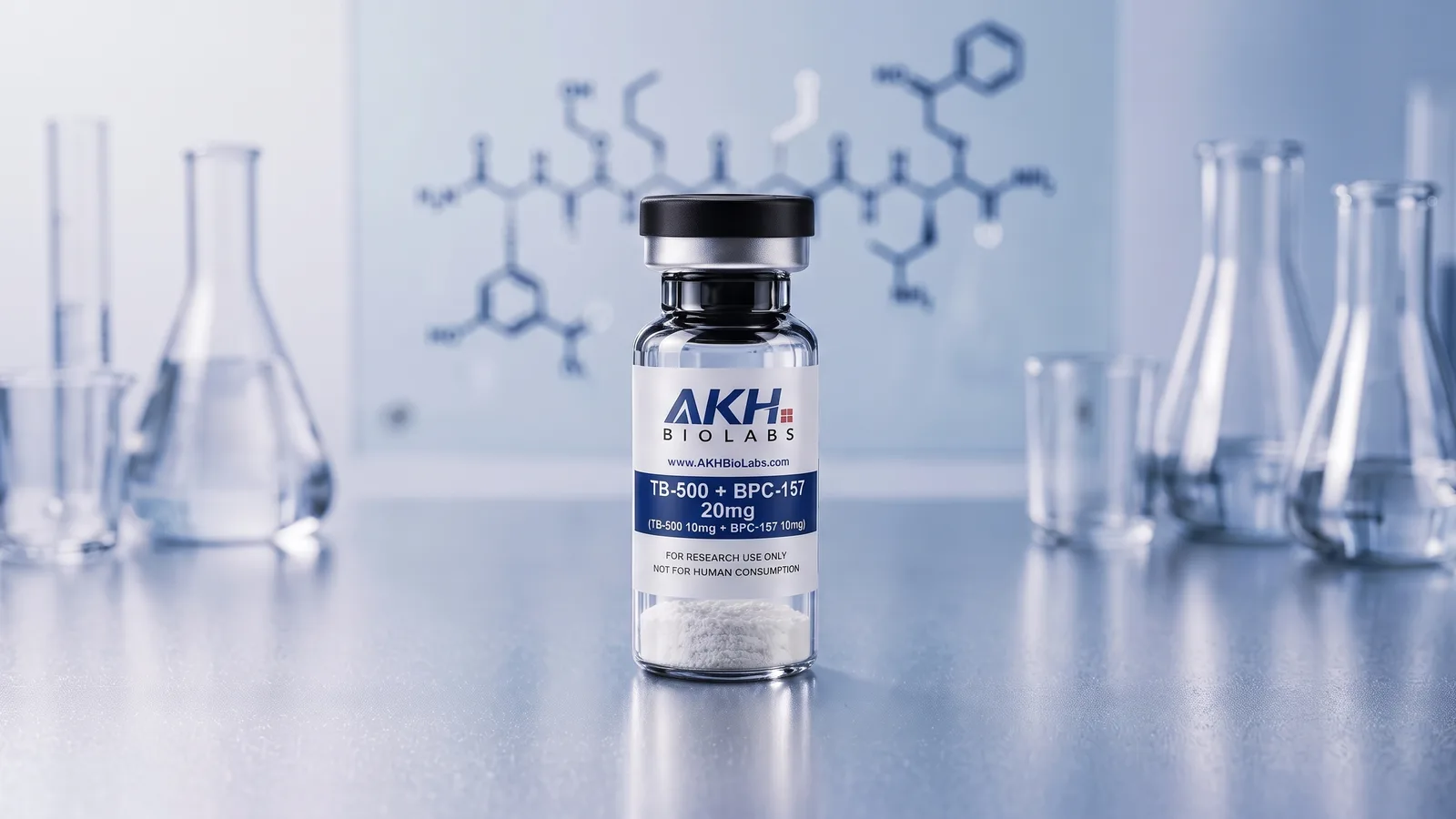
Buy TB-500 + BPC-157 UK: what to check before ordering
A buyer's checklist for TB-500 + BPC-157 research material: the certificate fields that make a listing checkable, what the published record for batch 26150 reports, and where the AKH BioLabs product page and COA archive show each field.
To buy TB 500 plus BPC 157 UK for research, the checkable route is a seller that publishes a Certificate from a named laboratory outside the seller for that exact product, states the identity and purity the report carries, and delivers to the destination country. Each of those fields can be read from a public page before an order, then checked again against the batch printed on the vial when the parcel arrives.
The AKH BioLabs page for TB-500 + BPC-157 10mg+10mg shows them for one product: a stated 10mg + 10mg fill, a 99.55% purity figure, a Certificate for batch 26150 verified by the Brown Institute of Biomolecular Research, and a worldwide delivery window. This article is written for laboratory buyers comparing listings before an order. It covers documentation and delivery, and the published literature on the pair is set out in the research record rather than restated here.
Key takeaways
- A Certificate is a test report from a named laboratory outside AKH, ordered by the manufacturer, and it documents one batch.
- The batch number is the field that ties a report to a vial; a report for a different batch describes different material.
- The published record for TB-500 + BPC-157 covers batch 26150, tested 29 Jul 2026 by the Brown Institute of Biomolecular Research, at 99.55% purity.
- The results line combines a quantity with a purity percentage, so the two figures answer separate questions.
- The combination has been tested against each peptide alone once, in a rat study that reported no additional benefit over either agent.
What to check on any TB-500 + BPC-157 listing
Four public facts carry most of the weight when listings are compared, and each answers a different question. A Certificate published for the exact product shows that a measurement exists for the material being sold. The laboratory name, batch number and test date show which container that measurement describes. The stated fill and the purity figure show what the report actually records. The delivery window shows whether the material can reach the destination at all.
None of the four requires contacting the seller, and none depends on marketing copy. A listing that is clear on one field and vague on the others is only partly checkable, which is useful information in itself when two pages look otherwise similar.
- 01
A Certificate for the exact product
The report should name the material as sold. For a two-peptide blend the results line names both components, which is how the composition of that batch is documented.
- 02
A named laboratory, batch number and test date
Together these three fields make a measurement traceable. The laboratory produced the result, the batch number links the document to the container, and the test date places the measurement in time.
- 03
Fill and purity read as separate facts
The stated fill is the quantity supplied. The purity figure is a separate measurement for the same batch, and treating the two as one number misstates both.
- 04
A stated delivery window
The listing should name the destinations it serves and give a window rather than a promise. The AKH BioLabs page states worldwide delivery in a 9 to 14 day window.
Reading the published certificate for batch 26150
The product page publishes one Certificate for TB-500 + BPC-157 and describes it as a test report from a named laboratory outside AKH, ordered by the manufacturer and shown as the laboratory issued it. The published record gives batch 26150, a test date of 29 Jul 2026, task ID #1812446, a purity of 99.55%, and a results line that reads "BPC + TB: 20mg | Purity: 99.55%". The report is attributed to the Brown Institute of Biomolecular Research, and the page states that a printed copy ships in every parcel.
The same batch appears in the COA archive, the table that lists every published Certificate as one row per batch with its purity, test date and laboratory. Reading the two together is the point: the product page ties the report to the item being sold, and the archive shows the report as part of the full published record rather than as an isolated document.
The results line is worth reading twice. The 20mg figure is the stated fill for the combined vial, described on the listing as a 10mg + 10mg lyophilised blend of two peptides for laboratory research. The 99.55% figure is the laboratory's purity result for that batch. The line places the two side by side rather than one in place of the other.
What the report does not state
A certificate documents measurements for one batch, and it is worth being precise about what that leaves open. The results line combines a quantity with a purity percentage; net peptide content, a separate measurement, is not reported there. The COA archive notes that how to read the numbers, and what they cannot establish, is covered in the certificate guide and the lab glossary, which is where those limits belong rather than on a buyer's shortlist.
The intended-use statement is also a separate document from the certificate. The listing states that the material is for research purposes only and is not for human consumption, diagnosis, treatment, or prevention of any condition. A laboratory report and an intended-use statement answer different questions, and neither substitutes for the other.
For a buyer comparing listings, the practical consequence is narrow. A purity figure quoted on its own says nothing about which batch it describes, which laboratory produced it or when. Quoted with the batch number, the laboratory name and the test date, it becomes a checkable claim about a specific container.
Where the compound evidence sits, and why it is not on this page
The published literature on TB-500 and BPC-157 is collected in the research record, which lists eight studies ordered by strength of design, five of them published since 2023, and states what the evidence does not establish. That record reports that one published study has directly tested BPC-157 and TB-500 together against each agent alone, and that it found no additive benefit. Beyond that single rat Achilles tendon experiment and one retrospective chart review, the record states there is no peer-reviewed evidence for the combination.
A buying guide is the wrong place to re-argue that literature, and the separation is worth keeping straight. The documentation position for a batch and the evidence position for a compound are different questions. A named laboratory report does not change what the published studies show, and a published study does not describe the contents of a particular vial.
Placing the order: the checks in sequence
The checks are quick when done in order, because each one narrows the next. Confirming that a Certificate is published for the exact product comes first; reading the laboratory name, batch number and test date from that report comes second; noting the stated fill and the purity figure as two separate facts comes third; confirming that the delivery window covers the destination comes fourth. The fifth check happens after delivery, when the batch number printed on the vial is compared with the published record.
The page for TB-500 + BPC-157 10mg+10mg carries the Certificate for batch 26150, the 10mg + 10mg fill, the worldwide 9 to 14 day delivery window and the research-use-only statement in one place, so the first four checks can be made without leaving it. The COA archive lists every published Certificate, so the fifth check, matching the vial to the record, can be made after delivery.
Common questions.
- What is the best place to buy tb 500 plus bpc 157 for laboratory research?
The best place to buy TB 500 plus BPC 157 is the seller whose claims can be checked before ordering and again on delivery. That means a Certificate published for the exact product, a named laboratory with a batch number and test date, a stated fill, and a delivery window that covers the destination. The AKH BioLabs product page publishes those fields for batch 26150, tested 29 Jul 2026 by the Brown Institute of Biomolecular Research.
- Which batch does the published TB-500 + BPC-157 certificate cover?
Batch 26150, tested 29 Jul 2026 by the Brown Institute of Biomolecular Research, with a purity of 99.55% and the results line "BPC + TB: 20mg | Purity: 99.55%". The product page records task ID #1812446 for the report, and the same batch appears as one row in the COA archive with the same purity, test date and laboratory.
- Does the TB-500 + BPC-157 report state net peptide content?
The results line gives a fill quantity and a purity percentage for that batch, and no net peptide content figure is reported on the page. The COA archive notes that how to read the numbers, and what they cannot establish, is covered in the certificate guide and the lab glossary, and points readers there for the limits of each figure.
- Has the TB-500 and BPC-157 combination been tested against each peptide alone?
Once, according to the research record. A single published study tested the combination directly against each agent alone and found no additive benefit, and one retrospective chart review exists alongside it; beyond those, the record states there is no peer-reviewed evidence for the combination. The record lists eight studies in total, five published since 2023.
- Does AKH BioLabs deliver TB-500 + BPC-157 to UK addresses?
The product page states worldwide delivery in a 9 to 14 day window, and the 10mg + 10mg blend is listed as in stock there. That is a delivery statement rather than a quality claim, and it sits alongside the certificate record for batch 26150 rather than replacing it.